Blockchain, Cryptocurrency, and Decentralized Finance
A complete 2026 guide to blockchain, cryptocurrency, and DeFi, covering stablecoins, tokenization, decentralized lending, regulation, and key risks.
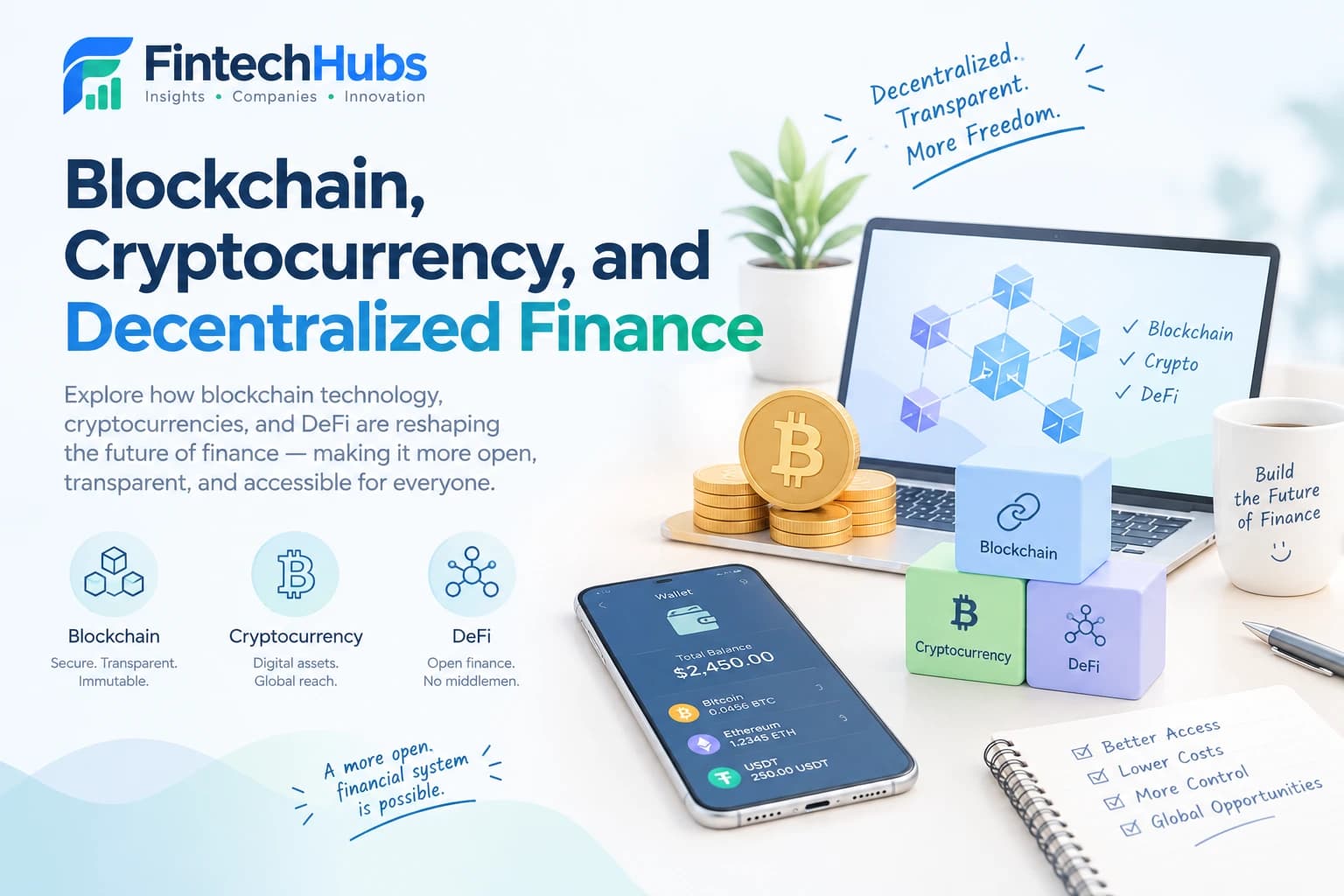
Blockchain, Cryptocurrency, and Decentralized Finance: A Complete Guide to Financial Technology fin 2026
For most of its history, money has needed a trusted middleman. A bank confirms a transfer actually happened. A clearinghouse guarantees a trade settles. A government backs the currency in someone's pocket. Blockchain technology introduced a different idea: what if a network of computers could agree on the truth of a transaction without needing a single trusted party in the middle at all.
That idea has grown from an obscure whitepaper into a trillion dollar layer of the global financial system. This guide explains what blockchain, cryptocurrency, and decentralized finance actually are, why this shift matters so much, and walks through every major branch of the space, from stablecoins and tokenized real world assets to decentralized lending and the AI agents now beginning to transact directly on blockchain networks.
What Are Blockchain, Cryptocurrency, and Decentralized Finance
A blockchain is a shared digital ledger that records transactions across a network of computers, rather than relying on a single central database controlled by one company or government. Once a transaction is recorded and confirmed by the network, it becomes extremely difficult to alter, which is what gives blockchain based systems their reputation for security and transparency.
Cryptocurrency is a digital asset that exists natively on a blockchain and can be transferred directly between people without a bank or payment processor acting as an intermediary. Bitcoin, the first and best known cryptocurrency, was designed specifically as an alternative to traditional, government issued money. Many other cryptocurrencies have since been built for a much wider range of purposes, from powering smart contract platforms to representing ownership of real world assets.
Decentralized finance, usually shortened to DeFi, refers to financial services, including lending, trading, and asset management, that are built entirely on blockchain networks using automated code called smart contracts, rather than relying on a traditional bank, broker, or exchange to manage the transaction. In a DeFi lending platform, for example, the terms of a loan are enforced automatically by code, without a loan officer or bank involved at any point in the process.
Why Blockchain, Cryptocurrency, and DeFi Matter
This technology matters because it offers a genuinely different way to move and manage money, with real advantages that traditional finance has struggled to match.
It removes unnecessary intermediaries: Every intermediary in a financial transaction typically adds cost and delay. Blockchain based systems can settle a transaction directly between two parties, often within seconds, at a fraction of the cost of a traditional multi step process, particularly for cross border payments that once required several intermediary banks.
It expands financial access: Anyone with an internet connection can access many blockchain based financial services directly, without needing approval from a bank or meeting a minimum balance requirement, which matters significantly for people in regions with limited traditional banking infrastructure.
It creates a transparent, verifiable record: Because blockchain transactions are recorded on a shared ledger that anyone can inspect, it becomes far harder to hide fraudulent activity or manipulate records after the fact, compared to a traditional financial system where transaction details are only visible to the institutions directly involved.
It is unlocking new forms of ownership and investment: Tokenization allows real world assets, from government bonds to real estate, to be represented digitally and traded with far greater speed and liquidity than their traditional paper based equivalents ever allowed.
It is becoming the infrastructure for automated, machine driven commerce: As artificial intelligence systems begin completing financial tasks on behalf of people and businesses, blockchain based smart contracts provide a way for these systems to transact directly and verifiably, without needing a human to manually approve every single step.
A Brief History of Blockchain and Cryptocurrency
Blockchain technology was introduced through Bitcoin, launched in 2009 by an anonymous creator or group using the name Satoshi Nakamoto, in direct response to the loss of trust in traditional banks following the 2008 financial crisis. Bitcoin proved that a digital currency could operate securely without any central authority, sparking years of experimentation with alternative cryptocurrencies.
A major turning point came with the launch of Ethereum in 2015, which introduced smart contracts, self executing code that could automatically enforce the terms of an agreement on the blockchain. This innovation made it possible to build far more than just a digital currency, laying the technical foundation for decentralized finance, tokenization, and eventually an entire ecosystem of blockchain based applications.
Through the late 2010s and early 2020s, the industry experienced dramatic boom and bust cycles, driven partly by speculation and partly by genuine technological progress. Regulatory clarity remained a major obstacle for years, with many governments unsure how to classify or oversee digital assets. That began changing significantly by the mid 2020s, as major markets introduced dedicated legal frameworks for stablecoins and digital assets, giving banks, payment companies, and institutional investors enough confidence to build directly on blockchain infrastructure rather than treating it as an unregulated curiosity.
By 2026, the industry has shifted decisively from experimentation toward commercial scale. Stablecoins now handle transaction volumes that rival major traditional payment networks, real world asset tokenization is accelerating with participation from some of the largest asset managers in the world, and institutional investors increasingly treat digital assets as a legitimate part of a diversified portfolio rather than a speculative side bet.
The Core Branches of Blockchain, Cryptocurrency, and DeFi
This space is best understood as a collection of distinct branches, each solving a different problem using the same underlying blockchain technology.
Cryptocurrency as a Store of Value and Medium of Exchange
Bitcoin and a handful of other established cryptocurrencies are increasingly treated as a store of value, similar in concept to digital gold, with growing institutional investment through regulated investment products that make it easier for traditional investors to gain exposure without directly managing digital assets themselves. At the same time, cryptocurrency continues to serve its original purpose as a medium of exchange, particularly for cross border transfers where traditional banking rails remain slow and expensive.
Stablecoins
Stablecoins are digital currencies designed to hold a steady value, typically by being backed one to one by a traditional currency such as the US dollar. Stablecoins have grown into one of the most widely used blockchain based products in the world, now representing the large majority of all cryptocurrency transaction volume, driven by practical use cases including cross border payments, payroll for international teams, and business treasury management. Clearer regulatory frameworks introduced in major markets have accelerated this shift, giving banks and payment companies enough confidence to build stablecoin settlement directly into their existing infrastructure rather than treating it as a separate experimental system.
Real World Asset Tokenization
Tokenization converts ownership of a real world asset, such as a government bond, a share of real estate, or a piece of fine art, into a digital token that can be traded on a blockchain. This makes traditionally illiquid assets far easier to buy, sell, and divide into smaller ownership shares than their paper based equivalents ever allowed. Major asset managers have begun tokenizing traditional financial products directly, and industry projections suggest tokenized assets could reach into the trillions of dollars in value within the coming years as adoption continues to accelerate.
Decentralized Finance Lending and Borrowing
DeFi lending platforms allow people to borrow and lend cryptocurrency directly through smart contracts, without a bank or traditional lender acting as an intermediary. Borrowers typically provide collateral in the form of other digital assets, and interest rates adjust automatically based on real time supply and demand within the platform. Institutional participation in on chain lending has grown substantially, as large financial institutions increasingly rely on these protocols directly for borrowing and lending activity rather than treating DeFi as a purely retail phenomenon.
Decentralized Exchanges
Decentralized exchanges allow people to trade cryptocurrencies directly with one another using smart contracts, without a centralized company holding custody of the funds being traded. This removes a significant point of risk present in traditional centralized exchanges, since users retain control of their own assets throughout the trading process rather than depositing them with a third party that could fail or be compromised.
Central Bank Digital Currencies
Separate from privately issued stablecoins, a large and growing number of countries are researching or actively developing their own central bank digital currencies, a government issued digital form of a national currency designed to function alongside physical cash. These projects are generally moving more cautiously than private stablecoins, with central banks focused heavily on privacy, financial stability, and how a digital currency would interact with the existing banking system before any full public rollout.
Non-Fungible Tokens
Non-fungible tokens, or NFTs, represent unique ownership of a specific digital or digitally linked physical asset, distinguishing them from cryptocurrencies where every unit is interchangeable with another. While early NFT adoption was dominated by digital art and collectibles, the underlying technology is increasingly being applied to more practical uses, including verifying ownership of real world items, tickets, and intellectual property rights.
Crypto Custody and Institutional Infrastructure
As institutional investment in digital assets has grown, so has demand for secure, regulated custody services that safely store cryptocurrency on behalf of large investors, similar to how a traditional custodian bank safeguards securities. This infrastructure has become essential to mainstream institutional adoption, since large investors generally cannot participate in digital assets responsibly without the same custody and security standards they expect from traditional finance.
Decentralized Physical Infrastructure Networks
Decentralized physical infrastructure networks, often referred to as DePIN, use blockchain based incentives to encourage individuals to contribute real world physical resources, such as wireless network coverage or computing power, in exchange for cryptocurrency rewards. This emerging branch extends blockchain technology beyond purely financial applications into building and coordinating physical infrastructure through decentralized, crowdsourced participation.
AI and Crypto Convergence
Artificial intelligence and blockchain are increasingly converging, with autonomous AI agents beginning to hold digital wallets and complete transactions directly through smart contracts, without a human approving each individual step. This is enabling new forms of automated, high frequency microtransactions, such as an AI agent paying small amounts for computing resources or data access in real time, using blockchain based payment rails specifically designed to support this kind of machine to machine commerce.
The Technology Powering Blockchain and Crypto
Several underlying technologies show up repeatedly across nearly every branch of this space.
Smart contracts are self executing pieces of code that automatically carry out the terms of an agreement once predefined conditions are met, forming the foundation of decentralized finance, tokenization, and much of the broader blockchain ecosystem.
Public blockchains, such as Ethereum and other similar networks, provide the shared, decentralized infrastructure that most cryptocurrency and DeFi applications are built on top of, with ongoing upgrades continuing to improve transaction speed and reduce costs.
Digital wallets allow individuals, businesses, and increasingly AI agents to hold, send, and receive digital assets securely, serving as the primary interface most people use to interact with blockchain based systems.
Zero knowledge proofs and privacy technology allow a transaction to be verified as valid without revealing all of its underlying details, a capability that is becoming increasingly important as institutions seek greater privacy while still operating on transparent public blockchain networks.
Regulation of Blockchain, Cryptocurrency, and DeFi
Regulatory clarity has improved substantially in recent years, with major markets introducing dedicated legal frameworks specifically covering stablecoin issuance, reserve requirements, and digital asset oversight more broadly. This clearer regulatory environment has been a major driver of institutional adoption, since large financial institutions generally require regulatory certainty before committing significant capital to a new type of asset or infrastructure.
Regulators continue to focus closely on areas including consumer protection, anti money laundering compliance, and how decentralized platforms that have no single controlling company should be regulated at all, since much of traditional financial regulation was written assuming a clearly identifiable, centrally controlled institution would always be responsible for compliance.
Challenges and Risks in Blockchain and Crypto
The rapid growth of this industry has not eliminated every risk. Volatility remains a defining characteristic of many cryptocurrencies, and even assets designed to serve practical financial purposes can experience significant price swings. Security risks persist, since both individual wallets and larger platforms remain attractive targets for theft, and mistakes in self custody, such as losing access credentials, can result in permanently lost funds with no recovery process available. Regulatory fragmentation across different countries continues to create complexity for companies operating globally, even as individual markets have become clearer on their own. Smart contract vulnerabilities can be exploited if code is not carefully audited, since a flaw in a smart contract can sometimes be used to drain funds from a DeFi platform with no traditional recourse available afterward.
The Future of Blockchain, Cryptocurrency, and DeFi in 2026 and Beyond
Several clear themes are shaping the next phase of this industry. Stablecoins are moving decisively from a crypto trading tool into mainstream payment and treasury infrastructure, with transaction volumes now rivaling major traditional payment networks. Real world asset tokenization is expanding well beyond experimentation, with major financial institutions actively building tokenized versions of traditional assets such as government bonds and investment funds. Institutional participation in DeFi lending and trading continues to deepen, moving the technology from a purely retail phenomenon into infrastructure that traditional financial institutions increasingly rely on directly. And the convergence of artificial intelligence with blockchain based payments is opening an entirely new category of automated, machine to machine commerce that did not meaningfully exist just a few years earlier.
At the same time, the fundamentals have not changed. This technology still needs to be secure, genuinely useful, and responsibly regulated to earn lasting trust, and the projects succeeding in 2026 are the ones solving real financial problems rather than chasing speculation for its own sake.
Final Thoughts
Blockchain, cryptocurrency, and decentralized finance have moved from a niche experiment into a genuine, expanding layer of the global financial system. Understanding the major branches of this space, from stablecoins and tokenized real world assets to decentralized lending, digital custody, and the emerging convergence of AI and blockchain, helps both individuals and businesses recognize where real, lasting value is being created, separate from the speculation and hype that has often surrounded this technology. The participants who benefit most going forward will be the ones who understand what problem each part of this technology actually solves, rather than treating every new development as equally significant.
Share this article
Related Articles
Stablecoins and Digital Currencies
A complete 2026 guide to stablecoins and digital currencies, covering types, the GENIUS Act, bank-issued coins, CBDCs, real use cases, and key risks.

Insurtech: How Technology Is Transforming Insurance
Discover how Insurtech is transforming insurance with digital solutions, AI, automation, personalized coverage, faster claims, and improved customer experiences.

Wealthtech & Robo-Advisors: Complete Guide 2026 | Fintechhubs
Explore wealthtech and robo-advisors in 2026 how automated investing works, its key branches, benefits, risks, and where financial technology is headed.