API-Driven Regulatory Reporting: Transforming Compliance Through Automation
API-Driven Regulatory Reporting: Benefits, Automation & Compliance
API-Driven Regulatory Reporting: Transforming Compliance Through Automation
Regulatory reporting has long been one of the most demanding responsibilities for organizations operating in highly regulated industries. Banks, insurance companies, investment firms, healthcare providers, and other regulated businesses must regularly submit accurate information to government agencies and regulatory authorities. Traditionally, this process has depended on spreadsheets, manual data collection, email exchanges, and complex internal workflows. These approaches are increasingly inadequate in an environment where regulators expect faster, more accurate, standardized, and transparent reporting.
API-driven regulatory reporting is emerging as a powerful solution to these challenges. By using Application Programming Interfaces (APIs) to connect internal systems with reporting platforms and regulatory infrastructures, organizations can automate the movement, validation, transformation, and submission of regulatory data. This approach can make compliance more efficient while reducing operational risk and creating a more reliable reporting process.
Understanding API-Driven Regulatory Reporting
An API is a software interface that enables different applications and systems to communicate with one another. In regulatory reporting, APIs can connect systems such as enterprise resource planning platforms, banking systems, customer databases, risk-management applications, accounting software, and compliance platforms.
Instead of manually extracting information from multiple systems and compiling it into a regulatory template, an API-driven architecture can automatically retrieve relevant data. The data can then be validated, transformed into the required regulatory format, and transmitted to the appropriate reporting system.
For example, a financial institution may need to report information about transactions, capital ratios, liquidity, customer exposures, or risk positions. An API-based reporting solution can collect this information directly from the institution's operational systems, apply predefined rules, and prepare the required submission. This creates a more streamlined and repeatable process.
Why Traditional Reporting Processes Are Becoming Insufficient
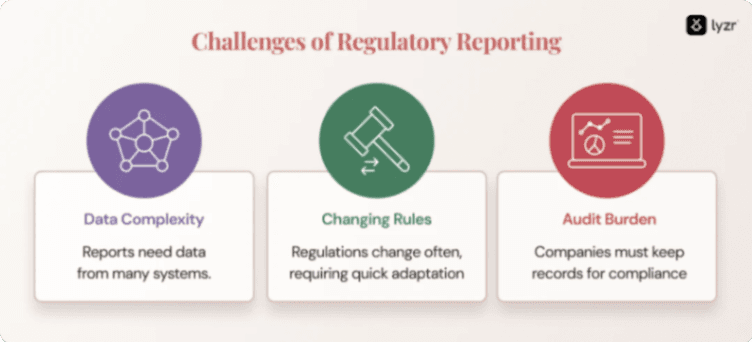
Manual regulatory reporting creates several challenges. One of the most significant is the risk of human error. Data copied between spreadsheets or systems can be accidentally changed, omitted, or duplicated. Even a small reporting error can result in regulatory scrutiny, financial penalties, or reputational damage.
Traditional processes are also time-consuming. Compliance teams may spend substantial amounts of time locating information, reconciling data, checking calculations, formatting reports, and obtaining approvals. This leaves less time for higher-value activities such as risk analysis and regulatory interpretation.
Another challenge is data fragmentation. Modern organizations often operate dozens or hundreds of applications, each storing information in different formats. Bringing these sources together manually can be difficult and expensive.
API-driven reporting addresses these limitations by establishing automated connections between systems and reducing the need for repetitive manual intervention.
Key Benefits of API-Driven Reporting
One major advantage is automation. Once integrations and reporting rules have been established, data can be collected and processed automatically according to predefined schedules or regulatory requirements. Automation reduces repetitive work and allows compliance teams to focus on exceptions and analysis rather than routine data gathering.
A second benefit is improved data accuracy. APIs can retrieve information directly from source systems, reducing transcription errors. Automated validation can also identify missing, inconsistent, or invalid data before a report is submitted.
API-driven reporting also improves speed. Regulatory reporting cycles can be shortened because information does not have to pass through as many manual stages. In some environments, organizations can move toward near-real-time or event-driven reporting.
Another important benefit is traceability. Modern regulatory frameworks increasingly require organizations to demonstrate where reported information originated and how it was processed. API-driven systems can maintain logs showing when data was collected, which systems supplied it, what transformations were applied, and when the final report was submitted.
Finally, APIs can provide scalability. As regulatory requirements expand, organizations can add new integrations and reporting rules without completely redesigning their reporting infrastructure.
Architecture of an API-Driven Reporting System
A typical API-driven regulatory reporting architecture contains several layers.
The first is the data-source layer, which includes operational systems such as financial databases, transaction-processing platforms, customer-management systems, and risk applications.
The second is the integration layer. APIs, middleware, and data pipelines retrieve information from these systems and move it into a centralized reporting environment.
The third layer is data transformation and validation. Here, raw information is standardized, mapped to regulatory definitions, checked for completeness, and subjected to business rules.
The fourth layer is the reporting and submission layer. Approved information is converted into the format required by the regulator and submitted through the relevant API, portal, or reporting mechanism.
A final layer provides monitoring, audit trails, security, and governance. This allows organizations to monitor submissions and investigate problems when they occur.
Security and Compliance Considerations
Although API-driven reporting offers significant advantages, it also introduces security considerations. Regulatory data can contain sensitive financial, personal, or commercially confidential information. APIs therefore need strong authentication and authorization mechanisms.
Encryption should be used when data is transmitted between systems, while access controls should ensure that employees and applications can access only the information necessary for their roles. Organizations should also maintain detailed logs of API activity to support security monitoring and regulatory audits.
Data governance is equally important. Automation does not guarantee that the underlying information is correct. Organizations must establish clear ownership of data, define authoritative sources, document transformations, and regularly test reporting rules.
Challenges in Implementation
Implementing API-driven regulatory reporting is not simply a matter of connecting two systems. Legacy infrastructure can make integration difficult, particularly when older applications lack modern APIs.
Organizations may also face inconsistent data definitions. The same customer, transaction, or financial metric may be represented differently across departments. Before automation can work effectively, these differences must be addressed.
Regulatory requirements themselves can change frequently. Reporting systems therefore need to be flexible enough to accommodate new data fields, calculation methods, deadlines, and submission formats without extensive redevelopment.
There is also an organizational challenge. Successful implementation requires cooperation among compliance specialists, technology teams, data professionals, cybersecurity experts, and business leaders. Regulatory reporting is ultimately both a technology and governance issue.
The Future of Regulatory Reporting
The future of regulatory reporting is likely to involve increasingly automated and data-driven processes. Regulators in many sectors are moving toward standardized digital reporting, while organizations are investing in technologies that can process and exchange information more efficiently.
API-driven architectures can serve as the foundation for this transformation. Combined with artificial intelligence, machine learning, real-time analytics, and automated data-quality monitoring, they can enable organizations to identify reporting anomalies before submissions are made.
The long-term goal is often described as continuous compliance: instead of treating regulatory reporting as a periodic exercise, organizations continuously collect, validate, monitor, and govern regulatory data. When a reporting deadline arrives, much of the necessary work has already been completed.
Conclusion
API-driven regulatory reporting represents a fundamental shift from manual, document-centered compliance toward automated, connected, and data-centric reporting. By integrating source systems directly with reporting platforms, organizations can improve accuracy, reduce costs, accelerate submissions, and strengthen auditability.
However, technology alone is not enough. Successful API-driven reporting requires robust data governance, secure infrastructure, clear regulatory mappings, effective controls, and collaboration between technology and compliance teams.
As regulatory expectations continue to evolve, organizations that build flexible API-driven reporting capabilities will be better positioned to respond to new requirements. Regulatory reporting can consequently become more than a compliance obligation: it can become a structured, automated capability that improves the organization's overall approach to data quality, risk management, and operational efficiency.
Share this article
Related Articles
The Role of RegTech in Digital Banking
RegTech in Digital Banking: Role, Benefits & Future
Embedded Finance Compliance Challenges
Embedded Finance Compliance Challenges | Key Risks & Solutions

Rule-Based vs AI-Based Transaction Monitoring: Which Approach Is Better?
Rule-Based vs AI-Based Transaction Monitoring | Complete Guide