Digital Wealth Management: Democratizing Investing in 2026
Explore how digital wealth management platforms are making professional investment services accessible, affordable, and automated for every investor.
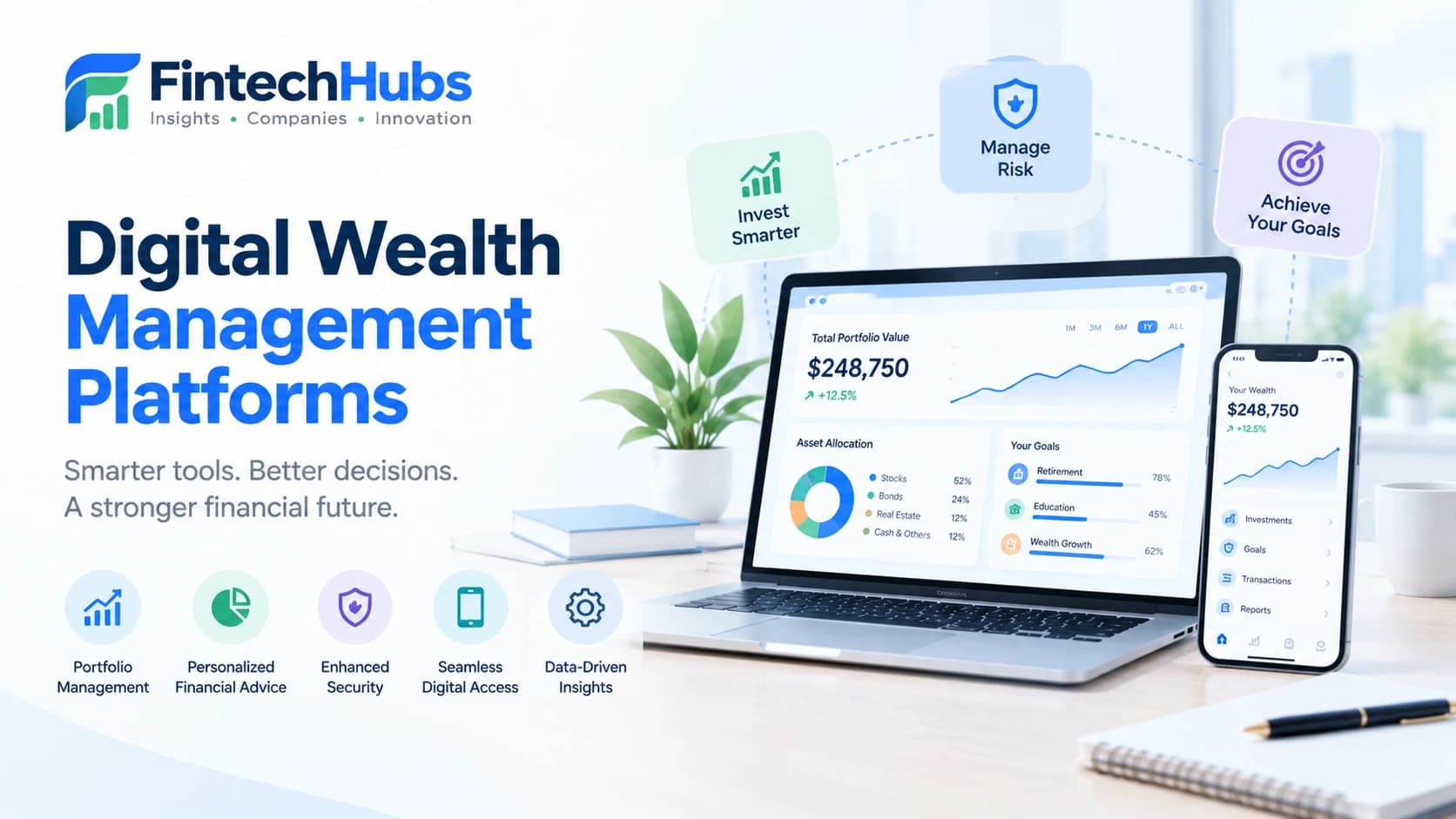
Digital Wealth Management Platforms: How Technology Is Democratizing Professional Investment Services
For most of the twentieth century, professional investment management was a service reserved for the wealthy. Access to a financial advisor, a diversified portfolio, and sophisticated planning tools typically required account minimums of hundreds of thousands of dollars, along with fees that made the service uneconomical for ordinary savers. Today, that model has been fundamentally reshaped. Digital wealth management platforms powered by cloud computing, automation, and data-driven portfolio construction have opened professional-grade investment services to a far broader population, often with no minimum balance and a fraction of the historical cost.
This guide examines what digital wealth management platforms are, how they work, the technologies behind them, and why they represent one of the most significant structural shifts in the financial services industry. It also covers the branches of this ecosystem, the challenges platforms face, and the trends likely to shape the next generation of digital investing.
This article is for general informational and educational purposes only and does not constitute investment, financial, or legal advice.
What Are Digital Wealth Management Platforms
Digital wealth management platforms are technology-driven services that provide investment management, financial planning, and related advisory functions through software rather than exclusively through in-person human advisors. They range from fully automated robo-advisors that build and rebalance portfolios algorithmically, to hybrid platforms that blend automation with access to human advisors, to enterprise software used by traditional wealth managers to scale their own services digitally.
At their core, these platforms aim to replicate and in many cases improve upon the functions a traditional wealth manager would perform: assessing a client's goals and risk tolerance, constructing a diversified portfolio, rebalancing it over time, optimizing for tax efficiency, and providing ongoing reporting and guidance.
How Digital Wealth Management Platforms Work
While implementations vary, most digital wealth management platforms follow a broadly similar operational flow:
Onboarding and Risk Profiling: New users complete a questionnaire covering financial goals, time horizon, income, net worth, and risk tolerance. Some platforms supplement this with behavioral questions designed to detect inconsistencies between stated and revealed risk preferences.
Account Linking and Funding: Users link a funding source and, depending on the platform, may also connect external accounts for a consolidated view of their overall financial picture.
Portfolio Construction: Based on the risk profile, an algorithm selects an asset allocation, typically expressed through low-cost, diversified instruments such as exchange-traded funds (ETFs).
Automated Execution: Trades are placed to establish the target allocation, often using fractional shares so that exact target weights can be achieved regardless of account size.
Ongoing Monitoring: The platform continuously tracks portfolio drift relative to target allocations and monitors for tax-loss harvesting opportunities.
Rebalancing: When allocations drift beyond a defined threshold, or on a scheduled basis, the platform automatically buys and sells assets to restore the target mix.
Reporting and Engagement: Users receive performance reporting, goal-tracking dashboards, and in many cases access to human advisors or financial planning tools for more complex questions.
The Shift From Traditional to Digital Wealth Management
Traditional wealth management relied on a human-intensive, relationship-driven model: an advisor meeting periodically with a client, manually constructing and adjusting portfolios, and billing a percentage of assets under management (commonly 1% or more annually). This model worked well for high-net-worth clients but priced out the majority of savers.
Several forces drove the shift toward digital alternatives:
Falling technology costs: Made it economically viable to serve smaller accounts profitably.
Passive investing's rise: Reduced the need for active, labor-intensive security selection.
Regulatory pressure toward fee transparency: Exposed the cost of traditional advisory models.
Changing consumer expectations: Shaped by mobile banking and e-commerce, created demand for self-service, app-based financial tools.
Open banking and API infrastructure: Made it easier to link accounts and aggregate financial data automatically.
The result has been a steady migration of assets toward platforms that charge a fraction of traditional fees commonly between 0.25% and 0.50% annually, or flat subscription fees while serving clients who previously had no access to professional portfolio management at all.
Types/Branches of Digital Wealth Management Platforms
5.1 Pure Robo-Advisors
Fully automated platforms that handle the entire investment process algorithmically, from onboarding through ongoing rebalancing, with minimal or no human interaction.
5.2 Hybrid Advisory Platforms
Combine automated portfolio management with access to human financial advisors, typically for an additional fee, serving clients who want algorithmic efficiency alongside the reassurance of human guidance for major decisions.
5.3 Goal-Based Investing Platforms
Organize investing around specific objectives: retirement, a home purchase, education with portfolios and risk levels tailored to each goal's time horizon rather than a single blended account.
5.4 Direct Indexing Platforms
Allow investors to own the individual securities underlying an index directly, rather than through a fund, enabling more granular tax-loss harvesting and personalized exclusions (e.g., excluding specific sectors or companies).
5.5 Thematic and Self-Directed Platforms
Allow users to invest in curated themes (clean energy, technology, dividend income) or build custom portfolios, often combined with automated rebalancing tools.
5.6 Enterprise Wealth Management Software
B2B platforms licensed to banks, broker-dealers, and registered investment advisors (RIAs) to power their own client-facing digital offerings, enabling incumbents to compete with standalone robo-advisors.
5.7 Workplace and Retirement-Focused Platforms
Integrate with employer-sponsored retirement plans to provide automated management of 401(k) and similar accounts, often including advice that spans outside accounts as well.
5.8 High-Net-Worth Digital Platforms
Serve more affluent clients with digital tools for estate planning, tax strategy, alternative investments, and concierge-style human advisory support layered on top of automation.
Core Technologies Powering These Platforms
Modern Portfolio Theory (MPT) algorithms: For asset allocation optimization based on risk and return trade-offs.
Cloud infrastructure: Enables scalable, low-cost operations without the overhead of physical branches.
API-based account aggregation; For linking external accounts and building a holistic financial picture.
Fractional share trading engines: That allow precise allocation regardless of account size.
Tax-loss harvesting algorithms: That automatically identify opportunities to realize losses for tax benefit while maintaining target exposure.
Natural language processing and chatbots: For client support and basic financial guidance.
Data analytics and machine learning: For personalization, risk profiling refinement, and behavioral nudges.
Mobile-first interface: Designed for self-service account management and goal tracking.
How Technology Is Democratizing Investment Services
7.1 Eliminating Minimum Balance Barriers
Many digital platforms have no or very low account minimums, compared to the hundred-thousand-dollar-plus minimums common at traditional wealth management firms.
7.2 Reducing Fees Dramatically
Automation removes much of the labor cost embedded in traditional advisory fees, allowing platforms to charge a fraction of what human-advisor models require.
7.3 Enabling Fractional Ownership
Fractional share investing means even small deposits can be allocated across a fully diversified portfolio, rather than being limited to whichever whole shares an investor can afford.
7.4 Simplifying Access and Onboarding
Mobile-first, self-service onboarding removes friction that previously required scheduling appointments and navigating paperwork-heavy processes.
7.5 Delivering Institutional-Grade Strategies to Retail Investors
Techniques once reserved for institutional or high-net-worth portfolios — systematic rebalancing, tax-loss harvesting, diversified low-cost indexing — are now available to everyday investors.
7.6 Expanding Financial Literacy
Many platforms pair investing tools with educational content, goal visualization, and plain-language explanations that help users understand concepts previously mediated entirely through an advisor.
Why It Matters
Broadening access to professional-grade investment management has implications well beyond individual convenience. It affects long-term retirement readiness, wealth inequality, and the overall efficiency of capital markets. As digital platforms bring millions of previously unserved or underserved savers into diversified, low-cost investing, the aggregate effect compounds over decades through the power of consistent saving and compounding returns.
For incumbent financial institutions, the rise of digital wealth management has also forced a reassessment of fee structures and client experience, driving broader modernization across the wealth management industry as a whole.
Industries and Use Cases
Retail banking: Banks embedding digital investment tools within their existing mobile banking apps.
Retirement plan administration: Automated management of workplace retirement accounts.
Independent financial advisory firms: RIAs using enterprise platforms to scale their practices.
Neobanks and fintech super-apps: Bundling investing alongside banking, budgeting, and payments.
Employee benefits platforms: Offering investment guidance as part of broader financial wellness benefits.
Insurance and annuity providers: Integrating digital investment tools into broader financial planning offerings.
Benefits for Different Investor Segments
Segment | Key Benefit |
|---|---|
First-time investors | Low barriers to entry, educational guidance, simplified onboarding |
Busy professionals | Hands-off, automated management requiring minimal ongoing attention |
Cost-conscious savers | Significantly lower fees than traditional advisory models |
Goal-oriented savers | Clear goal-tracking tools tied to specific objectives |
High-net-worth individuals | Access to direct indexing, tax optimization, and hybrid human support |
Underserved populations | Access to professional investment management previously out of reach |
Challenges and Limitations
Limited personalization at scale: Purely algorithmic platforms may struggle with complex, idiosyncratic financial situations that benefit from human judgment.
Market downturn behavior: Automated platforms must be carefully designed to prevent panic-driven user behavior during volatility, since algorithms alone cannot provide the reassurance a human advisor might.
Profitability pressure: Low fees that enable democratization also compress margins, pushing some providers toward consolidation or additional revenue streams.
Trust and engagement: Some investors remain hesitant to entrust significant savings to an algorithm without human interaction.
Regulatory complexity: Platforms must navigate evolving fiduciary and suitability requirements across jurisdictions.
Data privacy and security: Aggregating sensitive financial data across linked accounts increases the attack surface for cyber threats.
Algorithmic bias and model risk: Portfolio construction algorithms require ongoing validation to avoid systematic errors or unintended biases.
Regulatory and Compliance Considerations
Digital wealth management platforms generally operate as registered investment advisors (or equivalent licensed entities in other jurisdictions) and are subject to fiduciary or suitability obligations, disclosure requirements, and ongoing supervisory oversight. Key considerations include:
Fiduciary duty: To act in the client's best interest when providing investment advice.
Suitability requirements ensuring recommended portfolios align with the client's stated risk tolerance and objectives.
Disclosure obligations: Covering fees, conflicts of interest, and investment risks.
Data protection regulations governing the collection and use of sensitive financial data.
Cybersecurity requirements: Mandated by financial regulators to protect client assets and information.
Advertising and marketing rules: Governing how performance and projected outcomes may be presented to prospective clients.
Regulatory frameworks continue to evolve as supervisors adapt existing advisory regulations to automated and hybrid advice models; platforms should consult current regulatory guidance in their specific jurisdiction.
Best Practices for Choosing or Building a Platform
For investors evaluating a platform:
Compare total fee structures, including underlying fund expense ratios, not just the advisory fee.
Review the platform's investment philosophy and whether it aligns with personal goals and risk tolerance.
Confirm regulatory registration and understand how client assets are custodied and protected.
Assess the availability of human support for complex questions or major life events.
For institutions building or licensing a platform:
Prioritize transparent, explainable portfolio construction methodologies.
Invest in robust risk-profiling tools that go beyond simple questionnaires.
Build scalable compliance monitoring into the platform architecture from the outset.
Design clear escalation paths to human advisors for situations algorithms are not well suited to handle.
Ensure strong data security and account aggregation practices to maintain client trust.
Competitive Landscape
The digital wealth management space includes several categories of competitors: standalone robo-advisor pioneers that built their businesses purely around automated investing; large incumbent financial institutions that have launched their own digital offerings to defend market share; enterprise software vendors that license white-label wealth management technology to banks and advisory firms; and newer entrants combining investing with broader financial super-app functionality. Competition increasingly centers on breadth of financial planning features, fee structure, user experience, and the quality of hybrid human-advisory options rather than on automated portfolio construction alone, which has become a largely commoditized capability.
Future Trends
Deeper personalization: Using AI and alternative data to tailor portfolios beyond standard risk-tolerance buckets.
Expansion of direct indexing: To lower account minimums as trading costs continue to fall.
Integration of holistic financial planning: Budgeting, debt management, insurance, and estate planning within a single digital platform.
Greater use of generative AI: For client communication, financial education, and answering complex planning questions.
Embedded wealth management: Appearing within non-financial apps and platforms, extending reach beyond dedicated investing apps.
Continued fee compression: Pushing providers toward scale and ancillary revenue streams such as banking and lending products.
Growing emphasis on behavioral finance tools: Designed to help investors stay disciplined during market volatility.
Frequently Asked Questions
1. What is a digital wealth management platform?
It is a technology-based service that provides investment management, financial planning, and related advisory functions through software, ranging from fully automated robo advisors to hybrid platforms with human advisor access.
2. How is this different from a traditional financial advisor?
Traditional advisors typically provide in-person, relationship-driven service with higher fees and account minimums, while digital platforms automate much of the portfolio management process at lower cost and with greater accessibility.
3. Are digital wealth management platforms safe?
Reputable platforms are regulated financial entities subject to fiduciary or suitability requirements, with client assets typically held by regulated custodians. As with any financial service, users should verify a platform's regulatory status before committing funds.
4. Do I need a lot of money to start using one of these platforms?
Many platforms have low or no minimum balance requirements, partly due to fractional share investing, making them accessible to investors starting with modest amounts.
5. How do these platforms make money if fees are so low?
Revenue typically comes from asset-based advisory fees, subscription fees, interest on cash balances, and in some cases revenue from complementary banking or lending products.
6. Can I still get human advice on a digital platform?
Many platforms offer hybrid models that provide access to human advisors, either included in the fee or as an add-on service, particularly for more complex financial situations.
7. What is tax-loss harvesting and why does it matter?
It is an automated strategy that realizes investment losses to offset taxable gains elsewhere, potentially improving after-tax returns; it is one of the institutional-grade techniques now widely available on digital platforms.
8. How do these platforms decide my portfolio allocation?
Allocation is generally determined through a risk-profiling questionnaire covering goals, time horizon, and risk tolerance, which feeds into an algorithm based on established portfolio theory.
9. What happens to my investments during a market downturn?
Platforms continue to manage portfolios according to the predefined strategy and rebalancing rules; some also provide educational content or behavioral nudges to help investors avoid panic-driven decisions.
10. Are digital wealth management platforms suitable for retirement planning?
Many platforms offer retirement-specific account types and goal-based planning tools, making them a viable option for retirement savings, though investors with complex retirement needs may benefit from supplementing with human advisory input.
Conclusion
Digital wealth management platforms have fundamentally altered who can access professional investment management, replacing a historically exclusive, high-cost model with scalable, technology-driven alternatives available to nearly anyone with a smartphone and a modest initial deposit. By combining automation, low-cost diversified investing, and increasingly sophisticated personalization, these platforms continue to close the gap between institutional-grade investment practices and everyday savers reshaping the wealth management industry in the process.
Disclaimer: This article is provided for general informational and educational purposes only. It does not constitute investment, financial, legal, or tax advice. Readers should consult a licensed financial professional before making investment decisions.
Share this article