Financial Cybersecurity & Fraud Prevention: Full Guide
A complete guide to financial cybersecurity and fraud prevention — types of fraud, key technologies, best practices, trends, and 10 essential FAQs.
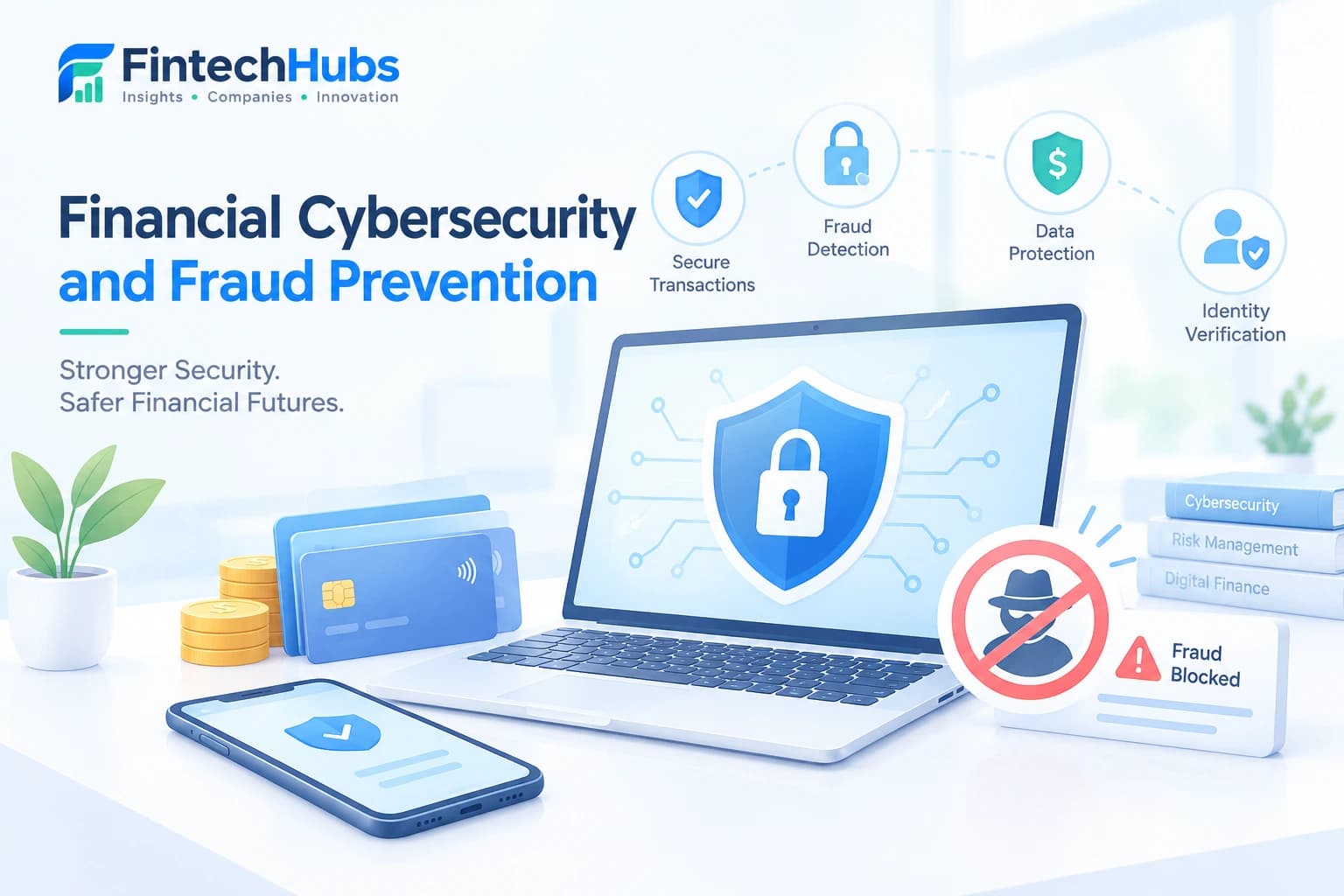
Financial Cybersecurity and Fraud Prevention: A Complete Guide
1. Introduction
Every dollar that moves digitally through a card swipe, a mobile transfer, an online checkout, or an instant payment travels through a system built on trust. That trust depends entirely on the invisible layer of protection working behind the scenes to ensure the transaction is legitimate, the account holder is who they claim to be, and no criminal is quietly siphoning value out of the system. That invisible layer is financial cybersecurity and fraud prevention.
As financial technology has accelerated faster payments, open banking, embedded finance, AI-driven services the opportunities for fraud and cybercrime have expanded just as quickly. Protecting financial systems is no longer a back-office function handled by a small compliance team; it has become a central, strategic discipline involving real-time data science, behavioral analytics, and increasingly, artificial intelligence working around the clock.
This guide offers a complete, in-depth look at financial cybersecurity and fraud prevention: what it is, how it works, the different types of fraud it defends against, its major branches, why it matters to institutions and individuals alike, and where the field is headed.
2. What Is Financial Cybersecurity and Fraud Prevention?
Financial cybersecurity and fraud prevention is the combination of technology, processes, policies, and human expertise used to protect financial institutions, businesses, and consumers from unauthorized access, data theft, and deceptive financial activity. It generally covers two connected disciplines:
Cybersecurity: Which protects the underlying technical infrastructure networks, applications, servers, and data from hacking, malware, and unauthorized intrusion.
Fraud prevention: Which focuses on detecting and stopping deceptive financial activity, including fraud committed using stolen credentials, fake identities, or social engineering tactics that manipulate legitimate users into authorizing harmful transactions themselves.
In practice, these two areas increasingly rely on shared infrastructure: real-time data analysis, behavioral monitoring, identity verification, and machine learning models trained to recognize the subtle signals that distinguish legitimate activity from criminal activity.
3. Why This Field Exists: The Scale of the Threat
Digital financial fraud and cybercrime represent one of the largest ongoing threats to the global economy. As more transactions move online and instant payment systems reduce the time available to catch and reverse fraudulent transactions, the pressure on real-time detection systems has grown substantially.
Several forces have driven this escalation:
The shift to digital-first and cashless transactions: Which has expanded the volume and speed of financial activity criminals can target
The growth of instant and real-time payments: Which often cannot be reversed once completed, unlike traditional bank transfers that had built-in delay
Increasingly sophisticated criminal tactics: Including organized fraud rings, AI-generated phishing content, and deepfake-enabled impersonation scams
A larger attack surface: As open banking, embedded finance, and third-party integrations connect more systems together, each representing a potential point of vulnerability
This is why financial cybersecurity has evolved from a narrow IT function into a core strategic priority for virtually every financial institution and fintech company.
4. How Modern Fraud Prevention Systems Work
Step 1: Identity Verification at Onboarding
Before an account is opened, systems verify a new customer's identity using government-issued ID verification, biometric checks (such as facial recognition matched to an ID photo), and screening against known fraud and watchlist databases.
Step 2: Continuous, Risk-Based Authentication
Rather than relying solely on a password, modern systems assess risk continuously throughout a session, examining device fingerprints, location consistency, typing patterns, and behavioral biometrics.
Step 3: Real-Time Transaction Risk Scoring
As a transaction is initiated, machine learning models evaluate it in milliseconds against dozens or hundreds of signals amount, merchant category, location, time, and how the transaction compares to the customer's historical behavior producing a real-time risk score.
Step 4: Adaptive, Proportional Response
Based on that risk score, the system responds proportionally: low-risk transactions proceed instantly, medium-risk transactions may trigger additional verification (a one-time code or biometric check), and high-risk transactions may be held for manual review or blocked outright.
Step 5: Human Investigation and Case Management
Flagged transactions and accounts are reviewed by fraud analysts, supported by case management tools that consolidate relevant data and prior history to speed up accurate decision-making.
Step 6: Continuous Learning
Confirmed fraud and false positives both feed back into the underlying models, allowing detection systems to improve accuracy and adapt to new fraud tactics over time.
5. Common Types of Financial Fraud
Understanding the field requires understanding what it's actually defending against:
Card fraud: Unauthorized use of stolen or counterfeit payment card details
Account takeover fraud: Criminals gaining unauthorized access to a legitimate customer's existing account, often through phishing or credential theft
Identity theft and synthetic identity fraud: Using stolen or fabricated personal information to open new fraudulent accounts
Authorized push payment (APP) fraud / scams: Tricking a legitimate account holder into knowingly authorizing a payment to a fraudster, such as through romance scams, fake tech support, or impersonation of banks and government agencies
Phishing and social engineering: Deceptive messages or calls designed to trick people into revealing credentials or sensitive information
Business email compromise: Impersonating executives or vendors to trick employees into authorizing fraudulent business payments
Money mule schemes: Recruiting individuals, sometimes unknowingly, to move illicit funds through their own accounts
Merchant and e-commerce fraud: Fraudulent transactions or chargebacks targeting online sellers
Insider fraud: Fraud committed by employees with legitimate access to financial systems
6. Core Branches of Financial Cybersecurity and Fraud Prevention
A. Identity Verification and Onboarding Fraud Prevention
Technology confirming a person is who they claim to be when opening an account, and detecting synthetic identities that blend real and fabricated information.
B. Transaction Fraud Detection
Real-time systems monitoring payments and purchases for signs of unauthorized or fraudulent activity across cards, transfers, and digital wallets.
C. Account Takeover Prevention
Tools specifically designed to detect unauthorized access to legitimate accounts, often through credential stuffing, phishing, or SIM-swapping attacks.
D. Authentication and Access Management
Multi-factor authentication, biometric login, passwordless authentication, and behavioral biometrics that continuously verify a user's identity throughout a session.
E. Anti-Money Laundering Technology
Closely related systems monitoring for the movement of illicit funds through the financial system, often sharing infrastructure and data signals with fraud detection.
F. Scam and Social Engineering Prevention
A growing branch specifically addressing scams where victims are deceived into authorizing fraudulent transactions themselves, which traditional "unauthorized activity" detection can struggle to catch.
G. Application and Infrastructure Security
Core cybersecurity practices penetration testing, vulnerability management, secure software development protecting the systems financial institutions run on from direct hacking and data breaches.
H. Third-Party and Vendor Risk Management
Assessing and monitoring the security posture of every external partner, API, and vendor a financial institution connects with, since vulnerabilities anywhere in that chain can expose the whole system.
I. Fraud Analytics and Investigation Tools
Case management and analytics platforms helping fraud teams prioritize, investigate, and document flagged cases efficiently.
J. Consumer-Facing Protection Tools
Features aimed directly at individual users — real-time transaction alerts, card-locking controls, dark web monitoring, and account activity notifications.
7. Key Technologies Powering Modern Fraud Prevention
Machine learning and predictive analytics: identifying subtle, evolving fraud patterns that static rules would miss
Behavioral biometrics: passively verifying identity based on how a person types, swipes, or holds a device
Device fingerprinting: recognizing the unique technical signature of a device to flag unfamiliar or suspicious access
Biometric authentication: facial recognition, fingerprint, and voice verification for secure, low-friction identity confirmation
Graph and network analysis: mapping relationships between accounts, devices, and transactions to detect coordinated fraud rings
Natural language processing: used to detect phishing content, scam scripts, and suspicious communications at scale
Blockchain analytics: tracing the movement of cryptocurrency across wallets and exchanges to identify illicit activity
8. Why Financial Cybersecurity and Fraud Prevention Matters
Protecting Individuals and Businesses from Direct Financial Loss
The most immediate purpose is straightforward: preventing people and companies from losing money to criminals.
Preserving Trust in Digital Finance
The entire digital financial ecosystem instant payments, mobile banking, open banking data sharing depends on public trust that these systems are safe to use.
Meeting Legal and Regulatory Obligations
Financial institutions face substantial legal requirements to protect customer data and prevent fraud, with serious penalties for failures.
Enabling Safe Innovation
New capabilities like instant payments and embedded finance are only viable at scale if the underlying fraud and security infrastructure can keep pace.
Protecting Vulnerable People
Scams disproportionately target elderly individuals and those less familiar with digital systems, giving fraud prevention a genuine human protective role beyond financial metrics.
Business Continuity and Reputation
A major security breach can cause severe reputational damage and costly remediation often far more expensive than prevention would have been.
9. Who Is Responsible for Financial Cybersecurity?
Protecting the financial system is a shared responsibility across multiple parties:
Financial institutions and fintech companies: who build and maintain the core detection and security infrastructure
Regulators: who set minimum security and compliance standards and enforce accountability
Technology vendors: who provide specialized fraud detection, identity verification, and cybersecurity tools
Merchants and businesses: who must secure their own payment systems and checkout processes
Individual consumers: who play a role in protecting their own credentials, recognizing scams, and reporting suspicious activity promptly
10. Challenges and Limitations
The arms race with criminals: who continuously adapt tactics, including using AI to generate more convincing scams and deepfakes
Balancing security and user friction: since excessive checks frustrate legitimate customers while insufficient checks let fraud through
False positives, which can incorrectly block or flag legitimate transactions
Authorized push payment fraud: which traditional systems struggle to catch since the victim technically authorizes the transaction
Fragmented data across institutions:limiting the ability to spot fraud patterns spanning multiple organizations
Resource disparities: as smaller institutions often lack the resources of large banks to build sophisticated detection systems
11. Best Practices for Institutions
Implement layered, risk-based authentication rather than one-size-fits-all security checks
Invest in real-time transaction monitoring powered by machine learning, not just static rules
Build robust third-party and vendor risk management processes
Maintain continuous employee training on emerging fraud tactics and social engineering
Establish clear, fast incident response and customer communication protocols
Participate in industry data-sharing initiatives where legally and competitively appropriate
12. Best Practices for Individual Consumers
Use strong, unique passwords and enable multi-factor authentication wherever available
Be skeptical of unsolicited calls, messages, or emails asking for personal or financial information
Monitor account activity regularly and set up real-time transaction alerts
Never share one-time passcodes or verification codes with anyone, including someone claiming to be from your bank
Verify requests for money independently before acting, especially if they involve urgency or emotional pressure
Report suspected fraud immediately to your financial institution
13. The Competitive and Institutional Landscape
The financial cybersecurity and fraud prevention ecosystem includes specialized fraud detection vendors offering real-time monitoring and risk scoring, identity verification companies focused on onboarding and authentication, broader cybersecurity firms providing infrastructure protection and threat intelligence, in-house fraud and security teams at banks and large fintechs, consumer-facing security app providers, and industry consortiums that pool anonymized fraud signals across institutions to strengthen collective detection.
14. Future Trends to Watch
AI versus AI: increasingly sophisticated detection systems responding to increasingly sophisticated AI-generated fraud
Behavioral biometrics becoming standard: working invisibly alongside traditional credentials
Greater cross-institution data collaboration: through privacy-preserving data-sharing frameworks
Regulatory focus sharpening on scam liability: particularly around authorized push payment fraud
Real-time protection becoming the default: as instant payments expand globally
Zero-trust security architecture: becoming a standard institutional approach
15. Frequently Asked Questions
1. What is the difference between financial cybersecurity and fraud prevention? Cybersecurity focuses on protecting the underlying technical systems and data from hacking and unauthorized access, while fraud prevention focuses on detecting and stopping deceptive financial activity, including cases where a criminal has legitimate-looking access. The two disciplines overlap significantly and often share the same underlying technology.
2. How do banks detect fraudulent transactions in real time? Banks use machine learning models that analyze a transaction against dozens of signals — amount, location, merchant type, timing, and comparison to a customer's historical behavior — assigning a risk score within milliseconds and responding proportionally, from allowing the transaction to blocking it or requiring extra verification.
3. What is authorized push payment fraud, and why is it hard to detect? This occurs when a scammer tricks a legitimate account holder into knowingly authorizing a payment, such as through a fake bank call or a romance scam. It's difficult to detect because the transaction is technically authorized by the real account holder, so systems built to catch "unauthorized" activity may not flag it.
4. Is biometric authentication safer than passwords? Biometric authentication (fingerprint, facial recognition) is generally considered more secure than passwords alone because it's harder to steal or guess, though it works best as part of a layered, multi-factor approach rather than a sole security measure.
5. What should I do if I think I've been a victim of financial fraud? Contact your financial institution immediately to report the issue and, where possible, freeze or lock the affected account or card. Change any compromised passwords, monitor your accounts closely, and report the incident to relevant consumer protection or law enforcement authorities.
6. How do financial institutions balance fraud prevention with customer convenience? Institutions use risk-based, adaptive security applying minimal friction to low-risk transactions and reserving additional verification steps for higher-risk activity, rather than applying the same level of scrutiny to every transaction.
7. What role does artificial intelligence play in fraud prevention? AI enables real-time analysis of massive volumes of transaction data, identifying subtle and evolving fraud patterns that static, rules-based systems would miss, while also helping detect increasingly sophisticated AI-generated scams and deepfakes.
8. Can fraud prevention systems make mistakes? Yes. False positives legitimate transactions incorrectly flagged as suspicious — are a known limitation, which is why institutions continuously refine their models and provide review processes to correct these errors quickly.
9. Why is third-party risk management important in financial cybersecurity? Modern financial systems rely heavily on interconnected APIs, vendors, and partners. A security weakness in any one of these connections can expose the broader system, making it essential to assess and monitor the security posture of every third party involved.
10. How is cryptocurrency fraud different from traditional financial fraud? Cryptocurrency transactions are typically irreversible and can be harder to trace back to a real-world identity without specialized blockchain analytics tools, which has made digital assets an attractive target for certain types of fraud and money laundering, prompting the growth of crypto-specific fraud prevention technology.
16. Conclusion
Financial cybersecurity and fraud prevention is the quiet, essential infrastructure underlying nearly every other advance in financial technology. Without it, faster payments, open banking, embedded finance, and AI-driven financial tools would all carry far greater risk. Its many branches from identity verification and transaction monitoring to scam prevention and infrastructure security work together toward a single goal: keeping the convenience of modern digital finance from becoming an equally convenient opportunity for criminals. As fraud tactics continue to evolve, often powered by the same technological advances reshaping the rest of the industry, the systems and strategies protecting financial services will need to keep pace, making this one of the most consistently critical fields in financial technology today and for the foreseeable future.
This content is for informational and educational purposes only and does not constitute financial, legal, or security advice. Readers should consult a qualified professional for guidance specific to their situation.
Share this article