What Is Fintech? A Complete Guide to Financial Technology in 2026
A complete 2026 guide to fintech, covering digital payments, banking, lending, blockchain, embedded finance, and the AI trends reshaping money.
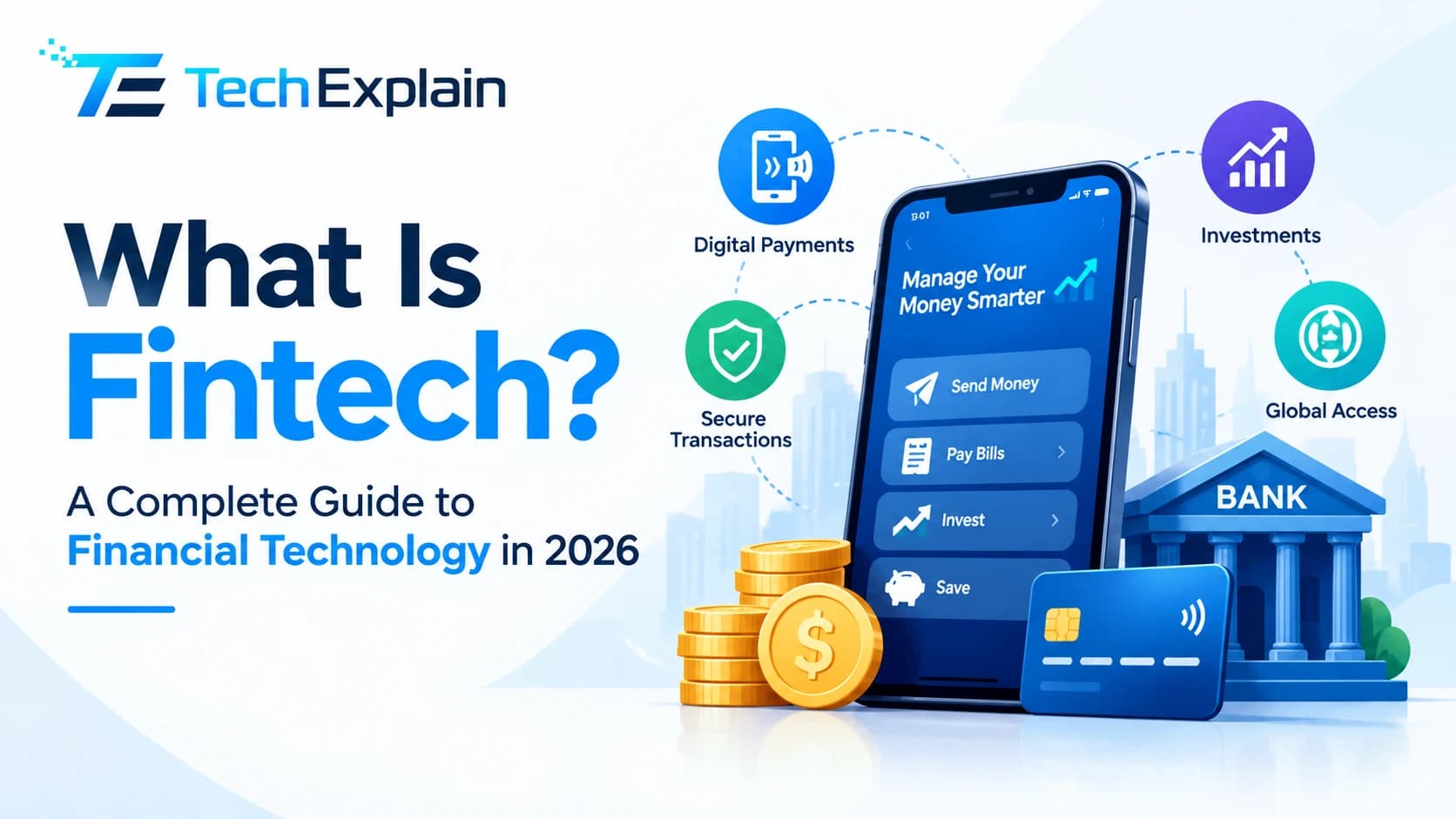
What Is Fintech? A Complete Guide to Financial Technology in 2026
Money has always moved through technology, from ledger books to telegraph wires to the first ATMs. What has changed in the last decade is the pace and the scope of that change. Financial technology, now universally shortened to fintech, has moved from a niche corner of Silicon Valley into the operating core of how people and businesses pay, save, borrow, invest, and protect their money.
This guide explains what fintech actually is, why it matters so much right now, and walks through every major branch of the industry, from digital payments and neobanks to embedded finance, blockchain, and the agentic AI systems reshaping financial decisions in 2026.
What Is Fintech
Fintech is a broad term for technology that is used to deliver, improve, or automate financial services. It includes the mobile app used to check a bank balance, the software that approves a small business loan in minutes, the payment link that lets a freelancer get paid instantly, and the algorithm that manages an investment portfolio without a human advisor.
Fintech is not a single product or company. It is an entire layer of innovation sitting on top of, and increasingly replacing parts of, the traditional financial system. Some fintech companies are standalone startups built entirely around a digital product. Others are technology providers working behind the scenes to power services offered by banks, retailers, and other established institutions. A growing share of fintech innovation today comes from partnerships between fast moving technology companies and regulated financial institutions, rather than pure competition between the two.
A Brief History of Fintech
Financial technology is not new. Banks have used computers to process transactions since the 1960s, and the first electronic stock trading systems appeared in the 1970s. What is new is the direction of innovation.
For most of the twentieth century, financial technology was built by banks, for banks, focused on internal efficiency. The rise of the internet in the 1990s introduced online banking, followed by online brokerages that let ordinary investors trade stocks without calling a broker.
The real turning point came after the 2008 financial crisis. Public trust in large banks fell sharply, smartphones became universal, and a wave of new companies began building financial products designed around the customer rather than the institution. Mobile payment apps, peer to peer lending platforms, and early robo-advisors emerged during this period, laying the foundation for the modern fintech industry.
The 2010s brought explosive growth, driven by cloud computing, open application programming interfaces, and a new generation of consumers comfortable managing their entire financial life from a phone. By the 2020s, fintech had become mainstream, and by 2026, it has become difficult to draw a clean line between "fintech companies" and "financial services companies," since nearly every bank, insurer, and investment firm now relies heavily on the same technologies that once defined only the startups challenging them.
Why Fintech Matters
Fintech matters because it solves real, practical problems that the traditional financial system left unresolved for decades.
It lowers the cost of financial services. Digital-first companies operate without the expense of thousands of physical branches, which allows them to offer lower fees, better interest rates, and fewer minimum balance requirements than many traditional banks.
It expands access. Billions of people around the world historically had no access to a bank account, a loan, or insurance, often because traditional institutions found it unprofitable to serve them. Mobile based fintech products have brought basic financial services to many of these populations for the first time, using nothing more than a low cost smartphone.
It speeds up decisions that used to take days. A small business loan that once required weeks of paperwork and in person meetings can now be approved in minutes using automated underwriting. Fraud that once took days to detect can now be flagged in real time.
It gives consumers more control and better information. Budgeting apps, spending alerts, and investment platforms give ordinary people a level of financial visibility and control that was previously available only to wealthy clients with a personal advisor.
It forces the entire industry to improve. Even banks and insurers that have not built their own cutting edge technology are pressured to improve their service, pricing, and speed because customers now compare every financial provider against the best digital experience they have used anywhere.
The Core Branches of Fintech
Fintech is best understood as a collection of distinct branches, each solving a different financial problem. Most fintech companies specialize in one branch, though many now expand into several as they grow.
Digital Payments
Digital payments are the branch of fintech that most people interact with daily. This includes mobile wallets, peer to peer payment apps, contactless card payments, and the invisible payment processing that runs behind almost every online purchase.
The shift toward digital payments has been dramatic. Industry forecasts suggest global digital payment volume will reach roughly twenty six trillion dollars by 2027, reflecting how thoroughly cash and paper checks have been displaced in everyday commerce. The financial services industry is being rebuilt from the ground up by this shift, rather than simply adopting new technology on top of old systems.
Behind the simple act of tapping a phone to pay lies a complex chain of technology, including payment processors, card networks, and increasingly, real time payment rails that settle transactions in seconds instead of days.
Digital Banking and Neobanks
Digital banks, often called neobanks, operate entirely online without physical branches. They offer checking accounts, savings accounts, and debit cards through a mobile app, typically with lower fees and faster account opening than traditional banks.
Some neobanks hold their own banking license and take deposits directly. Others partner with a licensed bank behind the scenes and focus purely on building the customer experience, a model that has become increasingly common as more companies want to offer banking features without becoming a bank themselves.
Lending and Alternative Credit
Fintech lending platforms use automated underwriting, alternative data sources, and streamlined digital applications to approve loans faster than traditional banks. This includes personal loans, small business financing, and increasingly sophisticated buy now pay later products that let shoppers split a purchase into installments at checkout.
Modern lending decisions increasingly rely on artificial intelligence models that can evaluate an application and return a decision in a fraction of a second, a dramatic change from the days or weeks a traditional loan application once required.
Wealthtech and Robo-Advisors
Wealthtech covers digital investing and wealth management tools, including robo-advisors that automatically build and manage an investment portfolio based on a person's goals and risk tolerance. These platforms have made professional style portfolio management available to everyday investors who could never have afforded a traditional financial advisor.
Fractional share investing, automated rebalancing, and tax efficient trading strategies, once reserved for wealthy clients, are now standard features on many low cost investing apps.
Insurtech
Insurtech applies the same digital first thinking to insurance. This includes fully digital insurance applications, usage based auto insurance that adjusts pricing based on actual driving behavior, and AI powered claims processing that can settle a simple claim within minutes instead of weeks.
Insurtech has also introduced new, more flexible insurance products, such as coverage that can be turned on and off for a single trip, a single item, or a specific short term need, rather than requiring a traditional annual policy.
Regtech
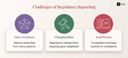
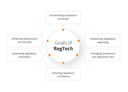
Regulatory technology, or regtech, helps financial institutions comply with increasingly complex rules around fraud prevention, money laundering, data privacy, and consumer protection. Regtech tools automate the monitoring and reporting that used to require large compliance teams working manually.
As financial regulation continues to expand and diverge across different countries, regtech has become one of the fastest growing branches of fintech, since compliance failures can carry severe financial and reputational consequences for any institution.
Blockchain, Cryptocurrency, and Decentralized Finance
Blockchain technology allows financial transactions to be recorded on a shared, tamper resistant digital ledger without relying on a single central authority. Cryptocurrency, the most well known application of blockchain, introduced digital assets that can be transferred directly between people without a bank acting as an intermediary.
Decentralized finance, often shortened to DeFi, takes this further by rebuilding financial services such as lending, trading, and insurance entirely on blockchain networks, using automated code instead of traditional financial institutions to manage transactions.
Stablecoins and Digital Currencies
Stablecoins are digital currencies designed to hold a steady value, typically by being backed one to one by a traditional currency such as the US dollar. After years as a niche tool used mainly within cryptocurrency trading, stablecoins are moving into mainstream financial infrastructure. Analysts project that blockchain based technologies, stablecoins included, could generate over three hundred sixty billion dollars in economic value within the near term, driven by growing institutional adoption and clearer regulatory frameworks. Regulators increasingly view stablecoins as a legitimate payment mechanism rather than a purely speculative asset, and banks are positioning themselves to play a central role in managing these digital currencies as adoption grows.
Meanwhile, a number of central banks around the world continue to research or pilot their own central bank digital currencies, a government issued alternative to privately created stablecoins.
Open Banking
Open banking allows a customer to securely share their financial data, such as bank transaction history, with third party apps and services, using standardized, regulated data connections instead of insecure workarounds. This makes it possible for a budgeting app to see a person's real spending across multiple banks, or for a lender to verify income directly rather than requiring uploaded bank statements.
Open banking has expanded steadily around the world, and it forms the technical foundation that many other fintech branches, particularly lending and personal finance apps, depend on to function well.
Embedded Finance and Banking as a Service
Embedded finance places financial products directly inside non-financial apps and platforms, so a customer never has to leave the product they are already using to access a payment, a loan, or a bank account. A ride sharing app offering instant driver payouts, or an online marketplace offering seller financing based on real sales data, are both examples of embedded finance in action.
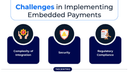
Industry leaders expect embedded finance to become one of the biggest opportunities in fintech in 2026, powered by next generation, API based banking infrastructure that lets ordinary businesses offer competitive financial services without needing a banking license of their own. This is made possible by banking as a service providers, which supply the regulated infrastructure behind the scenes while another company builds the customer facing product.
Personal Finance Management
Personal finance apps help individuals track spending, set budgets, monitor credit scores, and plan for savings goals, often by connecting directly to a person's bank and credit accounts through open banking connections. These tools have shifted financial planning from an occasional, effortful task into an ongoing, largely automated background process.
Financial Cybersecurity and Fraud Prevention
As more financial activity moves online, protecting it becomes its own specialized branch of fintech. This includes real time fraud detection systems, biometric authentication such as fingerprint and facial recognition, and increasingly, zero trust security models that verify every access request rather than assuming anything inside a network is automatically safe.
Modern fraud detection systems can analyze a transaction the instant it happens and block suspicious activity before money ever moves, a significant advance over older systems that could only flag fraud after the fact.
The Technologies Powering Fintech
Several underlying technologies show up repeatedly across nearly every branch of fintech.
Artificial intelligence now sits at the center of fintech innovation. AI models assess credit risk, detect fraud, personalize financial advice, and increasingly operate as autonomous agents capable of completing multi step financial tasks with limited human involvement. Some AI systems can now approve or decline a loan application in under two hundred milliseconds, and real time fraud detection models are cutting certain types of losses by roughly forty to sixty percent.
Application programming interfaces, or APIs, allow different financial systems to connect and share data securely, forming the technical backbone behind open banking, embedded finance, and most modern digital banking products.
Cloud computing gives fintech companies the flexible, scalable infrastructure needed to launch products quickly and handle sudden spikes in usage without owning physical data centers.
Blockchain provides the shared, verifiable ledger technology behind cryptocurrency, stablecoins, and a growing number of experimental applications in trade finance and cross border settlement.
Biometric authentication, including fingerprint, facial, and voice recognition, has become a standard security layer across banking apps and payment platforms, replacing or supplementing traditional passwords.
Fintech Regulation and Compliance
Fintech does not operate in a legal vacuum. Financial services remain one of the most heavily regulated sectors of the economy, and fintech companies must comply with rules covering consumer protection, data privacy, anti money laundering, and increasingly, digital asset oversight.
Regulatory approaches vary significantly by region. Some governments have introduced dedicated frameworks for digital assets and stablecoins, while others continue to apply existing banking and securities law to new fintech products. This regulatory patchwork creates real complexity for fintech companies operating across multiple countries, and it has made regtech, the branch of fintech built specifically to manage compliance, an increasingly important part of the industry rather than a back office afterthought.
Challenges and Risks in Fintech
Fintech's rapid growth has not come without genuine risks that deserve honest attention.
Cybersecurity threats remain a constant concern, since fintech platforms are attractive targets for criminals seeking to steal money or personal data.
Regulatory uncertainty can slow innovation or create compliance risk when rules change or vary sharply between regions.
Algorithmic bias in AI driven lending or insurance decisions can unintentionally disadvantage certain groups if models are not carefully designed and monitored.
Financial stability concerns have also been raised around rapid stablecoin adoption and decentralized finance, since these systems can behave differently under stress than traditional, more heavily supervised financial institutions.
Responsible fintech companies address these risks through strong security investment, careful regulatory engagement, and transparent, auditable decision making systems, rather than treating them as an afterthought to rapid growth.
The Future of Fintech in 2026 and Beyond
Several themes are shaping fintech's next phase. Agentic AI, systems that can independently complete financial tasks such as negotiating a bill, rebalancing an investment, or managing a small business's cash flow, is moving from experimental to mainstream. Stablecoins are transitioning from a crypto trading tool into a regulated piece of everyday payment infrastructure, particularly for cross border transactions. Embedded finance continues to spread further into everyday apps, and hyper personalization, where financial products adjust in real time to a person's actual behavior and circumstances, is becoming a genuine competitive differentiator rather than a marketing buzzword.
At the same time, the industry is maturing. Growth is increasingly measured by real, sustainable value rather than pure user growth or funding headlines, and partnerships between fintech innovators and established financial institutions are becoming more common than outright disruption.
Final Thoughts
Fintech is no longer a separate category sitting apart from mainstream finance. It has become the infrastructure that mainstream finance runs on. Understanding its major branches, from payments and digital banking to embedded finance, blockchain, and AI driven decision making, helps consumers make smarter choices about the tools they use, and helps businesses recognize where genuine opportunity still exists in an industry that continues to move faster than most others in the global economy.
The organizations and individuals who benefit most from fintech are rarely the ones chasing every new trend. They are the ones who understand what problem each branch of fintech actually solves, and choose the tools that genuinely fit their real financial needs.
Share this article
Related Articles
50 Best Fintech Companies in the USA: 2026 Guide
Fintech has become one of the most important parts of the modern financial ecosystem.

Fintech: The Complete Guide to Financial Technology in 2026
Financial technology, commonly known as fintech, is changing how individuals, businesses, banks, and financial institutions manage money.