
Biometric Authentication: Secure, Password Free Identity
A complete look at biometric verification for secure identity authentication: how it works, key technologies, and why it's replacing passwords.
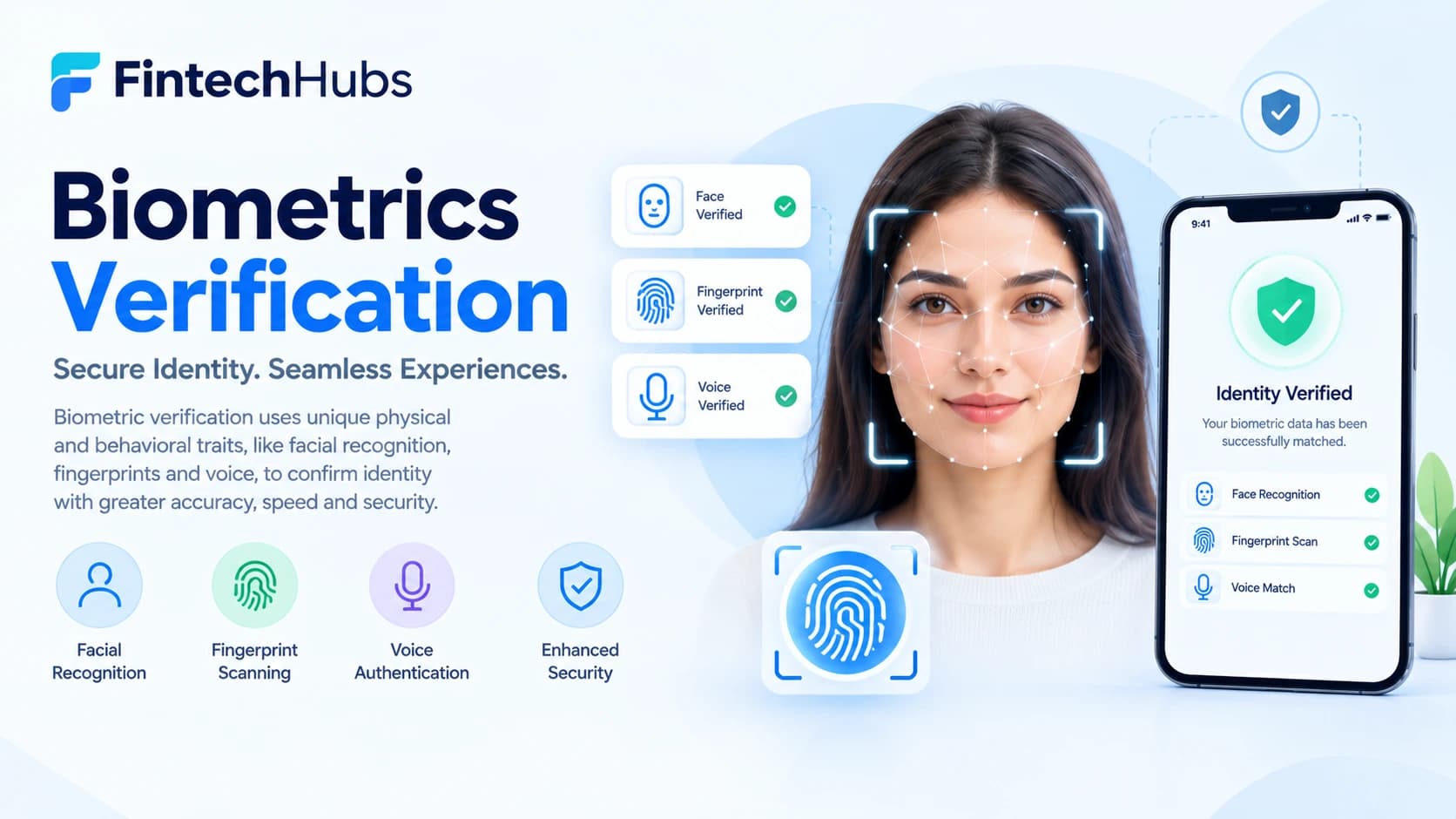
Biometric Verification: Secure Identity Authentication
A password can be forgotten, guessed, or stolen. A physical key can be lost or copied. But the unique physical and behavioral characteristics that make up a person their fingerprint, the geometry of their face, the pattern of their iris, the rhythm of their voice or typing are far harder to replicate, making biometric verification one of the most secure and increasingly common methods of confirming identity in the digital age.
Biometric verification is now woven into everyday life: unlocking a smartphone with a fingerprint or glance, boarding a flight with a facial scan, authorizing a payment with a thumbprint, or logging into a banking app using voice recognition. This guide provides a complete, professional overview of biometric verification as a whole: what it is, how it works across different biometric modalities, its major branches, the technology and security considerations involved, why it matters, and where the field is heading.
What Is Biometric Verification?
Biometric verification is the process of confirming a person's identity by comparing a captured biometric sample, such as a fingerprint, face, iris, or voice, against a previously registered reference sample belonging to that same individual. It answers a specific question: "Does this biometric sample match the one on record for the identity being claimed?"
Biometric verification relies on characteristics that are unique to each individual and generally stable over time, making them a powerful complement, or in some cases alternative, to traditional knowledge-based credentials like passwords and PINs, which can be forgotten, shared, or stolen.
Biometric Verification vs. Biometric Identification
These related but distinct concepts are often confused:
Biometric verification (one-to-one matching): Confirms whether a live biometric sample matches one specific, previously enrolled reference, answering "Is this the person they claim to be?" This is the method used for unlocking a personal device or logging into an individual account.
Biometric identification (one-to-many matching):Searches a database of many enrolled biometric records to determine who an unknown individual is, answering "Who is this person?" This approach is used in some law enforcement and large-scale security contexts and carries significantly different accuracy, privacy, and scale considerations than verification.
This distinction matters considerably for privacy and risk: verification typically involves a narrower, consent-based comparison against a single reference, while identification involves broader searching that raises more substantial privacy and accuracy concerns, particularly at large scale.
How Biometric Verification Works
Step 1: Enrollment
A reference biometric sample is captured and securely stored during an initial setup process, such as registering a fingerprint on a new device or providing a facial scan during account creation.
Step 2: Template Creation
Rather than storing the raw biometric sample directly in most modern systems, the captured data is converted into a mathematical representation, often called a template, that encodes the unique, distinguishing characteristics without storing an easily reversible copy of the original image or recording.
Step 3: Live Capture
When verification is needed, the system captures a new, live biometric sample from the person attempting to verify their identity.
Step 4: Liveness Detection
For methods like face or voice verification, the system checks that the live sample comes from a real, present individual rather than a photo, recording, or synthetic reproduction, a critical safeguard against spoofing.
Step 5: Template Comparison
The newly captured sample is converted into a template using the same process as enrollment, and compared against the stored reference template using specialized matching algorithms.
Step 6: Similarity Scoring and Decision
The system calculates a similarity score between the two templates and compares it against a pre-set threshold to determine whether the samples represent a match, applying stricter or more lenient thresholds depending on the security needs of the specific use case.
Step 7: Result and Response
Based on the outcome, the system grants or denies access, or in borderline cases, routes the attempt for additional verification steps or human review.
Core Components of a Biometric Verification System
Capture devices and sensors: Such as fingerprint scanners, cameras, or microphones, that gather the raw biometric sample
Feature extraction algorithms: Converting raw captures into structured, comparable templates
Liveness and anti-spoofing detection: Confirming the authenticity of the presented sample
Matching engines: Calculating similarity between live and reference templates
Secure template storage: Protecting enrolled reference data, often using encryption and, on many modern devices, dedicated secure hardware
Decision and threshold management: Balancing security and usability based on the specific application's risk level
Audit and logging systems: Recording verification attempts for security monitoring and compliance purposes
Branches of Biometric Verification (By Modality)
A. Fingerprint Verification
One of the most established and widely adopted biometric methods, analyzing the unique pattern of ridges and valleys on a person's fingertip, commonly used in smartphones, physical access control, and financial services.
B. Face Verification
Comparing a live facial capture against a reference image or template to confirm identity, widely used in mobile device unlocking, remote identity verification, and increasingly in payment authorization.
C. Iris and Retina Verification
Analyzing the unique patterns within the iris or, less commonly, the retina of the eye, offering very high accuracy and stability over a person's lifetime, though requiring more specialized capture equipment than fingerprint or face methods.
D. Voice Verification
Analyzing unique vocal characteristics, including pitch, tone, and speech patterns, to confirm identity, commonly used in call center authentication and voice-activated banking services.
E. Palm and Vein Pattern Verification
Analyzing the unique pattern of veins beneath the skin's surface, typically in the palm, offering strong security since vein patterns are internal and very difficult to replicate or observe covertly.
F. Signature Verification
Analyzing the unique characteristics of a person's handwritten signature, including both its visual shape and, in dynamic versions, the speed, pressure, and rhythm used while signing.
G. Behavioral Biometrics
Analyzing patterns in how a person interacts with a device, such as typing rhythm, touchscreen gestures, mouse movement, or gait, providing a form of continuous, often passive verification distinct from traditional physiological methods.
H. Multimodal Biometric Verification
Combining two or more biometric modalities, such as face and voice, or fingerprint and behavioral signals, to increase accuracy and resistance to spoofing beyond what any single modality can achieve alone.
Physiological vs. Behavioral Biometrics
Biometric verification methods generally fall into two broad categories:
Physiological biometrics: Are based on stable, physical characteristics of the body, such as fingerprints, facial geometry, iris patterns, and vein patterns. These tend to be highly stable over time and offer strong accuracy, though they typically require a specific enrollment and verification action from the user.
Behavioral biometrics:Are based on patterns in how a person acts or interacts with a device, such as typing rhythm, touchscreen pressure, walking gait, or voice cadence. These can often be captured passively and continuously, supporting ongoing verification throughout a session rather than only at a single checkpoint, though they can be somewhat more variable over time due to factors like mood, injury, or environment.
Many modern systems combine both categories to balance strong initial verification with continuous, low-friction confirmation throughout a user's session.
Key Technologies Supporting Biometric Verification
Deep learning and neural networks, powering highly accurate feature extraction and matching across face, voice, and other modalities
Specialized sensors, including capacitive and optical fingerprint scanners, high-resolution cameras, infrared sensors, and near-field vein-imaging devices
Secure hardware elements, such as dedicated chips found in many modern smartphones, that store biometric templates in isolated, tamper-resistant environments
Liveness detection technology, working alongside matching algorithms to confirm sample authenticity
Encryption and template protection techniques, including methods that allow matching to occur without ever exposing a reversible version of the original biometric data
Edge computing and on-device processing, allowing biometric matching to occur locally on a device rather than transmitting sensitive biometric data to external servers
Why Biometric Verification Matters
Stronger Security Than Traditional Credentials
Biometric characteristics are significantly harder to steal, guess, or share than passwords and PINs, reducing the risk of unauthorized access due to credential theft or reuse.
Convenience and Speed
Biometric verification is typically faster and more intuitive than typing credentials, particularly on mobile devices, improving the overall user experience without sacrificing security.
Reducing Identity Fraud
By confirming that the person attempting access genuinely matches the enrolled identity, biometric verification helps reduce account takeover, impersonation, and fraudulent transactions.
Enabling Secure Remote Processes
Biometric verification allows sensitive processes, such as opening a financial account or accessing healthcare services, to be completed securely and entirely remotely.
Supporting Multi-Factor Authentication
Biometrics are commonly used as one factor within a broader multi-factor authentication strategy, adding a layer that is fundamentally different in nature from something a person knows (a password) or has (a device or token).
Reducing Password-Related Support Costs
For organizations, biometric verification can reduce the significant support burden associated with forgotten passwords and account recovery processes.
Industries and Use Cases
Banking and financial services: Account access, transaction authorization, and remote identity verification during onboarding
Mobile devices and consumer technology: Unlocking smartphones, authorizing app purchases, and securing personal data
Travel and border security: Passenger identification at airports and other transit checkpoints
Healthcare: Patient identification and secure access to medical records
Government services: National identity programs and secure access to public benefits
Workplace security: Physical access control and secure login to sensitive systems
Law enforcement and public safety: Identity confirmation in specific, legally governed contexts, which raises additional considerations distinct from consumer verification use cases
Retail and payments: Biometric payment authorization in some markets
Accuracy and Performance Metrics
Evaluating biometric verification systems typically involves several key metrics:
False Acceptance Rate (FAR): The rate at which the system incorrectly matches a biometric sample from a different individual, a critical security metric
False Rejection Rate (FRR): The rate at which the system incorrectly rejects a genuine match, which affects usability
Equal Error Rate (EER): The point at which false acceptance and false rejection rates are equal, often used as a single summary measure of overall system accuracy
Failure to Enroll Rate: The percentage of individuals who cannot successfully complete initial enrollment due to sensor limitations or physical characteristics
Speed and throughput: How quickly the system can complete a verification, which is particularly important in high-volume use cases such as airport security
Different biometric modalities and providers vary significantly in these metrics, making independent, standardized testing results valuable when evaluating specific technology choices.
Security Considerations and Spoofing Defenses
Biometric verification systems must defend against various attempts to fool them, including presenting photos, recordings, masks, or synthetic reproductions of a legitimate user's biometric characteristics. Key defenses include:
Liveness detection: Confirming that a live, physically present individual is providing the sample rather than a static or artificial reproduction
Multimodal verification: Combining multiple biometric factors to make successful spoofing significantly more difficult
Secure template storage: Protecting enrolled reference data from theft or unauthorized access, since unlike a password, a compromised biometric characteristic cannot simply be changed
Encrypted transmission: Protecting biometric data as it moves between a capture device and matching systems
Continuous monitoring and updates: Since spoofing techniques, particularly involving AI-generated synthetic media, continue to evolve over time
13. Privacy, Legal, and Ethical Considerations
Because biometric data is uniquely sensitive and, unlike a password, cannot be changed if compromised, biometric verification systems require particular care:
Biometric-specific privacy laws:Many jurisdictions have enacted specific legal requirements governing the collection, storage, use, and retention of biometric data, often requiring explicit consent.
Data minimization and secure storage: Best practice generally favors storing irreversible mathematical templates rather than raw biometric images or recordings, and retaining data only as long as necessary.
Clear consent and transparency: Individuals should be clearly informed about what biometric data is collected, why, how it will be used, and how long it will be retained.
Distinguishing verification from broader surveillance: Because verification (one-to-one) is technically and ethically distinct from identification or surveillance (one-to-many) applications, organizations should be transparent about which type of system is being deployed.
Irrevocability of biometric data: Because biometric characteristics cannot be reset the way a password can, protecting stored biometric templates with strong security is especially critical.
Jurisdictional variation: Rules governing biometric data differ substantially between countries and regions, requiring careful, jurisdiction-specific legal guidance for organizations operating internationally.
Challenges and Limitations
Accessibility and inclusivity: Certain physical conditions, injuries, or environmental factors can make some biometric methods difficult or impossible for some users, requiring accessible alternative verification paths.
Spoofing and evolving attack methods: As biometric verification technology improves, so do attempts to spoof it, particularly with increasingly realistic synthetic media, requiring continuous investment in countermeasures.
Irrevocability: Unlike a password, a compromised biometric characteristic cannot simply be changed, making strong security around stored biometric data especially critical.
Cross-device and cross-provider interoperability: Biometric enrollment is often tied to a specific device or service, limiting the ability to easily reuse biometric verification across different platforms.
Public trust and perception: Some individuals remain hesitant about biometric data collection due to privacy and surveillance concerns, requiring clear communication and genuinely privacy-respecting practices to build trust.
Environmental and performance variability: Factors such as lighting, background noise, or sensor quality can all affect accuracy depending on the specific biometric modality used.
Best Practices for Implementation
Select biometric modalities appropriate to the specific use case, balancing security needs, user convenience, and accessibility
Store biometric data as irreversible templates rather than raw images or recordings wherever technically feasible
Implement robust liveness detection to defend against spoofing attempts
Apply strong encryption and access controls to all stored biometric data
Provide clear, transparent disclosure to users about data collection, use, and retention practices
Offer accessible alternative verification methods for users who cannot use a particular biometric modality
Consider multimodal approaches for particularly high-security or high-value use cases
Continuously monitor and update systems to defend against evolving spoofing techniques
Conduct regular independent security and accuracy testing rather than relying solely on vendor claims
Stay current with applicable biometric privacy laws in every jurisdiction of operation
16. The Competitive and Vendor Landscape
The biometric verification market includes specialized biometric technology vendors focused on specific modalities such as fingerprint, face, or voice, broader identity verification platforms incorporating multiple biometric methods alongside document and database checks, device manufacturers building biometric capabilities directly into consumer hardware, enterprise security vendors integrating biometrics into workplace access control, and government-affiliated providers supporting national digital identity programs.
17. Future Trends to Watch
Growth of multimodal and continuous verification: Expect continued movement toward combining multiple biometric and behavioral signals for stronger, more resilient identity assurance, alongside continuous rather than one-time verification.
Advancing anti-spoofing and deepfake defenses: As synthetic media generation becomes more sophisticated, biometric verification providers are expected to continue investing heavily in more advanced liveness and spoof detection techniques.
Wider adoption of privacy-preserving biometric techniques: Expect growing use of methods that allow biometric matching without exposing reversible personal data, along with greater emphasis on on-device processing.
Expansion of passwordless authentication: Biometric verification is increasingly central to broader passwordless authentication strategies, reducing reliance on traditional credentials across both consumer and enterprise applications.
Standardization and interoperability efforts: Industry and government initiatives are expected to continue working toward greater interoperability, allowing verified biometric identity to be more easily and securely reused across different services.
Tighter regulatory frameworks: As biometric verification becomes more deeply embedded in daily life, expect continued development of biometric-specific privacy and security regulations across more jurisdictions.
Frequently Asked Questions
1. What is biometric verification?
Biometric verification is the process of confirming a person's identity by comparing a live biometric sample, such as a fingerprint, face, or voice, against a previously registered reference sample belonging to that individual.
2. How is biometric verification different from biometric identification?
Verification performs a one-to-one comparison to confirm a claimed identity, while identification performs a one-to-many search across a database to determine an unknown individual's identity, involving different accuracy, privacy, and scale considerations.
3. What biometric modalities are most commonly used today?
Fingerprint and face verification are among the most widely used due to their convenience and widespread hardware support, followed by voice verification and, in specialized or high-security contexts, iris and vein pattern verification.
4. Is biometric data stored as an actual image or recording?
In most modern, well-designed systems, biometric data is converted into a mathematical template rather than stored as a raw, easily reversible image or recording, though practices vary by provider and system design.
5. Can biometric verification be hacked or spoofed?
While biometric verification is generally more secure than traditional credentials, it is not entirely immune to spoofing attempts, which is why robust liveness detection and, in higher-security contexts, multimodal verification are important complementary safeguards.
6. What happens if my biometric data is compromised?
Because biometric characteristics cannot be changed the way a password can, a compromise of stored biometric templates is a serious concern, underscoring the importance of strong encryption, secure storage, and, where possible, systems designed so that even a data breach does not expose reversible biometric information.
7. Is biometric verification legally required to use passwords as a backup?
Requirements vary by jurisdiction, industry, and specific use case, but many systems offer alternative verification methods for accessibility, technical, or legal reasons, rather than relying on biometrics as the sole verification method.
8. How accurate is biometric verification compared to passwords?
Biometric verification generally offers strong resistance to common attack methods used against passwords, such as guessing or credential reuse, though accuracy varies by modality, implementation quality, and environmental factors, and no verification method is entirely infallible.
9. Can biometric verification be used across multiple apps and services?
This depends on the specific implementation. Some biometric verification is tied to a single device or service, while broader digital identity initiatives are working toward more interoperable, reusable biometric verification across multiple platforms.
10. What industries rely most heavily on biometric verification?
Banking and financial services, mobile technology, travel and border security, healthcare, and government digital services are among the industries making the most extensive use of biometric verification today.
Conclusion
Biometric verification has moved from a specialized security technology into a mainstream, everyday method of confirming identity across mobile devices, financial services, travel, healthcare, and government services. Its branches, spanning fingerprint, face, iris, voice, and increasingly behavioral biometrics, all serve a shared purpose: using the unique physical and behavioral characteristics that make each person distinct to provide stronger, more convenient identity assurance than traditional credentials alone can offer. As the technology continues to advance, alongside growing attention to accuracy, fairness, and biometric privacy protections, organizations that implement biometric verification thoughtfully, with strong security safeguards, transparent practices, and accessible alternatives, are best positioned to realize its full security and convenience benefits responsibly.
This content is for informational and educational purposes only and does not constitute legal, security, or compliance advice. Biometric data regulations vary significantly by jurisdiction and change over time. Organizations should consult qualified legal and technical professionals regarding their specific implementation and compliance obligations.
Share this article
Related Articles
Liveness Detection: A Complete Guide
Understand liveness detection how it stops spoofing and deepfakes, active vs passive methods, key technologies, industries, best practices, and 10 FAQs.
Face Verification: How It Works, Benefits & Uses
Discover how face verification works liveness detection, key technologies, industries, accuracy, privacy considerations, best practices, and 10 FAQs.
ESG & Sustainability Reporting: Why It Matters for Business
Learn why ESG and sustainability reporting matters for businesses: key frameworks, benefits, challenges, best practices, future trends, and 10 essential FAQs.