Digital Payments Guide: Complete Overview for 2026
Everything you need to know about digital payments in 2026: how they work, every major type, key risks, and the trends reshaping how money moves.
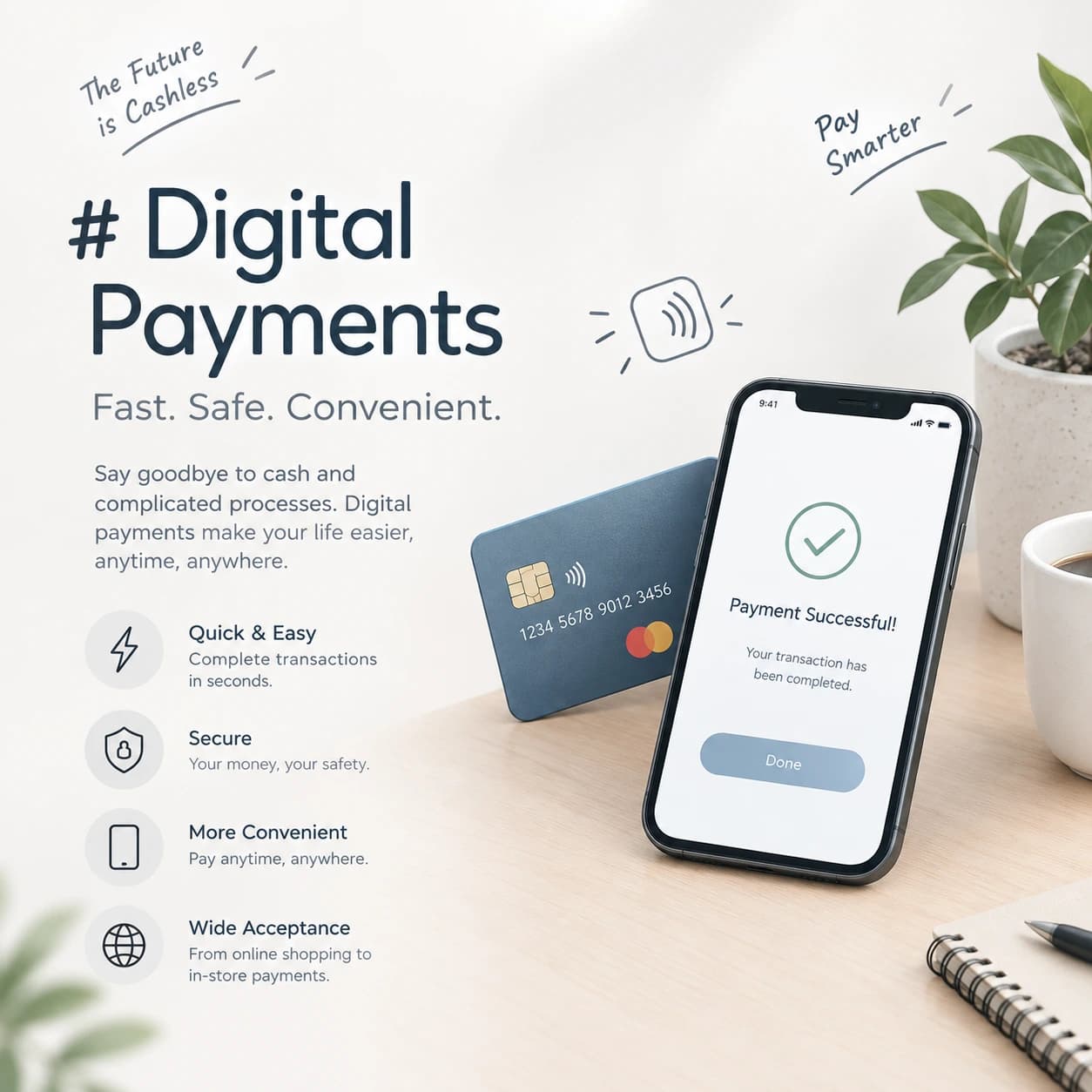
Digital Payments: A Complete Guide to Financial Technology in 2026
Twenty years ago, paying for something usually meant handing over cash or swiping a card at a physical terminal. Today, a single purchase might involve a mobile wallet, a tokenized card number, an instant bank transfer, or even a stablecoin, all completed in under a second without the buyer thinking about the technology working behind the scenes. Digital payments have quietly become the plumbing of the entire global economy, and in 2026 that plumbing is changing faster than at almost any point in its history.
This guide explains what digital payments actually are, why they matter so much to businesses and everyday life, and walks through every major branch of the industry, from contactless cards and mobile wallets to real time bank transfers, stablecoins, and the AI driven agents now beginning to make purchases on a person's behalf.
What Are Digital Payments
Digital payments are any transfer of money that happens electronically rather than through physical cash or a paper check. This includes tapping a phone at a checkout counter, sending money to a friend through an app, a business collecting a subscription fee automatically each month, and a company transferring millions of dollars overseas to pay a supplier.
The term covers a wide range of methods, technologies, and participants. A single digital payment often passes through several companies within a few seconds, including a payment gateway, a card network or bank rail, a fraud detection system, and the receiving bank, all coordinated so smoothly that the person making the purchase never notices the complexity involved.
Why Digital Payments Matter
Digital payments matter because they touch nearly every economic transaction that takes place today, and the way they work directly affects cost, speed, security, and access for everyone involved.
They make commerce faster: A transaction that once took days to clear through paper checks or manual bank transfers can now settle in seconds, allowing businesses to access their money almost immediately and plan cash flow with far more confidence.
They lower costs for businesses and consumers: Digital payment rails, particularly newer real time and bank to bank transfer methods, often carry lower fees than traditional card processing, which matters enormously for businesses operating on thin margins.
They expand financial access: Mobile wallets have brought basic payment and money transfer capability to people who never had access to a traditional bank account, particularly across regions where mobile phones are far more common than bank branches.
They generate the data that powers modern finance: Every digital transaction creates a data trail that can be used to detect fraud, extend credit responsibly, personalize offers, and help businesses understand their customers, something a cash transaction could never provide.
They are becoming the foundation for entirely new business model: Subscription services, on demand marketplaces, and instant payouts to freelancers and gig workers would not be practical without fast, low cost digital payment infrastructure running underneath them.
A Brief History of Digital Payments
Electronic payments are older than most people assume. Credit card networks and electronic bank transfers date back to the 1950s and 1960s, and automated clearing house systems have moved money between banks since the 1970s. What has changed dramatically is the speed, the number of participants, and how directly consumers interact with the technology themselves.
The rise of the internet in the 1990s made online card payments possible, followed by the first digital wallets and person to person payment apps in the 2000s. Smartphones then transformed the entire industry during the 2010s, turning every phone into a payment terminal through contactless technology and QR codes, and giving rise to a new generation of mobile first payment companies operating entirely outside the traditional banking branch network.
By the 2020s, instant bank to bank payment systems began rolling out across major economies, allowing money to move directly between bank accounts in real time rather than through the multi day delays of older transfer systems. Now, in 2026, the industry is entering another major shift, as regulated stablecoins move from a niche crypto tool into mainstream payment infrastructure, and artificial intelligence begins to initiate and manage payments on behalf of both individuals and businesses.
The Core Branches of Digital Payments
Digital payments are best understood as a collection of distinct methods and technologies, each suited to different situations, users, and needs.
Card Payments and Contactless Technology
Debit and credit cards remain one of the most widely used forms of digital payment worldwide, though the way people use them has changed significantly. Contactless payments, made using near field communication technology built into modern cards and phones, let a customer complete a purchase with a simple tap instead of inserting or swiping a card. Behind the scenes, card payments rely on tokenization, which replaces sensitive card details with a unique digital code during the transaction, reducing the risk that stolen data could ever be used elsewhere.
Mobile Wallets
Mobile wallets store payment credentials, loyalty cards, and increasingly identification documents directly on a smartphone, allowing a person to pay, receive money, and manage their finances entirely from one app. Wallet adoption has grown enormously, with billions of people worldwide now using a mobile
wallet for at least part of their spending, and wallets now account for a substantial share of both online and in person purchases in many markets. Their appeal comes down to speed, security, and cost, since wallets often bypass some of the fees associated with traditional card processing while giving users real time transaction visibility.
QR Code Payments
QR code based payments let a customer scan a code with their phone to complete a transaction instantly, without needing a physical card reader or point of sale terminal at all. This method has become especially dominant in markets where mobile payment adoption grew faster than traditional card infrastructure, since it allows even a small street vendor to accept digital payments using nothing more than a printed code and a smartphone.
Peer to Peer Payments
Peer to peer payment apps let individuals send money directly to each other instantly, replacing the need to write a check, exchange cash, or coordinate a bank transfer manually. These apps have become the default way many people split a bill, repay a friend, or send money to family, and they have increasingly expanded into small business payments as well, blurring the line between personal and commercial payment tools.
Real Time and Instant Payments
Real time payment systems allow money to move directly between bank accounts within seconds, at any time of day, rather than waiting for the batch processing cycles that traditional bank transfers relied on for decades. Several major economies have rolled out national instant payment rails in recent years, and businesses are increasingly building these rails directly into consumer products, allowing for immediate payouts to workers, instant refunds, and same day settlement for merchants who previously had to wait days to access their funds. Industry observers widely expect real time payments to shift from a competitive advantage into a basic customer expectation during 2026, as more banks and payment providers connect to these faster rails.
Bank Transfers and Pay by Bank
Traditional bank transfers remain essential for larger transactions, payroll, and business to business payments. A newer variation, often called pay by bank, lets a customer authorize a payment directly from their bank account during checkout, using the same secure data connections that power open banking. This approach can offer lower fees than card payments and stronger security, since it relies on the customer's own bank to authenticate the transaction rather than transmitting card details to a merchant at all.
Cross Border Payments and Remittances
Sending money internationally has historically been slow and expensive, often passing through several intermediary banks before reaching its destination. Modern cross border payment services increasingly use real time domestic rails connected across countries, along with new settlement tools such as stablecoins, to move money internationally in minutes rather than days, at a fraction of the cost of traditional wire transfers. This matters enormously for migrant workers sending remittances home, as well as for businesses managing international suppliers and payroll.
Buy Now Pay Later
Buy now pay later services let a shopper split a purchase into several installments, often interest free, directly at checkout. This payment method has grown rapidly by offering a simpler, more transparent alternative to traditional credit cards, particularly among younger shoppers who are often less comfortable carrying revolving credit card debt. Regulators in a number of countries have begun applying consumer protection rules to these products as their use has grown, treating them more like traditional credit than as a separate, lightly regulated category.
Stablecoins and Digital Currency Payments
Stablecoins are digital currencies designed to hold a steady value, typically by being backed directly by a traditional currency such as the US dollar. After years as a tool used mainly within cryptocurrency trading, stablecoins are increasingly being used for real payment purposes, including business treasury operations, cross border settlement, and payouts to independent contractors and gig workers. Clearer regulatory frameworks introduced in major markets have accelerated this shift, giving banks, card networks, and payment companies enough confidence to build stablecoin settlement directly into their existing infrastructure rather than treating it as a separate, experimental system.
Central Bank Digital Currencies
Separate from privately issued stablecoins, a number of central banks around the world are developing their own digital currencies, designed to function alongside physical cash as a government backed digital payment option. These projects are generally moving more cautiously than private stablecoins, with central banks focused heavily on privacy, financial stability, and how a digital currency would interact with the existing banking system before any full public rollout.
Embedded Payments and Payment Gateways
Payment gateways and embedded payment infrastructure allow any business, not just dedicated financial companies, to accept and process payments directly within their own app or website. This has made it possible for ride sharing apps, marketplaces, and software platforms to handle payments, payouts, and even lending entirely within their own product, without sending customers to a separate banking website to complete a transaction.
Subscription and Recurring Billing
Recurring billing systems automatically charge a customer on a set schedule, powering everything from streaming services to software subscriptions to membership programs. This branch of digital payments has grown alongside the broader shift toward subscription based business models, and it has introduced its own specific challenges, particularly around reducing failed payments caused by expired cards, which can otherwise cause a business to lose a paying customer unintentionally.
Business to Business Payments
Business payments, including supplier payments, payroll, and invoice settlement, have historically lagged behind consumer payments in speed and digitization, often still relying on paper checks in some markets. This is changing quickly as real time payment rails, virtual card numbers, and automated invoice matching tools bring the same speed and convenience that consumers already expect into the business payment world, reducing the manual work involved in reconciling large volumes of transactions.
Biometric Payments
Biometric payment methods use a fingerprint, facial scan, or other unique physical characteristic to authorize a transaction, replacing or supplementing a password or PIN. This approach has expanded well beyond unlocking a phone to authorize a payment, and is increasingly used directly at physical checkout counters and ATMs, offering both stronger security and a faster checkout experience than traditional card verification methods.
Agentic Commerce
One of the newest branches of digital payments involves artificial intelligence systems, often called agents, that can search for products, compare prices, and complete a purchase on a person's or business's behalf within limits the user has defined in advance. This emerging category, often referred to as agentic commerce, is prompting payment companies to build new verification and authorization systems specifically designed to confirm that an AI agent acting on someone's behalf is legitimate, and to clearly capture what happened if something goes wrong during an automated transaction.
The Technology Powering Digital Payments
Several underlying technologies show up across nearly every branch of digital payments described above.
Tokenization: replaces sensitive payment details with a unique, single use code during a transaction, so that even if data is intercepted, it cannot be reused to make another purchase.
Application programming interfaces: allow banks, payment processors, and merchants to connect their systems securely, forming the technical backbone behind open banking, embedded payments, and most modern checkout experiences.
Artificial intelligence :now plays a central role in fraud detection, capable of analyzing a transaction the instant it happens and blocking suspicious activity before money moves, a significant improvement over older systems that could only flag fraud after the fact.
Digital identity verification: confirms that the person or system initiating a payment is who they claim to be, a capability that has become increasingly important as payments move faster and increasingly involve automated agents rather than a human directly entering their card details.
Security and Fraud Prevention
Faster payments create faster opportunities for fraud if security has not kept pace, which is why payment security has become its own specialized discipline within the industry. Modern fraud prevention relies on real time transaction monitoring, behavioral analysis that can spot when a transaction looks unusual for a specific customer, and layered authentication that adjusts based on the risk level of a given transaction rather than treating every purchase the same way.
As instant payments and stablecoin settlement both remove the built in delay that once gave banks time to catch fraudulent transactions before money actually moved, providers are investing heavily in verifying identity and intent before a payment is authorized, rather than only reviewing transactions after the fact.
Regulation of Digital Payments
Digital payments operate under significant regulatory oversight, covering consumer protection, data privacy, anti money laundering rules, and increasingly, digital asset and stablecoin specific frameworks. Major markets have introduced dedicated legislation in recent years specifically to bring clarity to stablecoin issuance and reserves, giving banks and payment companies enough regulatory certainty to build these assets into mainstream products rather than treating them purely as a compliance risk.
Open banking regulations in a number of regions have also directly enabled several branches of digital payments described above, particularly pay by bank services, by requiring banks to securely share customer data with authorized third parties when the customer consents.
Challenges and Risks in Digital Payments
The rapid growth of digital payments has not eliminated every risk. Fraud and cybersecurity threats remain a constant concern, since payment systems are an obvious target for criminals. Financial exclusion can worsen if payment systems are designed only around smartphone owners and bank account holders, leaving behind people who lack reliable access to either. Fragmentation across different countries and payment rails can make cross border commerce more complicated for businesses trying to support customers everywhere. Concentration risk has also drawn regulatory attention, particularly around a small number of dominant card networks and stablecoin issuers whose stability now matters to the broader financial system.
The Future of Digital Payments in 2026 and Beyond
Several clear themes are shaping the next phase of digital payments. Real time payments are shifting from a competitive advantage into a basic expectation, pushing banks and payment providers to connect to faster rails or risk losing customers to those who already have. Stablecoins are moving decisively from experimental crypto tools into regulated, practical infrastructure, particularly for cross border settlement and business treasury operations. Agentic commerce is forcing an entirely new layer of identity verification and authorization to be built, since payments initiated by an AI system on someone's behalf raise different trust questions than a human tapping their own card. And digital wallets continue expanding into full multi currency, cross border financial tools rather than simple card storage apps.
At the same time, the fundamentals have not changed. Payments still need to be fast, secure, affordable, and trustworthy, and the providers succeeding in 2026 are the ones building genuine improvements on those fundamentals rather than chasing new technology for its own sake.
Final Thoughts
Digital payments have moved from a convenient alternative to cash into the essential infrastructure of the global economy. Understanding the major branches of this industry, from contactless cards and mobile wallets to real time bank transfers, stablecoins, and AI driven agentic commerce, helps both businesses and consumers make smarter decisions about the tools they use every day. As the pace of change continues to accelerate, the winners will be the businesses and payment providers who focus on genuine speed, security, and trust, rather than simply following whichever trend is loudest in a given year.
Share this article
Related Articles

Lending and Alternative Credit: A Complete Guide to Financial Technology in 2026
A complete 2026 guide to lending and alternative credit, covering BNPL, embedded lending, AI underwriting, revenue-based financing, risks, and regulation.
What Is Fintech? A Complete Guide to Financial Technology in 2026
A complete 2026 guide to fintech, covering digital payments, banking, lending, blockchain, embedded finance, and the AI trends reshaping money.