
Digital Banking and Neobanks
: A complete 2026 guide to neobanks and digital banking, covering business models, embedded finance, AI banking tools, and key risks to know.
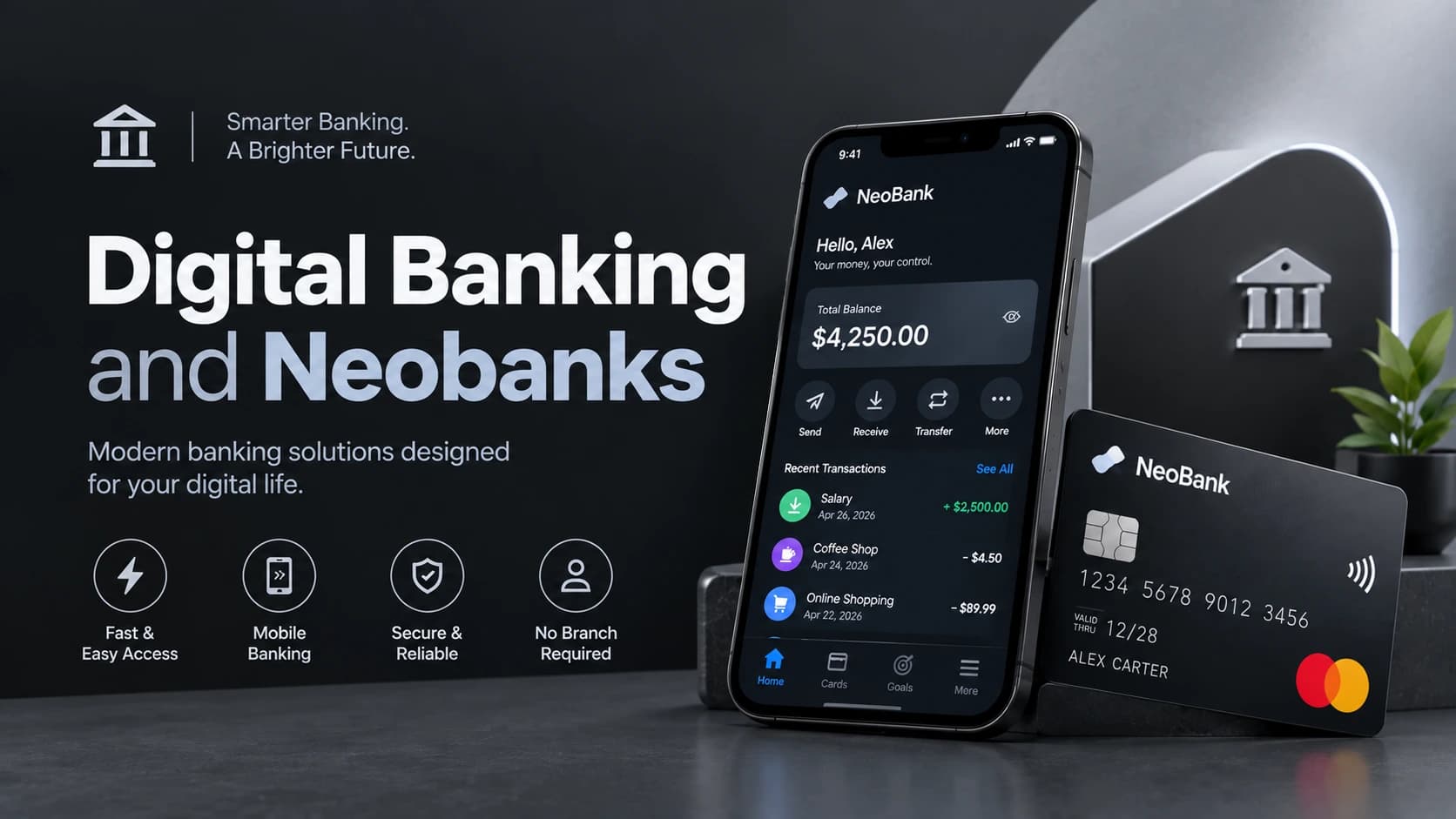
Digital Banking and Neobanks: A Complete Guide to Financial Technology in 2026
A generation ago, opening a bank account meant visiting a branch, filling out paperwork by hand, and waiting days for everything to process. Today, a person can open a fully functioning bank account from their couch in under five minutes, receive their paycheck two days early, and never once speak to a human being. This shift did not happen inside traditional banks. It happened because an entirely new category of financial institution, the neobank, rebuilt banking around the phone in someone's pocket rather than the branch on the corner.
This guide explains what digital banking and neobanks actually are, why this shift matters so much to everyday consumers and businesses, and walks through every major branch of the space, from full stack digital banks and banking as a service platforms to embedded finance and the AI powered tools now reshaping how people manage their money in 2026.
What Are Digital Banking and Neobanks
Digital banking refers to any banking activity conducted through an online or mobile channel rather than a physical branch, including checking a balance, transferring money, or applying for a loan through an app. Most traditional banks now offer some form of digital banking alongside their branches.
A neobank goes further. It is a financial institution built entirely around digital channels, with no physical branch network at all. Every part of the customer relationship, from opening an account to resolving a dispute, happens through an app or website. Neobanks are sometimes called digital only banks or challenger banks, since many of them positioned themselves from the start as a direct alternative to slower, fee heavy traditional banking.
It helps to separate neobanks into two structural models. A full stack neobank holds its own banking license and takes deposits directly, operating as a genuine, independently regulated bank. A second, increasingly common model involves a technology company partnering with a licensed bank behind the scenes, building the entire customer experience itself while the partner bank holds the actual deposits and regulatory responsibility. Both models can look identical to the customer using the app, but the underlying structure affects everything from deposit protection to how quickly new features can be launched.
Why Digital Banking and Neobanks Matter
This shift matters because it directly addresses problems that traditional banking left unresolved for a very long time.
It removes the cost of physical branches: Branch networks are expensive to build and maintain, and those costs are ultimately passed on to customers through fees and lower interest rates. Digital-only banks operate with a fraction of that overhead, which allows many of them to offer lower fees, higher savings rates, and simpler account terms than a traditional branch based bank.
It reaches people traditional banks overlook: Millions of people around the world have historically had no practical access to a bank account, either because no branch existed nearby or because minimum balance requirements and fees made a traditional account impractical. Mobile first digital banks have brought basic banking within reach of many of these people for the first time, using nothing more than a smartphone and an internet connection.
It moves money faster: Features such as early access to a paycheck, instant transfers between accounts, and real time spending notifications have become standard on digital banking platforms, replacing the multi day delays that were once simply accepted as how banking worked.
It gives customers more control and clarity: Digital banking apps typically show spending broken down by category, flag unusual charges immediately, and make it easy to freeze a card or set a savings goal, giving ordinary customers a level of visibility into their own finances that used to require a dedicated financial advisor.
It forces the entire banking industry to improve: Even large, well established banks have had to rebuild their own digital experiences and rethink their fee structures because customers now compare every bank against the best neobank app they have used, regardless of how large or established that bank is.
A Brief History of Digital Banking
Online banking itself is not new. Traditional banks began offering basic internet banking, mostly limited to checking balances and viewing statements, during the late 1990s. What changed the trajectory of the industry was the arrival of the smartphone and, shortly after, the 2008 financial crisis, which badly damaged public trust in large banks and created an opening for new entrants willing to build something different.
The first true neobanks emerged during the early 2010s, offering simple, free checking and savings accounts through sleek mobile apps, at a time when most traditional banks still treated their apps as a secondary feature bolted onto branch based banking. Early growth was concentrated among younger customers and people underserved by traditional banks, but as neobanks proved they could operate reliably at scale, adoption spread rapidly across nearly every demographic.
Through the late 2010s and into the 2020s, neobanks expanded well beyond basic checking accounts into lending, investing, and business banking, while a parallel industry of banking as a service provider emerged, allowing non bank companies to embed banking features directly into their own products. By 2026, digital only banking has moved from a niche alternative into one of the fastest growing segments of financial services worldwide, with total spending flowing through neobank accounts reaching well into the trillions of dollars globally.
The Core Branches of Digital Banking and Neobanking
Digital banking today spans a wide range of business models and services, each addressing a different part of a person's or business's financial life.
Full Stack Neobanks
Full stack neobanks hold their own banking license and manage the entire deposit relationship directly, rather than relying on a partner bank behind the scenes. This gives them more control over their own product roadmap and regulatory relationship, though obtaining a banking license is a lengthy, expensive process that has limited how many companies pursue this path. Full stack neobanks typically offer checking and savings accounts, debit cards, and increasingly, lending products built entirely on their own infrastructure.
Banking as a Service and Partner Bank Models
Many neobanks do not hold their own banking license at all. Instead, they partner with a licensed bank that holds deposits and manages regulatory compliance behind the scenes, while the neobank focuses entirely on building the app, the brand, and the customer experience. This model, often called banking as a service, has dramatically lowered the barrier to launching a digital banking product, since a company no longer needs to become a licensed bank itself to offer banking features to its customers.
Digital Only Savings and Checking Accounts
The most basic and widely used branch of neobanking involves straightforward digital checking and savings accounts, typically offering no monthly fees, no minimum balance requirements, and often a higher savings interest rate than a comparable account at a traditional branch based bank. Many of these accounts also include early direct deposit, allowing a customer to receive their paycheck up to a couple of days before the official pay date, a small feature that has become one of the most popular reasons people switch to a digital bank.
Digital Lending Within Neobanks
Many neobanks have expanded from simple deposit accounts into lending, including personal loans, lines of credit, and short term cash advances, using the transaction data they already collect to make faster, more personalized credit decisions than a traditional bank could using only a credit score. This tight integration between spending data and lending decisions allows some neobanks to extend credit more responsibly, adjusting limits or repayment terms based on a customer's actual real time financial situation rather than a static, backward looking credit history.
Business and SME Digital Banking
Digital banking has expanded well beyond individual consumers into dedicated business banking platforms built for freelancers, small businesses, and startups. These platforms typically combine a business checking account with invoicing, expense tracking, payroll, and tax preparation tools in a single interface, replacing the patchwork of separate software many small businesses previously relied on. This branch has grown quickly because small business owners often found traditional business banking slow, expensive, and poorly suited to how a modern small business actually operates.
Embedded Banking
Embedded banking allows a non-financial company to offer banking features, such as an account, a debit card, or instant payouts, directly within its own existing product, without customers ever needing to open a separate account elsewhere. A ride sharing app offering instant driver payouts into a built in digital wallet, or a marketplace offering sellers a business account tied directly to their sales dashboard, are both examples of embedded banking. This branch depends heavily on banking as a service infrastructure operating quietly behind the scenes.
Digital Wealth and Savings Tools
Many digital banks now include built in savings tools that go beyond a basic savings account, including automated round up savings that invest spare change from everyday purchases, goal based savings buckets, and in some cases, direct access to investment accounts within the same app used for everyday spending. This has blurred the line between neobanking and the broader wealth management branch of fintech, since a single app increasingly handles both daily spending and long term saving.
Cryptocurrency Integrated Banking
A growing number of neobanks now offer direct access to cryptocurrency trading, custody, and in some cases crypto backed spending cards, directly within the same app used for everyday banking. This allows a customer to hold both traditional currency and digital assets in one place, and increasingly to spend from either balance using the same card, rather than needing a completely separate platform to manage cryptocurrency.
AI Powered Financial Assistance
Artificial intelligence has moved from a background fraud detection tool into a visible, interactive feature within many digital banking apps. This includes chat-based assistants that can answer account questions instantly, automated insights that flag unusual spending or a bill increase before it becomes a problem, and increasingly, proactive recommendations that suggest moving money into savings when a customer's spending pattern suggests they can afford it.
International and Multi Currency Banking
Several neobanks have built their entire identity around serving customers who live, work, or travel across multiple countries, offering multi currency accounts, low cost international transfers, and fee free spending abroad. This branch has proven especially valuable for remote workers, frequent travelers, and immigrants who need to manage money across borders in a way that traditional single country banks were rarely designed to support.
The Technology Powering Digital Banking
Several underlying technologies show up repeatedly across nearly every branch of digital banking described above.
Cloud based core banking systems: allow digital banks to launch new features and scale to millions of customers far faster than the decades old mainframe systems many traditional banks still rely on internally.
Application programming interfaces: connect banking infrastructure to the apps, budgeting tools, and embedded finance products built on top of it, forming the technical foundation behind both banking as a service and open banking.
Digital identity verification: allows a new customer to open an account entirely online within minutes, using a photo identification document and a live selfie to confirm their identity, replacing the in person verification that branch based account opening once required.
Artificial intelligence: now supports fraud detection, credit decisions, and customer service simultaneously, often within the same platform, allowing digital banks to operate with far smaller support teams than a comparable traditional bank while still responding to customers quickly.
Security and Trust in Digital Banking
Trust is the single most important asset any bank has, digital or otherwise, and neobanks have had to work hard to establish it without the physical presence of a branch to reassure customers. Reputable digital banks rely on strong encryption, multi factor authentication, and real time fraud monitoring to protect customer accounts, and in most regulated markets, deposits held at a properly licensed neobank or its partner bank are protected by the same government deposit insurance that covers traditional bank accounts.
It remains important for customers to understand exactly which entity holds their deposits and what protection actually applies, since the relationship between a neobank brand and its underlying partner bank is not always obvious from the app itself.
Regulation of Digital Banking
Digital banks are subject to the same core banking regulations as traditional institutions including deposit protection rules, anti money laundering requirements, and consumer protection law, regardless of whether they hold their own banking license or operate through a partner bank. Regulators in many markets have paid particularly close attention to the banking as a service model in recent years, since a failure or oversight at a technology partner can create real risk for the customers of the neobank built on top of it, even though the underlying bank remains the licensed, regulated entity.
This regulatory attention has pushed many banking as a service providers and their neobank partners to invest heavily in stronger oversight and clearer accountability between the two sides of the relationship, rather than treating the partnership as a purely technical arrangement.
Challenges and Risks in Digital Banking
The rapid growth of digital banking has not eliminated every risk. Reliance on a partner bank creates a layer of complexity that can confuse customers about exactly who protects their money and who they should contact if something goes wrong. Customer support limitations remain a common complaint, since chat and email support can feel impersonal or slow compared to speaking with someone directly during a serious account problem. Profitability pressure has pushed some neobanks to expand quickly into lending and other revenue generating products, which introduces credit risk that a pure deposit account never carried. Cybersecurity threats remain a constant concern, since digital only banks are an attractive target for criminals seeking to exploit weaknesses in account opening or authentication.
The Future of Digital Banking and Neobanks in 2026 and Beyond
Several themes are shaping the next phase of digital banking. Competition has intensified sharply, as traditional banks have invested heavily in their own digital experiences to compete directly with neobanks, narrowing the gap that once made digital only banks feel clearly superior. At the same time, neobanks are expanding well beyond their original simple checking account offering into lending, investing, and even cryptocurrency, increasingly positioning themselves as a complete financial hub rather than a single product.
Artificial intelligence is becoming a deeper, more proactive part of the banking relationship, moving from answering questions when asked toward actively helping customers manage their money before a problem occurs. And embedded banking continues to spread further into everyday apps and platforms, meaning a growing share of banking activity in the future may happen inside products that were never built by a bank at all.
Final Thoughts
Digital banking and neobanks have fundamentally changed what people expect from a financial institution, shifting the standard from a nearby branch and a paper statement to an instant, personalized experience available entirely from a phone. Understanding the major branches of this industry, from full stack digital banks and banking as a service platforms to embedded finance and AI powered financial assistance, helps consumers choose the right account for their needs and helps businesses recognize where genuine opportunity still exists in one of the fastest growing corners of financial technology. The institutions that succeed going forward will be the ones that combine genuine technological convenience with real trust, rather than treating either one as optional.
Share this article