ISO 20022: How the Payments Standard Is Changing Banking
Learn what ISO 20022 is, how it differs from legacy MT messages, key message types, global migration timelines, benefits, challenges, and implementation steps.
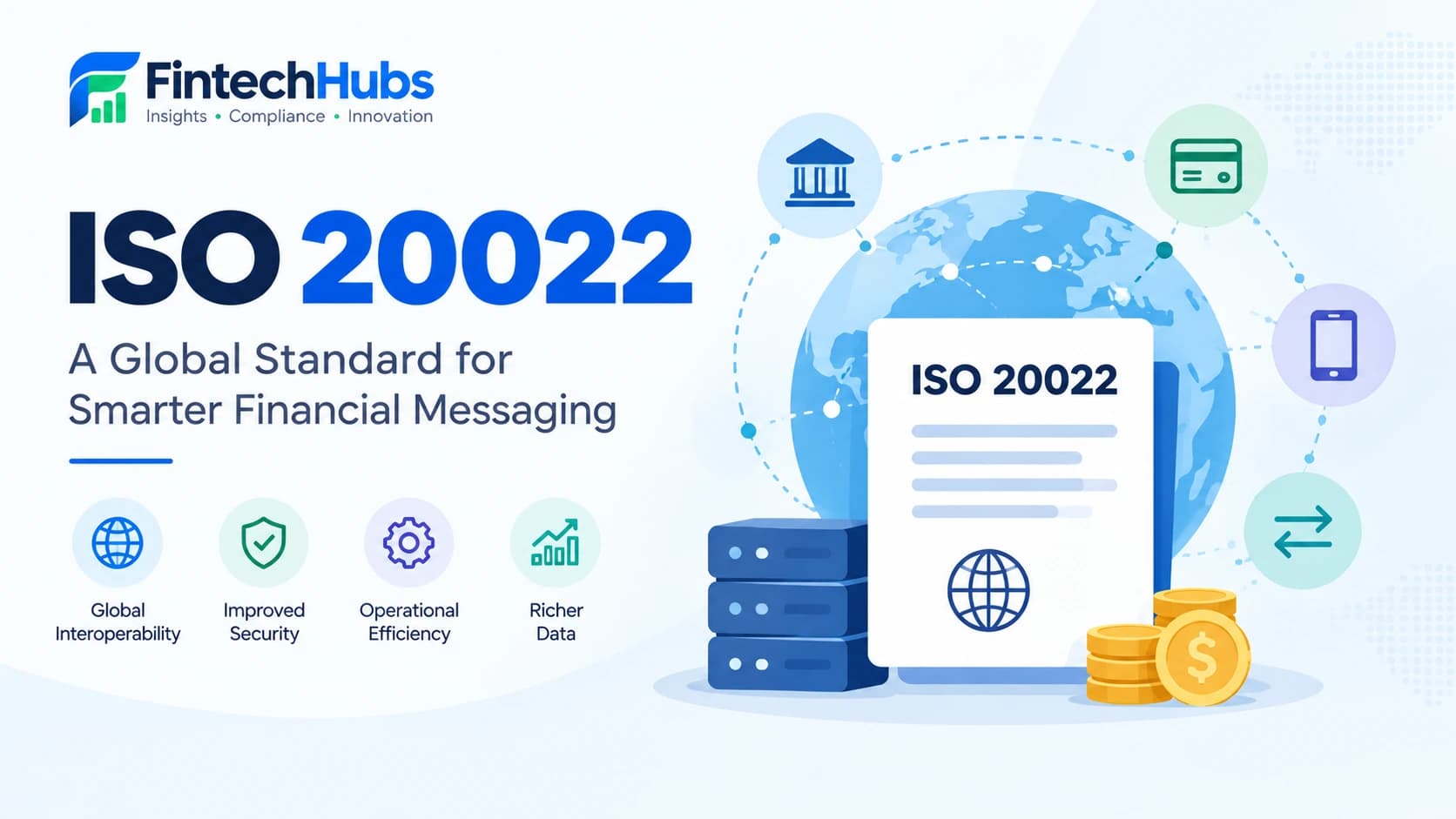
ISO 20022: How the Global Payments Messaging Standard Is Transforming Banking
Behind every payment is a message: a structured set of data telling banks who is paying, who is being paid, how much, and why. For decades, much of the world's cross-border and high-value payment traffic used message formats designed in the 1970s, with tight length limits and limited fields. As payments became faster, more digital, and more closely scrutinized, those formats struggled to carry the information institutions needed.
ISO 20022 is the global standard designed to solve that problem. It provides a common language and a richer data model for financial messages, and it has become the foundation of major payment systems worldwide. For banks, corporates, fintechs, and regulators, understanding ISO 20022 is now part of understanding modern payments.
This guide explains what ISO 20022 is, how it works, what it changes in practice, where it has been adopted, and what challenges and opportunities it brings.
This article is for general informational and educational purposes only. It does not constitute legal, technical, financial, or compliance advice. Migration dates and market rules change; verify current details with the relevant payment system operators, standards bodies, and your providers.
What Is ISO 20022
ISO 20022 is an international standard for developing financial messages. It defines a methodology and a central repository that cover business processes, data elements, and message formats, so different financial communities can exchange information consistently.
Key characteristics:
Data-rich: Supports detailed, structured information
XML-based: Messages are commonly expressed in XML, with other syntaxes possible
Model-driven: Built from a business model, so messages are consistent across domains
Extensible: New message types can be developed and registered
Cross-domain: Covers payments, securities, trade services, cards, and foreign exchange
It is a standard for how information is described and exchanged, not a payment network itself.
A Brief History and Governance
ISO 20022 was developed under the International Organization for Standardization (ISO), through its technical committee on financial services, with the aim of creating a single, universal approach to financial messaging. A registration authority maintains the central repository of messages and data dictionary, and standards evaluation groups from different industries propose and review message sets.
Early adoption came through the Single Euro Payments Area (SEPA), which used ISO 20022 XML formats for credit transfers and direct debits. Over the following years, central banks, market infrastructures, and global messaging networks began planning wider migrations, leading to the large-scale transitions seen in the 2020s.
Why ISO 20022 Matters
Richer information: More data per payment improves clarity, reconciliation, and risk assessment.
Global common language: Reduces translation between regional and legacy formats.
Support for real-time and instant payments: Many modern systems are built on it.
Better compliance and screening: Structured data supports more accurate sanctions and anti-money laundering checks.
Automation: Structured, machine-readable data enables straight-through processing.
Interoperability: A shared standard makes it easier to connect systems across borders and institutions.
Innovation foundation: Supports new services such as enhanced remittance information and data-driven products.
ISO 20022 vs. Legacy Messaging Standards
Dimension | Legacy Formats (e.g., MT messages) | ISO 20022 |
|---|---|---|
Structure | Field-based, fixed formats | XML-based, hierarchical, structured |
Data richness | Limited, with tight length limits | Extensive, with many structured fields |
Party identification | Often free text | Structured names, addresses, identifiers (such as LEI) |
Remittance information | Limited length | Much larger and structured remittance data |
Purpose of payment | Limited | Purpose codes and detailed fields |
Machine readability | Lower, often needing parsing | Higher, supports automation |
Extensibility | Limited | Designed for extension |
Global consistency | Fragmented by region and use | Common model across domains |
How ISO 20022 Works
ISO 20022 follows a layered approach:
Business model: Business processes, roles, and data requirements are modeled.
Data dictionary: Reusable data elements (such as "debtor," "amount," "currency") are defined once and reused.
Message definitions: Messages are built from dictionary components for specific purposes, such as a customer credit transfer.
Syntax: Messages are expressed in a technical format, most commonly XML.
Implementation guidelines: Market practice groups and payment systems publish usage rules specifying which fields are mandatory, optional, or restricted for each scheme.
Because the same core model supports many message types, institutions can reuse data and logic across payments, reporting, and other processes.
Key Message Families and Examples
ISO 20022 message identifiers use a four-letter prefix indicating the business area, followed by numbers indicating the specific message and version.
Family | Area | Common Examples |
|---|---|---|
pain | Payments initiation | pain.001 customer credit transfer initiation; pain.002 payment status report; pain.008 direct debit initiation |
pacs | Payments clearing and settlement | pacs.008 financial institution credit transfer; pacs.009 financial institution transfer; pacs.002 status report; pacs.004 payment return |
camt | Cash management | camt.053 bank-to-customer statement; camt.052 account report; camt.054 debit/credit notification; camt.056 payment cancellation request |
acmt | Account management | Account opening and maintenance messages |
other families | Securities, trade, cards, FX | Messages for settlement, corporate actions, and more |
Specific versions and usage rules differ by payment system.
Richer Data: What Changes in Practice
Structured party details: Names, addresses, and identifiers can be separated into fields rather than lumped into free text.
Legal Entity Identifiers (LEIs): Can be carried to identify organizations unambiguously.
Purpose codes and categories: Provide context on why a payment is made.
Extended remittance information: Can carry invoice numbers, references, and structured details to support automatic reconciliation.
Ultimate parties: Can identify the ultimate debtor and creditor behind intermediaries.
Clear charge and exchange rate information: Improves transparency of fees and currency conversion.
End-to-end identifiers: Help track a payment through its lifecycle.
Better status and reason codes: Improve exception handling and customer communication.
Global Adoption and Major Migrations
Adoption has been phased across regions and systems. Major milestones widely reported include (verify current status):
SEPA: Long based on ISO 20022 formats.
Eurozone large-value payments: The Eurosystem's large-value payment system moved to ISO 20022 with its consolidated platform in 2023.
United Kingdom: CHAPS and the Bank of England's real-time gross settlement infrastructure moved to ISO 20022 as part of its renewal.
Global cross-border messaging: The SWIFT network's Cross-Border Payments and Reporting Plus (CBPR+) usage guidelines began a coexistence period with legacy messages in 2023, with legacy-format cross-border payment instructions scheduled to end in November 2025.
United States: The Fedwire Funds Service and CHIPS migrated to ISO 20022, with Fedwire's migration taking place in 2025.
Instant payment systems: Many real-time schemes, such as FedNow, SEPA Instant, and several Asia-Pacific systems, use ISO 20022 natively.
Other markets: Numerous countries in Asia-Pacific, the Middle East, Africa, and Latin America have adopted or are adopting ISO 20022 for domestic payment systems.
Timelines and usage rules differ by system, and some markets use customized "flavors" of the standard.
Benefits for Banks, Corporates, and Consumers
For banks and financial institutions
Improved straight-through processing and fewer manual repairs
Better data for screening, risk, and analytics
Reduced translation between formats over time
A foundation for new data-driven services
For corporates and treasurers
Automated reconciliation using richer remittance data
Clearer statements and status information
Better cash visibility and forecasting
Easier integration with ERP and treasury systems
For consumers and small businesses
Potentially faster and more transparent payments
Fewer errors and rejected payments
Better payment tracking and information
For regulators and the ecosystem
More consistent data for supervision and financial crime detection
A common standard supporting interoperability
Actual benefits depend on how fully institutions use the richer data, not just on adopting the format.
Use Cases
Cross-border payments: Richer data and structured details to support compliance and reconciliation
High-value and real-time gross settlement systems: The core of interbank settlement
Instant payments: Structured messages and status reporting suited to 24/7 processing
Corporate payments and cash management: Payment initiation and statements
Direct debits and bulk payments: Payroll, supplier payments, and collections
Reconciliation automation: Matching payments to invoices
Sanctions and AML screening: Better party and purpose data
Securities and trade settlement: Extension of the standard to other domains
Regulatory reporting and analytics: More consistent data for reporting
Challenges and Risks
Complexity and cost: Upgrading core systems, interfaces, and testing is resource-intensive.
Legacy system limits: Older platforms may not store or process richer data.
Fragmented implementation: Different market practices and usage rules create variations.
Data truncation and loss: Conversion between formats can drop information.
Data quality: Richer messages only help if institutions populate fields correctly.
Dependence on counterparties: Benefits are limited if other banks do not provide quality data.
Operational risk during migration: Testing gaps can cause payment failures or delays.
Skills shortages: Need for expertise in the standard and in data modeling.
Screening impacts: Changes in data structure can affect sanctions and fraud tools.
Customer readiness: Corporates and software providers also need to adapt.
Coexistence, Translation, and Data Truncation
During migrations, systems using older and newer formats must interoperate. Messages are translated between formats, which can create problems:
Truncation: ISO 20022 fields may carry more data than legacy fields can hold, so information may be shortened or dropped when converting back.
Mapping differences: Fields do not always align one-to-one.
Inconsistent results: Different translation rules may produce different outputs.
Loss of structure: Structured data may be flattened into free text.
Institutions typically manage this through in-flight translation services, careful mapping documentation, testing, and retaining the original message for audit. The longer-term goal is end-to-end ISO 20022 so that fewer conversions are needed.
Structured Addresses and Data Quality
A key practical change is the move from free-text addresses to structured address fields, such as town, country, and postal code in separate elements. Global cross-border payments guidance has moved toward phasing out fully unstructured addresses, with a transition period that extends into 2026. Check current usage guidelines for exact rules and dates.
Institutions should:
Clean and structure customer address data at source
Validate required fields before sending
Align customer onboarding forms to collect structured data
Monitor rejections and repairs related to data quality
Educate corporate clients who originate payments
Better data at the start reduces repairs, delays, and screening false positives later.
Compliance, Sanctions, and Financial Crime Implications
Richer, structured data can strengthen compliance, but it also requires adjustments:
More precise screening: Separate fields for names, addresses, and purposes can reduce false positives and improve match quality.
Better transaction monitoring: More context supports behavioral analysis and typology detection.
LEI and ultimate party information: Can reveal hidden relationships.
Travel Rule and AML data requirements: Structured fields align with requirements to carry originator and beneficiary information.
Tool updates needed: Screening and monitoring systems must be configured and tested to interpret new fields.
Data protection: Richer personal data increases the importance of privacy and security controls.
Audit trails: Retaining original messages supports investigations and regulatory inquiries.
Implementation Roadmap for Financial Institutions
Phase 1: Assess and plan: Inventory payment flows, systems, message types, and dependencies. Identify which markets, schemes, and counterparties are affected and their deadlines.
Phase 2: Gap analysis: Compare current data and system capabilities with required ISO 20022 usage guidelines.
Phase 3: Architecture and design: Decide on approach: native ISO 20022 core, translation layers, or hybrid. Design data models and mapping rules.
Phase 4: Data remediation: Improve customer and counterparty data, especially addresses and identifiers.
Phase 5: Build and integrate: Upgrade payment hubs, interfaces, screening, reporting, and reconciliation systems.
Phase 6: Testing: Conduct internal, network, and counterparty testing, including edge cases, rejections, and cancellations.
Phase 7: Migration and cutover: Use phased or pilot rollouts where possible, with contingency plans.
Phase 8: Optimize: Use richer data for automation, analytics, and new services, and monitor performance.
Best Practices
Start early and plan by market and scheme, since rules and dates differ.
Engage corporate clients and ERP providers Well before changes affect them.
Prioritize data quality, especially structured addresses and party identifiers.
Minimize reliance on translation, and document mapping rules carefully.
Retain original messages for audit and dispute resolution.
Test screening and monitoring systems with the new data formats.
Use market practice documentation and official usage guidelines.
Build cross-functional teams across payments, technology, compliance, operations, and client management.
Monitor exceptions and repairs after go-live and fix root causes.
Look beyond compliance and use the new data to improve reconciliation, analytics, and customer service.
Maintain governance over changes as standards and market practices evolve.
Technology and Vendor Landscape
Solutions typically fall into these categories:
Payment hubs and core payment engines with native ISO 20022 support
Translation and mapping services for coexistence periods
Messaging network and gateway providers
Screening, monitoring, and fraud platforms updated for ISO 20022 data
Data quality and address validation tools
Testing and simulation tools
ERP and treasury management systems updated for corporate payment formats
Consulting and systems integrators specializing in migration programs
When selecting tools, consider conformity with relevant market usage guidelines, support for multiple schemes, performance at scale, data lineage, and vendor roadmap. This article provides an independent overview and does not promote or recommend any particular software vendor.
Future Trends
Completion of migrations and reduction of translation reliance
Broader adoption in instant and domestic payment schemes worldwide
Greater use of structured data for analytics, AI, and fraud detection
Richer remittance and invoice-level data enabling automated reconciliation and new services
Further harmonization of market practice and fewer local variations
Integration with digital identity and LEI adoption
Support for new payment forms, including programmable payments and tokenized value, using extensible messaging
Cross-border interlinking of instant payment systems using common data standards
Stronger focus on data governance and privacy as more detail travels with payments
Frequently Asked Questions
1. What is ISO 20022?
It is an international standard for financial messaging that defines a common data model and message formats, allowing richer, more structured information to be exchanged in payments and other financial processes.
2. Is ISO 20022 a payment system?
No. It is a messaging standard. Payment systems and networks use it to carry instructions and information.
3. How is ISO 20022 different from older formats like MT messages?
Legacy formats are field-based with tight limits. ISO 20022 is structured, XML-based, and supports much more detailed data, including structured addresses, identifiers, and remittance information.
4. Which payment systems use ISO 20022?
Many, including SEPA schemes, major large-value systems in Europe, the UK, and the US, numerous instant payment systems, and global cross-border messaging through updated network usage guidelines. Check each system for current status.
5. Does ISO 20022 make payments faster?
Not by itself. It supports automation and fewer manual repairs, which can speed processing, but speed also depends on the underlying payment rail and operating hours.
6. What are the main message families?
Common ones include pain (payment initiation), pacs (clearing and settlement), and camt (cash management and reporting).
7. What is data truncation and why does it matter?
When richer ISO 20022 data is converted to a legacy format, extra information may be shortened or dropped. This can affect screening, reconciliation, and audit unless managed carefully.
8. Do businesses and corporations need to do anything?
Often yes. Corporates may need to update ERP or treasury systems and provide structured data, such as addresses and references, to their banks.
9. Why are structured addresses important?
They allow more accurate processing and screening, reduce errors, and align with updated cross-border usage rules phasing out fully unstructured addresses.
10. Is ISO 20022 only about banks?
No. It also affects corporates, fintechs, payment processors, software vendors, regulators, and the securities and trade finance industries.
Conclusion
ISO 20022 represents one of the most significant shifts in how financial information moves. By replacing limited legacy formats with a rich, structured, and extensible standard, it enables better automation, stronger compliance, more reliable reconciliation, and a foundation for new data-driven services. The migration is demanding, requiring investment in systems, data quality, testing, and coordination across counterparties. Institutions that go beyond basic compliance and actually use the richer data will gain the most. As adoption deepens and translation falls away, ISO 20022 is set to become the common language of global payments.
Disclaimer: This article is provided for general informational and educational purposes only. It does not constitute legal, technical, financial, or compliance advice. Migration dates, usage guidelines, and market rules change; verify current details with payment system operators, standards bodies, and your providers before acting.
Share this article
Related Articles
Soft vs Hard Declines: Advanced Payment Recovery Guide
Soft vs hard declines explained: Visa and Mastercard retry rules, smart retries, network tokens, 3-D Secure, dunning, recovery metrics, and 10 FAQs.
Interlinking Instant Payment Systems Across Countries
How countries link instant payment systems: bilateral links, Nexus, UPI-PayNow, risks, compliance, operations, a rollout roadmap, and 10 FAQs.
PCI DSS 4.0.1: Technical Requirements for Modern Payments
PCI DSS 4.0.1 explained: 12 requirements, MFA, payment page scripts, cloud and API compliance, scope reduction, a rollout roadmap, and 10 FAQs.