Regulatory Bodies in Asia: Financial & FinTech Guide
A complete guide to Asia's financial and fintech regulators key bodies in Singapore, China, India, Japan and more, regulatory sandboxes, and 10 FAQs.
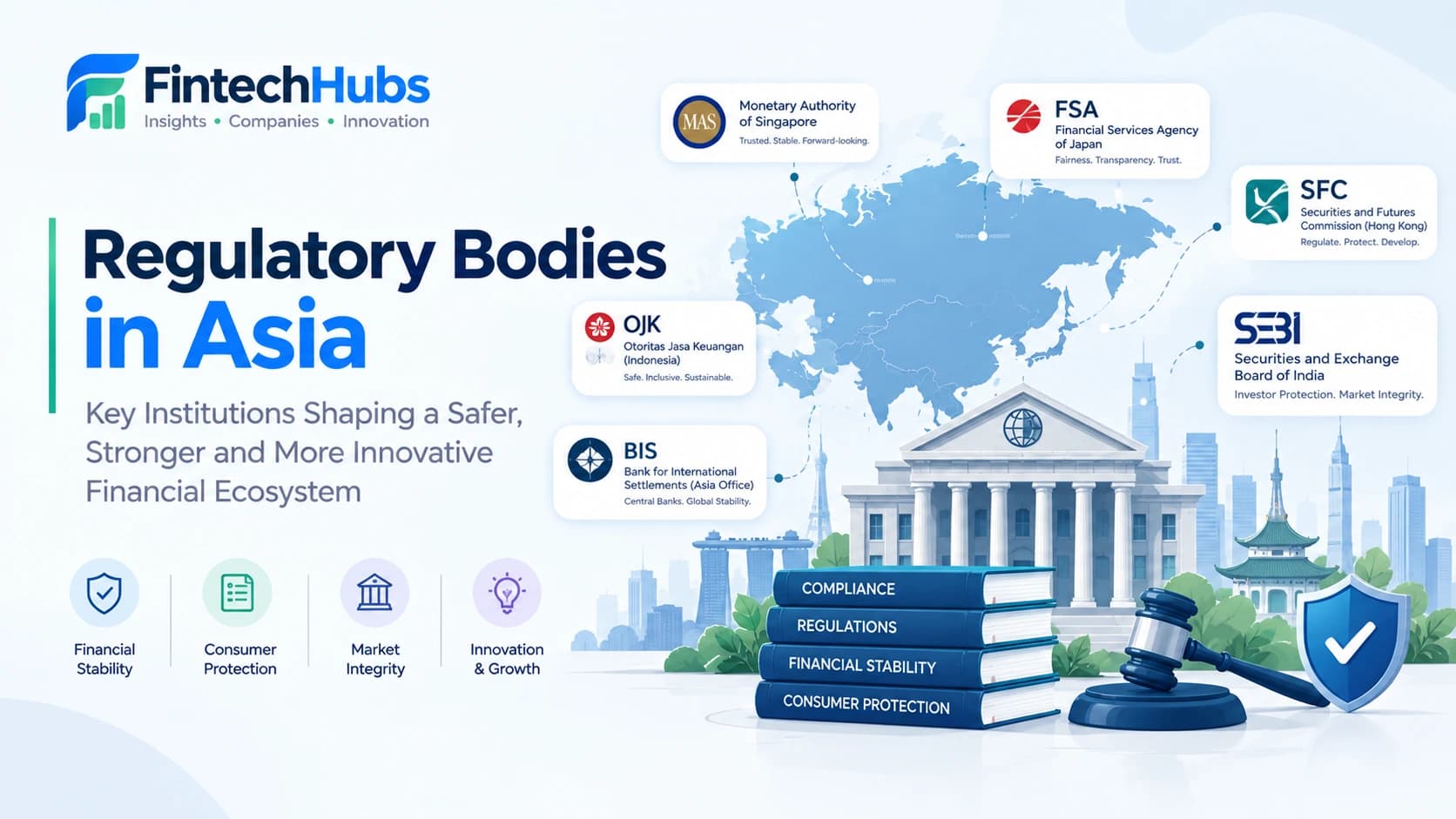
Regulatory Bodies in Asia: A Guide to Financial and FinTech Regulation
Asia is not a single regulatory market. It is a collection of some of the world's most dynamic, fast-growing, and individually distinct financial systems, from Singapore's tightly coordinated single-regulator model to China's large and complex multi-agency structure, from Japan's long-established supervisory framework to India's rapidly digitizing financial sector overseen by several specialized bodies. For a fintech company looking to expand across the region, there is no single "Asian regulator" to satisfy. Instead, success depends on understanding a patchwork of national authorities, each with its own licensing processes, risk appetite, and approach to innovation.
This guide offers a complete, professional overview of the regulatory bodies shaping financial services and fintech across Asia: the key national regulators in major markets, regional coordination efforts, the sector-specific oversight fintech companies most often encounter, and where financial regulation across the region is heading.
Regulatory structures, mandates, and specific regulations referenced in this guide evolve over time and vary significantly by country. Readers should always verify current details directly with the relevant regulatory body or official government sources before making compliance decisions.
Why Understanding Asian Regulatory Bodies Matters
Asia's financial regulatory landscape differs from more harmonized regions in a few important ways:
No single regional framework: Unlike the European Union's harmonized approach, there is no equivalent pan-Asian financial regulatory body with binding authority across the region, meaning each country must generally be approached as its own distinct regulatory jurisdiction.
Wide variation in regulatory maturity and approach: Some markets have developed sophisticated, fintech-specific regulatory frameworks and sandboxes, while others are still building out foundational digital finance regulation.
Rapid digital finance growth: Many Asian markets have experienced extremely fast growth in mobile payments, digital banking, and fintech adoption, often outpacing the development of formal regulatory frameworks and requiring regulators to adapt quickly.
Significant market diversity: The region spans highly developed financial centers, large emerging economies, and markets at earlier stages of financial infrastructure development, each requiring a different regulatory engagement strategy.
The Structure of Financial Regulation Across Asia
Financial regulation across Asia generally follows one of a few structural models:
Single integrated regulator models: Where one central authority oversees most or all financial sectors, as seen in markets such as Singapore, aiming for regulatory consistency and streamlined oversight.
Multi-agency models: Where separate regulators oversee banking, securities, insurance, and sometimes payments or fintech specifically, as seen in markets such as China, India, and Japan, often requiring fintech companies to engage with multiple bodies depending on their specific activities.
Central bank-led models: Where the national central bank plays an unusually central role in overseeing not just monetary policy and banking, but also payments systems and, increasingly, fintech innovation more broadly.
Because there is no binding regional framework equivalent to the EU, companies expanding across multiple Asian markets generally need to treat each country as a largely separate regulatory and licensing exercise, even when pursuing similar fintech activities.
Key Regulatory Bodies by Major Market
This is a representative, not exhaustive, overview of regulators in several of the region's most significant financial and fintech markets.
Singapore
Monetary Authority of Singapore (MAS): Singapore's integrated financial regulator, overseeing banking, securities, insurance, and payments, and widely regarded as one of the more fintech-forward regulators in the region, known for its regulatory sandbox and proactive engagement with fintech innovation.
China
People's Bank of China (PBOC): The central bank, with significant authority over payments systems and monetary policy. National Financial Regulatory Administration (NFRA) — the body responsible for broader financial sector regulation following a restructuring of China's financial oversight framework. China Securities Regulatory Commission (CSRC): The regulator overseeing securities and capital markets.
Japan
Financial Services Agency (FSA): Japan's primary financial regulator, overseeing banking, securities, insurance, and increasingly, crypto-asset and fintech-related activities. Bank of Japan (BOJ) — the central bank, with responsibilities including payments system oversight.
India
Reserve Bank of India (RBI): The central bank, with extensive authority over banking, payments, and non-banking financial companies, and a particularly active role in shaping digital payments regulation. Securities and Exchange Board of India (SEBI) the regulator overseeing securities markets and investment-related activities. Insurance Regulatory and Development Authority of India (IRDAI) — the insurance sector regulator, relevant to insurtech companies.
Hong Kong
Hong Kong Monetary Authority (HKMA): The de facto central bank and primary banking regulator, also active in fintech-related initiatives including virtual banking licenses. Securities and Futures Commission (SFC) — the regulator overseeing securities markets, including increasing oversight of crypto-asset trading platforms.
South Korea
Financial Services Commission (FSC): South Korea's top financial policymaking body. Financial Supervisory Service (FSS) — the body responsible for day-to-day supervision and enforcement across the financial sector.
Indonesia
Otoritas Jasa Keuangan (OJK), the Financial Services Authority: Indonesia's integrated financial regulator, overseeing banking, capital markets, insurance, and fintech lending. Bank Indonesia — the central bank, with authority over payments systems and monetary policy.
Malaysia
Bank Negara Malaysia (BNM): the central bank, with broad authority over banking and payments, and an active role in fintech regulation including digital banking licenses. Securities Commission Malaysia (SC) — the regulator overseeing securities markets and certain digital asset activities.
Philippines
Bangko Sentral ng Pilipinas (BSP): the central bank, overseeing banking and payments, including digital bank licensing. Securities and Exchange Commission (SEC) of the Philippines — the regulator overseeing securities and certain fintech lending activities.
Vietnam
State Bank of Vietnam (SBV): the central bank, with primary authority over banking and payments regulation in a rapidly developing fintech market.
Thailand
Bank of Thailand (BOT): the central bank, overseeing banking and payments, including an active regulatory sandbox program. Securities and Exchange Commission (SEC) Thailand the regulator overseeing securities and digital asset activities.
Regional and Cross-Border Coordination Bodies
While Asia lacks a single binding regional regulator, several bodies support coordination and information sharing:
ASEAN (Association of Southeast Asian Nations): Facilitates broader economic and, increasingly, financial sector cooperation among Southeast Asian member states, including efforts toward payment system connectivity.
Asian Development Bank (ADB): Supports financial sector development and digital finance initiatives across the region, though it is not a regulator itself.
Financial Stability Board (FSB) regional consultative groups: Provide a forum for regulatory dialogue and coordination on financial stability issues among Asian regulators and global standard-setters.
Bilateral and multilateral fintech cooperation agreements: Many Asian regulators, such as the MAS, have signed fintech cooperation agreements with counterparts both within and outside the region to support innovation and information sharing.
These bodies generally support dialogue and coordination rather than imposing binding, harmonized rules, meaning individual national regulation remains the primary compliance reference point for fintech companies.
Regulatory Bodies for Specific FinTech Sectors
Digital Payments
Payments regulation across Asia is typically overseen by national central banks, often through specific payment services licensing regimes, given the region's significant growth in mobile and digital payment adoption.
Digital Banking and Virtual Banks
Several Asian markets, including Hong Kong, Singapore, Malaysia, and the Philippines, have introduced specific virtual or digital banking license frameworks, generally overseen by the relevant central bank or integrated financial regulator.
Crypto-Assets and Digital Assets
Approaches to crypto-asset regulation vary significantly across Asia, from more developed licensing frameworks in markets like Singapore, Japan, and Hong Kong, to more restrictive or still-developing approaches elsewhere, generally overseen by securities regulators, central banks, or a combination of both depending on the specific market.
Fintech Lending and Peer-to-Peer Lending
Markets such as Indonesia, China, and India have developed specific regulatory frameworks for fintech and peer-to-peer lending platforms, often overseen by securities or financial services regulators given concerns about consumer protection in this sector.
Insurtech
Insurance-specific regulators, such as IRDAI in India or relevant divisions within integrated regulators like MAS, oversee insurtech activities, often alongside broader insurance sector rules.
Major Regulatory Frameworks and Approaches Across Asia
Because Asia does not share a single unified legal framework, this section highlights general regulatory approaches and themes rather than specific legislation, which varies significantly by country:
Payment services licensing regimes, present in most major Asian markets, generally requiring fintech payment companies to obtain specific licenses based on the scope of services offered
Virtual and digital banking license frameworks, introduced by several markets to allow fully digital banks to operate alongside traditional institutions
Data protection and privacy laws, which have expanded significantly across the region in recent years, with many countries introducing comprehensive data protection frameworks relevant to fintech data handling
Anti-money laundering frameworks, generally aligned with international standards set by global bodies, though implementation and enforcement intensity vary by market
Open banking and data-sharing initiatives, which are in earlier and more varied stages of development across Asia compared to some other regions, with certain markets further along than others
Crypto-asset and virtual asset service provider licensing, an area of particularly rapid regulatory development across multiple Asian markets in recent years
Branches and Focus Areas of Asian Financial Regulation
A. Banking and Prudential Supervision
Ensuring banks and, increasingly, digital-only banks maintain adequate capital and risk management practices, generally overseen by national central banks or integrated regulators.
B. Securities and Capital Markets Regulation
Governing investment services, trading platforms, and increasingly, digital asset trading, generally overseen by dedicated securities regulators in most markets.
C. Payments Regulation
Covering the licensing and supervision of payment service providers, a particularly active and fast-evolving area given the region's rapid digital payments growth.
D. Insurance Regulation
Overseeing insurance providers and increasingly insurtech companies, generally through dedicated insurance regulators or divisions within integrated authorities.
E. Anti-Money Laundering and Financial Crime
Addressing money laundering and terrorist financing risks, generally aligned with international standards but implemented through national frameworks and enforcement bodies.
F. Data Protection and Privacy
Governing how fintech companies collect, process, and protect customer data, an area that has seen significant regulatory development across the region in recent years.
G. Crypto-Asset and Digital Asset Regulation
A rapidly evolving area with significant variation in approach, from comprehensive licensing frameworks in some markets to more restrictive or still-developing approaches in others.
H. Fintech Innovation and Sandbox Programs
Covering the regulatory sandbox and innovation support programs many Asian regulators have introduced to allow controlled testing of new fintech products.
I. Consumer Protection
Addressing fair treatment of financial services consumers, an increasingly significant focus as digital lending and payments adoption has grown rapidly across the region.
Why This Regulatory Landscape Matters for FinTech Companies
Market Entry Complexity
Because there is no single regional framework, fintech companies expanding across Asia generally need distinct licensing and compliance strategies for each target market, requiring more extensive planning than expansion within a more harmonized region.
Varying Levels of Regulatory Support for Innovation
Some Asian regulators, such as Singapore's MAS, are widely regarded as particularly proactive in supporting fintech innovation, while others take a more cautious or still-developing approach, making regulator-specific research essential to market entry planning.
Significant Market Opportunity
Asia includes some of the world's fastest-growing fintech markets, particularly in digital payments and financial inclusion-focused services, making the region strategically important despite its regulatory complexity.
Risk of Regulatory Gaps or Rapid Change
Because some fintech sectors, particularly crypto-assets and digital lending, have seen rapid regulatory development in response to fast market growth, companies need to actively monitor for new rules that may significantly affect previously less-regulated activities.
Cultural and Administrative Considerations
Beyond formal regulation, successful market entry in many Asian markets often requires understanding local business culture, language considerations, and relationship-based aspects of regulatory engagement that may differ from more process-driven regulatory interactions elsewhere.
Regulatory Sandboxes Across Asia
Many Asian financial regulators have introduced regulatory sandbox programs, allowing fintech companies to test innovative products and services within a controlled environment and with regulatory relief from certain requirements, before full licensing is required. Notable examples include:
Singapore's MAS Regulatory Sandbox: Widely regarded as one of the more established and well-utilized programs in the region
Hong Kong's Fintech Supervisory Sandbox: Supporting innovation testing under HKMA and SFC oversight
Thailand's Bank of Thailand Regulatory Sandbox: Supporting payments and broader fintech innovation testing
Malaysia's Financial Technology Regulatory Sandbox: Overseen by Bank Negara Malaysia
Indonesia's OJK Regulatory Sandbox: Supporting fintech lending and broader digital finance innovation
These programs reflect a broader regional trend of regulators seeking to balance innovation support with consumer protection and financial stability, and they can offer fintech companies a valuable, lower-risk pathway to testing products in a new market before committing to full licensing.
Challenges of Operating Across Asian Regulatory Bodies
Absence of regional harmonization, requiring largely separate compliance strategies for each market rather than a single passportable license
Significant variation in regulatory maturity, with some markets offering sophisticated, fintech-specific frameworks and others still developing foundational digital finance regulation
Rapid regulatory change in fast-growing sectors, particularly crypto-assets and digital lending, requiring continuous monitoring
Language and administrative barriers, since many regulators operate primarily in their national language, adding complexity for international fintech companies
Varying enforcement intensity and regulatory culture, which can differ significantly from one market to another even when formal rules appear similar
Currency, capital control, and cross-border data transfer restrictions, which can add complexity beyond core financial licensing requirements in certain markets
Best Practices for FinTech Companies Navigating Asian Regulation
Engage experienced local legal and regulatory counsel in each target market, given the significant variation in regulatory approach across the region
Research and consider regulatory sandbox programs as a lower-risk entry pathway where available and appropriate
Prioritize market entry sequencing based on regulatory readiness, market opportunity, and the company's specific fintech activity
Build compliance processes flexible enough to accommodate significantly different requirements across markets, rather than assuming a single regional approach will work
Monitor regulatory developments closely in fast-evolving sectors such as crypto-assets and digital lending
Invest in understanding local business culture and relationship-based aspects of regulatory engagement, not just formal legal requirements
Consider partnering with local financial institutions or licensed entities where direct licensing is complex or still-developing
Future Trends to Watch
Continued rapid growth in digital payments regulation: As mobile and digital payments adoption continues to grow rapidly across the region, expect continued regulatory development and refinement in this area.
Expanding crypto-asset and digital asset frameworks: Several Asian markets are expected to continue developing and refining crypto-asset regulation, potentially narrowing, though likely not eliminating, the significant variation currently seen across the region.
Growing regional cooperation on specific initiatives: While a binding regional framework is unlikely in the near term, expect continued growth in specific cooperative initiatives, such as cross-border payment connectivity projects among several Southeast Asian markets.
Increased focus on financial inclusion-driven regulation: Given the significant role fintech plays in expanding financial access across parts of Asia, expect continued regulatory attention to balancing innovation with consumer protection in underserved market segments.
Expansion of digital and virtual banking frameworks: More markets are expected to continue developing or refining digital banking license frameworks as this model matures across the region.
Growing attention to AI governance in financial services: As artificial intelligence plays a larger role in lending, fraud detection, and financial advice across Asian fintech markets, expect increasing regulatory attention to AI-specific governance and accountability requirements.
Frequently Asked Questions
1. Is there a single regulatory body that oversees fintech across all of Asia?
No. Unlike some other regions, Asia does not have a single binding regional financial regulator. Each country maintains its own national regulatory authorities, requiring fintech companies to navigate each market largely independently.
2. Which Asian regulator is considered the most fintech-friendly?
Singapore's Monetary Authority of Singapore (MAS) is widely regarded as one of the more proactive and fintech-supportive regulators in the region, known for its regulatory sandbox and active engagement with the fintech industry, though several other markets have also developed increasingly supportive frameworks.
3. What is a regulatory sandbox, and which Asian countries offer one?
A regulatory sandbox allows fintech companies to test innovative products in a controlled environment with certain regulatory flexibility before obtaining full licensing. Several Asian markets, including Singapore, Hong Kong, Thailand, Malaysia, and Indonesia, offer established sandbox programs.
4. How does crypto-asset regulation differ across Asia?
Approaches vary significantly, ranging from more developed licensing frameworks in markets like Singapore, Japan, and Hong Kong to more restrictive or still-developing approaches in other markets. Companies should research the specific current approach in each target market rather than assuming a consistent regional standard.
5. Which regulators oversee digital payments in major Asian markets?
This is typically the responsibility of each country's central bank, such as the Monetary Authority of Singapore, the Reserve Bank of India, Bank Indonesia, or the Bangko Sentral ng Pilipinas, often through specific payment services licensing regimes.
6. Do fintech companies need separate licenses for each Asian country they operate in?
Generally, yes. Because there is no regional passporting system comparable to the EU, fintech companies typically need to obtain separate licenses or approvals in each country where they conduct regulated financial activities.
7. What is the role of central banks in Asian fintech regulation?
Central banks across Asia often play an unusually central role, not only in monetary policy and banking supervision but also in payments regulation and, in several markets, broader fintech innovation support, sometimes more extensively than in other global regions.
8. How significant is data protection regulation for fintech companies in Asia?
Data protection regulation has expanded significantly across the region in recent years, with many countries introducing comprehensive data protection frameworks that directly affect how fintech companies must handle customer data, making this an increasingly important compliance area alongside core financial licensing.
9. Are there efforts to harmonize fintech regulation across Asian countries?
While there is no binding regional framework, there are growing cooperative initiatives, particularly among Southeast Asian nations through ASEAN, focused on specific areas such as cross-border payment connectivity, alongside bilateral fintech cooperation agreements between individual regulators.
10. What should a fintech company consider first when entering a new Asian market?
Key considerations typically include the specific licensing requirements for the company's fintech activity in that market, whether a regulatory sandbox option is available, the local regulatory culture and processing timelines, and whether experienced local legal counsel is engaged early in the planning process.
Conclusion
Asia's financial regulatory landscape reflects the sheer diversity of the region itself: a mix of highly sophisticated, innovation-forward regulators alongside markets still building out foundational digital finance frameworks, with no single binding regional structure tying them together. For fintech companies, this means treating Asia not as one market but as a collection of distinct regulatory relationships, each requiring its own research, licensing strategy, and local expertise. As digital payments, crypto-assets, and digital banking continue to grow rapidly across the region, and as individual regulators continue refining their approaches, fintech companies that invest in understanding each market's specific regulatory bodies, and in building strong local relationships and compliance capabilities, will be best positioned to navigate Asia's complex but opportunity-rich financial technology landscape.
This content is for informational and educational purposes only and does not constitute legal or regulatory advice. Regulatory bodies, their mandates, and applicable frameworks change over time and vary significantly by jurisdiction across Asia. Readers and businesses should consult qualified legal professionals and verify current requirements directly with relevant regulatory authorities before making compliance or business decisions.
Share this article
Related Articles

Regulatory Bodies in Europe: Financial & FinTech Guide
A complete guide to Europe's financial and fintech regulators EU bodies, national authorities, key frameworks like MiCA and DORA, and 10 essential FAQs.
Top 20 RegTech Companies in the USA in 2026
Explore the top 20 RegTech companies in the USA in 2026, featuring leading firms in compliance, risk management, fraud prevention, and regulatory technology.

OSINT Framework: Open Source Intelligence Guide
Explore the OSINT Framework to discover open source intelligence tools, data sources, investigation methods, and resources for effective online research.