FinTech Regulatory Authorities in the Gulf: What You Need to Know
An in-depth professional overview of the authorities, laws and frameworks that govern finance and financial technology across the Gulf Cooperation Council (GCC) region
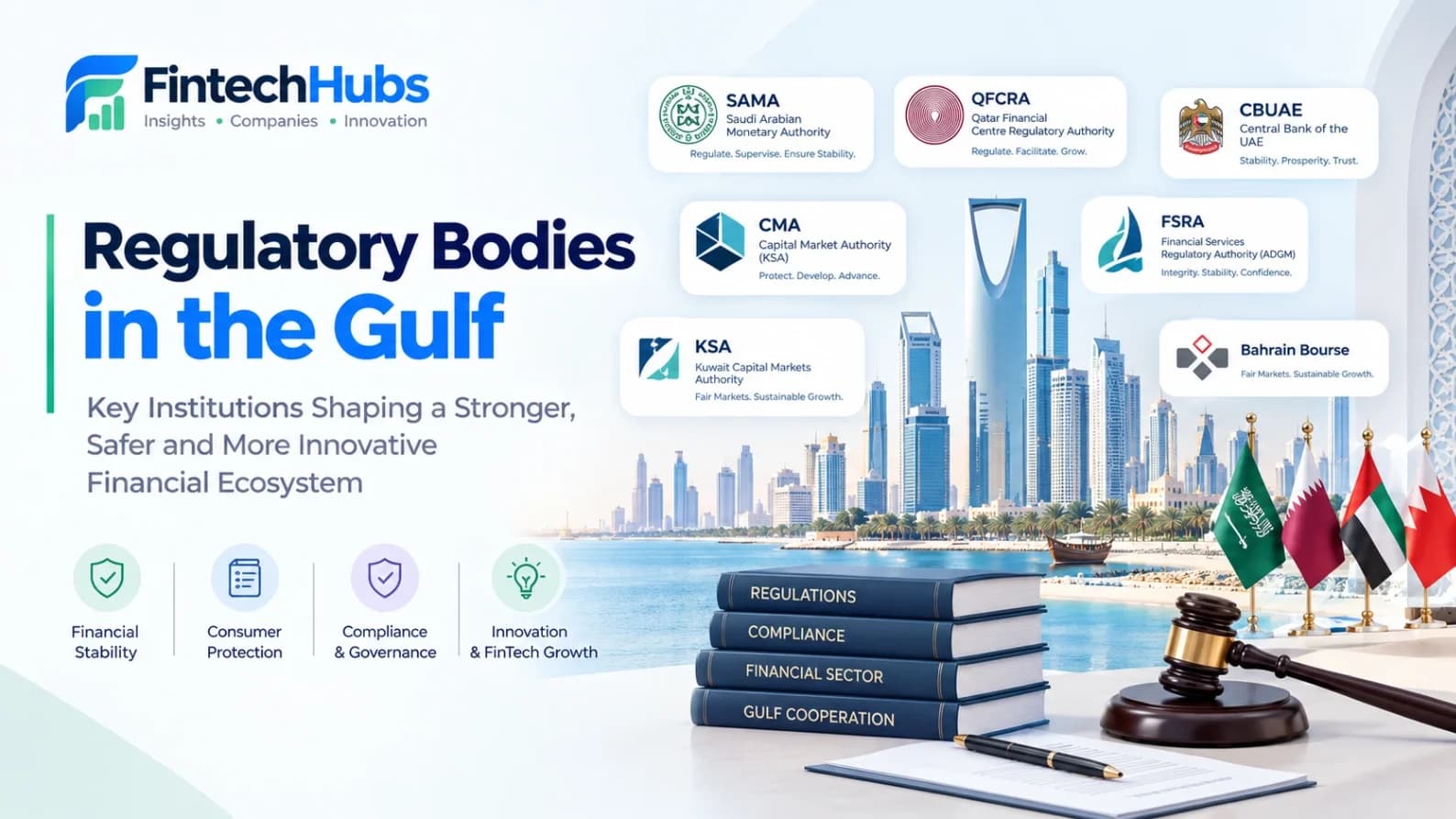
Regulatory Bodies in the Gulf: A Guide to Financial and FinTech Regulation
The Gulf has become one of the world’s most dynamic financial and FinTech regions. The six GCC states (the United Arab Emirates, Saudi Arabia, Qatar, Kuwait, Bahrain and Oman) combine deep capital, young and highly connected populations, national diversification strategies (such as Saudi Vision 2030, UAE Centennial 2071, Qatar National Vision 2030 and Bahrain Economic Vision 2030), and ambitious digital finance agendas.
The regulatory picture is distinctive. The region mixes onshore federal or national regulators with internationally modelled financial free zones, has a large Islamic finance sector, and is moving quickly on open banking, digital banks, virtual assets and central bank digital currencies. This guide explains who the regulators are, what laws they apply, how FinTech activity is licensed, which cross-cutting obligations apply, and how firms can build a practical compliance plan. It ends with ten FAQs, a glossary and a list of official sources.
Why Gulf Financial Regulation Matters
Financial regulation in the Gulf serves the same core goals as elsewhere, with some regional emphases:
Financial stability: Protecting banking systems that are closely tied to hydrocarbon revenues and sovereign wealth.
Consumer and investor protection: Especially as retail adoption of digital wallets, buy-now-pay-later (BNPL) and online investing grows.
Combating financial crime: AML/CFT compliance has been a major policy priority, and the UAE’s 2024 removal from the FATF “grey list” showed how strongly reputation and market access depend on it.
Economic diversification: Attracting FinTech talent, capital and global firms to regional hubs.
Shariah-compliant finance: Ensuring Islamic principles are respected in digital products.
Digital sovereignty: Managing data protection, localisation and cloud use.
How Gulf Regulatory Systems Are Organized: The Dual Structure: Onshore and Financial Free Zones
A key feature, most visible in the UAE and Qatar, is the coexistence of two regulatory layers:
Layer | Description | Examples |
|---|---|---|
Onshore (federal or national) | Civil-law-based regimes administered by a central bank and a capital markets authority | UAE (CBUAE, SCA), Saudi Arabia (SAMA, CMA), Kuwait (CBK, CMA), Oman |
Financial free zones | Self-contained jurisdictions with their own common-law-inspired legal frameworks, courts and regulators | DIFC and ADGM (UAE), Qatar Financial Centre (QFC) |
Integrated regulator | A single authority supervises most sectors | Bahrain (Central Bank of Bahrain) |
A firm must therefore decide not only which country to enter, but also which regulatory perimeter to operate in. Cross-border activity between a free zone and the onshore market often needs separate permissions.
Typical Institutional Roles
Central bank: Monetary policy, banking supervision, payments and, in many cases, insurance and finance companies.
Capital markets authority: Securities, funds, crowdfunding and sometimes virtual assets.
Financial intelligence unit: Receives suspicious transaction reports.
Data protection and cyber authorities: Enforce privacy and security standards.
Telecom or digital regulators: Relevant to digital identity, e-KYC and cloud.
Country-by-Country Guide to Key Regulators
United Arab Emirates
The UAE has the most layered system in the region.
Federal regulators
Central Bank of the UAE (CBUAE): Licenses and supervises banks, finance companies, exchange houses, payment service providers and, since 2020, insurance companies (after merging the former Insurance Authority). It is also responsible for AML supervision of its licensees and for CBDC development.
Securities and Commodities Authority (SCA): Onshore securities, commodities, funds, crowdfunding and, under federal arrangements, virtual assets.
UAE Financial Intelligence Unit (FIU): Receives suspicious activity reports via the go AML platform.
Ministry of Economy and Ministry of Justice: Supervision of designated non-financial businesses and professions (DNFBPs).
Free zone regulators
Dubai Financial Services Authority (DFSA): Regulates financial services in the Dubai International Financial Centre (DIFC), including a crypto token framework.
Financial Services Regulatory Authority (FSRA): Regulates Abu Dhabi Global Market (ADGM), one of the earliest regulators globally to publish a virtual asset framework (2018).
Virtual Assets Regulatory Authority (VARA): The Dubai-level regulator for virtual asset activity outside DIFC, created under Dubai Law No. 4 of 2022.
Key frameworks and developments
CBUAE Retail Payment Services and Card Schemes Regulation (2021) licensing payment activities.
CBUAE Payment Token Services Regulation (2024) governing dirham-backed payment tokens.
A new federal central bank law issued in 2025 broadening the licensing perimeter to include certain technology-enabled and decentralized finance activities (with a transition period). Check the current text and deadlines.
UAE Open Finance Regulation (2024), supporting a standardized data-sharing framework.
Federal personal data protection law (Federal Decree-Law No. 45 of 2021) alongside the DIFC Data Protection Law and ADGM Data Protection Regulations.
National infrastructure: the Aani instant payment platform, Jaywan domestic card scheme and the Digital Dirham CBDC programme.
Character: fast-moving, competitive between jurisdictions, strongly international, and strict on AML following recent reforms.
Saudi Arabia
Main regulators
Saudi Central Bank (SAMA): Banks, finance companies, payments, insurance, open banking and digital banks. It was renamed from the Saudi Arabian Monetary Agency in 2020.
Capital Market Authority (CMA): Securities, investment funds, crowdfunding, and capital-markets FinTech such as robo-advisory.
Saudi Data and Artificial Intelligence Authority (SDAIA): Data protection and AI governance.
Communications, Space and Technology Commission (CST), National Cybersecurity Authority (NCA) and Zakat, Tax and Customs Authority (ZATCA): Cloud, cyber and e-invoicing requirements affecting FinTech operations.
Saudi Financial Intelligence Unit: AML/CFT reporting.
Key frameworks
Payments and Payment Service Providers regulation, with licences for payment initiation, account information and e-money services.
SAMA Open Banking Framework, rolled out from 2022–2023 with phased use cases.
Digital bank licensing, with the first licences awarded from 2021.
Finance Companies Control Law and BNPL rules for consumer finance activities.
CMA crowdfunding, debt crowdfunding and FinTech lab arrangements.
Personal Data Protection Law (PDPL), in force from 2023 with enforcement from late 2024.
Instant payment rail sarie and the national debit scheme mada.
Innovation support: SAMA Regulatory Sandbox, CMA FinTech Lab, and the Fintech Saudi initiative.
Virtual assets: Saudi authorities have historically warned against unlicensed crypto activity. There is no general retail crypto licensing regime comparable to the UAE or Bahrain, though the kingdom participates in cross-border CBDC experiments. Verify current policy before planning any crypto-related service.
Character: Large domestic market, state-led strategy under Vision 2030, comprehensive licensing and strong data-localization expectations.
Qatar
Main regulators
Qatar Central Bank (QCB): Banks, payments, insurance and the national FinTech strategy.
Qatar Financial Centre Regulatory Authority (QFCRA): Regulates firms in the QFC.
Qatar Financial Markets Authority (QFMA): Onshore securities and capital markets.
National Cyber Security Agency and the Ministry of Communications and Information Technology: Cyber and data policy.
Qatar Financial Information Unit (QFIU): AML reporting.
Key frameworks and developments
QCB FinTech Strategy (2023) with a regulatory sandbox and licensing pathway for payment and digital finance firms.
QCB position restricting dealing in cryptocurrencies by supervised institutions, balanced by interest in tokenisation. The QFC introduced a digital assets framework for tokenised assets in 2024.
Personal Data Privacy Protection Law (Law No. 13 of 2016).
Fawran instant payments service and QCB CBDC research.
Character: conservative on crypto, supportive of institutional tokenisation and payments modernisation, backed by the QFC’s common-law-style regime.
Kuwait
Main regulators
Central Bank of Kuwait (CBK): Banks, exchange companies, payment service providers and the national payments framework.
Capital Markets Authority (CMA Kuwait): Securities, funds, brokers and investment advisers.
Kuwait Financial Intelligence Unit: AML/CFT reporting.
Communication and Information Technology Regulatory Authority (CITRA): data and telecommunications rules.
Key themes
CBK regulatory sandbox and licensing of payment service providers, with a rising focus on open banking and digital payments.
A cautious stance on virtual assets, with official warnings and restrictions on regulated entities dealing with them.
Data protection rules issued by CITRA, and an evolving national AML framework.
Character: conservative and bank-centred, with gradual openness to FinTech partnerships.
Bahrain
Main regulator:
Central Bank of Bahrain (CBB): An integrated regulator covering banking, insurance, capital markets, payments and Islamic finance through a consolidated CBB Rulebook.
Key frameworks and developments
Regulatory sandbox: Launched in 2017, one of the first in the region.
Crypto-asset module (2019) with licensing categories for crypto-asset brokers, dealers, exchanges and custodians, and a stablecoin issuance and redemption module added later.
Bahrain Open Banking Framework (2020), setting API standards and participant roles.
Licences for payment service providers, crowdfunding platforms and ancillary service providers.
Personal Data Protection Law (Law No. 30 of 2018), enforced by the Personal Data Protection Authority.
Bahrain FinTech Bay: And the Economic Development Board supporting ecosystem growth.
Hosting of AAOIFI, the global Islamic accounting and auditing standard-setter.
Character: an early, pragmatic regulator with a one-stop supervisory model and a strong Islamic finance and crypto licensing record.
Oman
Main regulators
Central Bank of Oman (CBO): Banks, finance companies, payment systems and the national FinTech sandbox.
Financial Services Authority (FSA): Capital markets, insurance, and non-bank financial services.
Financial Intelligence Unit (Oman): AML reporting.
Key themes
Payment systems and open banking regulation, supported by the CBO’s FinTech sandbox and digital payment initiatives.
Personal data protection legislation issued by royal decree in 2022, with implementing rules phasing in.
Active development of Islamic banking regulation and securities market modernisation.
Character: steady, incremental and increasingly supportive of digital payments and sandboxes.
Summary Table of Key Regulators
Jurisdiction | Banking and payments | Securities and markets | Insurance | AML / FIU |
|---|---|---|---|---|
UAE (federal) | CBUAE | SCA | CBUAE | UAE FIU |
UAE: DIFC | DFSA | DFSA | DFSA | UAE FIU |
UAE: ADGM | FSRA | FSRA | FSRA | UAE FIU |
UAE: Dubai virtual assets | VARA | VARA | N/A | UAE FIU |
Saudi Arabia | SAMA | CMA | SAMA | Saudi FIU |
Qatar | QCB / QFCRA | QFMA / QFCRA | QCB / QFCRA | QFIU |
Kuwait | CBK | CMA Kuwait | Ministry of Commerce / CBK | Kuwait FIU |
Bahrain | CBB | CBB | CBB | CBB Financial Intelligence Directorate |
Oman | CBO | FSA | FSA | Oman FIU |
Regulation by FinTech Segment
Payments and E-Money
Payment services are licensed in every GCC state, with categories such as payment initiation, account information, e-money issuance, remittance and merchant acquiring. Common requirements include minimum capital, safeguarding of customer funds, technology risk controls, AML/CFT programmes and local presence. Instant payment systems (Aani in the UAE, sarie in Saudi Arabia, Fawran in Qatar, Fawri+ in Bahrain) and national card schemes are strengthening domestic rails and reducing reliance on international networks.
Digital Banking
Saudi Arabia, the UAE, Kuwait, Bahrain and Qatar have licensed or are developing digital-only banks and wholesale digital banks. Licensing criteria usually include a sustainable business plan, strong technology governance, minimum capital that increases with scale, and exit planning.
Lending, BNPL and Crowdfunding
Regulators have moved to bring BNPL and consumer finance under licensing and responsible-lending rules, including affordability checks, fee transparency and debt collection conduct. Crowdfunding (equity and debt) is generally supervised by capital markets authorities with investor eligibility and exposure limits.
Virtual Assets, Stablecoins and Tokenisation
This is the area of greatest regional divergence:
Licensing hubs: UAE (VARA, ADGM FSRA, DFSA, SCA) and Bahrain (CBB crypto-asset module).
Selective and institutional approach: Qatar (tokenisation through the QFC, restrictions for banks on crypto).
Cautious or restrictive: Saudi Arabia, Kuwait and Oman, where public warnings and bank restrictions have been common.
Common licensing themes include segregation and custody of client assets, market abuse rules, marketing restrictions, risk disclosure, Travel Rule compliance and strong governance. Dirham-backed payment tokens are now explicitly regulated in the UAE.
Open Banking and Open Finance
Bahrain moved first with a framework in 2020. Saudi Arabia’s SAMA framework and the UAE’s Open Finance Regulation extend data-sharing beyond banking into insurance, investments and other financial products. Core issues include customer consent, API security standards, liability and fees.
Islamic FinTech
Products such as Shariah-compliant digital wallets, crowdfunding, robo-advisors and tokenised sukuk must comply with Islamic finance governance. This typically means a Shariah supervisory board, adherence to standards from AAOIFI and the Islamic Financial Services Board (IFSB), and Shariah audit processes. Bahrain, the UAE, Saudi Arabia, Kuwait and Qatar all have mature Islamic finance rules that apply to digital offerings.
InsurTech
Insurance supervisors license digital insurers, brokers and aggregators and regulate digital distribution, data use and claims handling. Takaful (Islamic insurance) models require additional governance.
WealthTech, Brokerage and Capital Markets Technology
Investment platforms and robo-advisors fall under securities regulation, with suitability assessments, disclosure and algorithm governance. Tokenisation pilots in ADGM, DIFC and the QFC illustrate regulators’ interest in tokenised funds and bonds.
RegTech and SupTech
Regulators use data analytics and automated reporting for supervision, while firms deploy RegTech for e-KYC, transaction monitoring, sanctions screening and regulatory reporting. Digital identity systems (such as UAE Pass and Saudi Arabia’s Absher and Nafath) make e-KYC more efficient.
Cross-Cutting Regulatory Themes
AML/CFT and Sanctions
The GCC is a member of the Financial Action Task Force (FATF), and individual states are assessed by MENAFATF, the Middle East and North Africa FATF-style regional body. Expect risk-based customer due diligence, beneficial ownership transparency, enhanced due diligence for higher-risk customers, suspicious transaction reporting, targeted financial sanctions screening and the FATF Travel Rule for virtual assets. Penalties can include heavy fines, licence withdrawal and personal liability.
Data Protection and Localisation
Privacy laws now exist in the UAE (federal law, DIFC and ADGM regimes), Saudi Arabia (PDPL), Qatar, Bahrain and Oman. Obligations cover lawful basis or consent, purpose limitation, breach notification and restrictions on cross-border transfers. Financial regulators may also impose sector-specific data hosting or cloud requirements, notably in Saudi Arabia.
Cybersecurity and Operational Resilience
Expect technology risk guidelines, incident reporting, penetration testing, business continuity and exit planning for outsourced providers. Cloud and outsourcing rules require due diligence, audit rights and, in some cases, regulatory approval.
Consumer Protection and Conduct
Central banks have introduced consumer protection regulations covering disclosure, complaints, fair marketing, debt collection and protection against fraud. Anti-scam measures, such as fraud alerts and stricter authentication, are an increasing priority.
Artificial Intelligence and Algorithmic Governance
Saudi Arabia’s SDAIA has published AI ethics principles, and the UAE has a national AI strategy and AI-related guidance in the financial sector. Firms using AI for credit, fraud or advice should be ready to demonstrate explainability, fairness and human oversight.
Sustainable Finance
Central banks and capital markets authorities have issued sustainability and climate disclosure expectations. Green and sustainable sukuk and bond frameworks are growing, and greenwashing scrutiny is increasing for products marketed as sustainable.
Tax, Corporate and Licensing Considerations
Corporate tax and VAT regimes (in the UAE, Saudi Arabia, Bahrain and Oman), foreign ownership rules, economic substance requirements and commercial licensing from national investment ministries (such as MISA in Saudi Arabia) can all affect FinTech structuring.
Regulatory Sandboxes and Innovation Hubs
Regulatory sandboxes allow firms to test new products under supervisory oversight with tailored requirements.
Jurisdiction | Examples |
|---|---|
UAE | CBUAE Regulatory Sandbox, DFSA Innovation Testing Licence, FSRA RegLab, Dubai Future Foundation sandbox |
Saudi Arabia | SAMA Regulatory Sandbox, CMA FinTech Lab, Fintech Saudi |
Qatar | QCB Regulatory Sandbox, Qatar FinTech Hub, QFC innovation tools |
Kuwait | CBK Regulatory Sandbox |
Bahrain | CBB Regulatory Sandbox, Bahrain FinTech Bay |
Oman | CBO FinTech sandbox |
Sandbox participation is typically time-limited, competitive and does not remove core AML, data protection or consumer protection obligations.
Central Bank Digital Currencies (CBDCs)
The Gulf is a prominent participant in CBDC research and cross-border pilots:
UAE: Digital Dirham programme as part of the Financial Infrastructure Transformation initiative; participation in mBridge with China, Hong Kong and Thailand; and the earlier Project Aber with Saudi Arabia.
Saudi Arabia: a participant in multi-CBDC cross-border experiments and Project Aber, with wholesale-focused research.
Bahrain, Qatar, Kuwait and Oman: research, wholesale CBDC and instant payments modernization work, with differing timelines.
Policy issues include privacy, legal tender status, impact on bank deposits, cyber resilience and interoperability. The BIS stepped back from its role in the mBridge project in 2024, with participating central banks continuing the work.
Regional and Global Coordination
GCC institutions: the GCC Secretariat and the GCC central bank governors’ committee coordinate on payment connectivity and financial integration, including the regional GCC real-time gross settlement (RTGS) initiative.
FATF and MENAFATF: AML/CFT standards, mutual evaluations and follow-up.
Basel Committee, IOSCO and IAIS: global prudential and conduct standards implemented by local regulators.
AAOIFI and IFSB: Islamic finance standards.
Bilateral FinTech bridges: cooperation agreements between Gulf regulators and regulators in Singapore, the UK, India and others to refer innovators and share information.
Key Trends Shaping the Region
Broader licensing perimeters: the UAE and others are bringing technology-enabled and decentralized activities into licensing.
Open finance expansion: moving from payments and accounts into insurance, investments and credit.
Instant payments and domestic card schemes: reducing reliance on external networks and increasing interoperability.
Tokenisation and stablecoin regulation: institutional tokenised assets and licensed payment tokens.
Digital banks at scale: stronger competition and tougher sustainability expectations.
Stronger AML enforcement: heightened penalties, beneficial ownership registers and cross-border cooperation.
AI governance: clearer regulatory expectations for models and data.
Sustainability and Islamic finance integration: green sukuk and Shariah-compliant digital products.
Common Challenges for FinTech Firms
Dual regulatory regimes: onshore and free-zone rules, with separate licences and limited passporting.
Regulatory uncertainty: particularly for virtual assets, DeFi and new BNPL models.
Local presence and ownership rules: local directors, offices, capital or strategic partners.
Data localisation: hosting and cloud restrictions, especially in Saudi Arabia.
Banking access: opening corporate bank accounts can be slow for higher-risk businesses.
Shariah governance: added cost and complexity for Islamic products.
Pace of change: frequent circulars, deadlines and transition periods.
Practical Compliance Roadmap
Define your activities and customers: identify exactly what you do (payments, lending, custody, advice) and which markets you will serve.
Choose the jurisdiction and perimeter: onshore, DIFC, ADGM, QFC, Dubai VARA or another option.
Identify the licence category and regulator and note capital, local presence and fit-and-proper requirements.
Consider entry routes: Direct licence, sandbox, partnership with a licensed entity, or acquisition.
Design governance: Qualified board and senior management, compliance officer, money laundering reporting officer and, where relevant, a Shariah board.
Build core controls: KYC/CDD, transaction monitoring, sanctions screening, safeguarding, data protection and cyber security.
Prepare your application: Business plan, financial model, policies, technology architecture, outsourcing arrangements and exit plan.
Engage with regulators early: Pre-application meetings reduce rework and uncertainty.
Plan banking and operations: Arrange corporate banking, auditors, local legal counsel and tax registration.
Monitor and adapt: Track circulars, update policies, run periodic reviews and train staff.
Recommended Official Sources
Use primary sources for the latest rules: the websites of CBUAE, SCA, DFSA, FSRA and VARA (UAE); SAMA, CMA, SDAIA and NCA (Saudi Arabia); QCB, QFCRA and QFMA (Qatar); CBK and CMA Kuwait; CBB (Bahrain); and CBO and the FSA (Oman). Supplement with FATF, MENAFATF, BIS, IOSCO, AAOIFI and IFSB publications.
Frequently Asked Questions (FAQs)
1. Is there a single financial regulator for the whole Gulf region?
No. Each GCC state has its own regulators and laws, and the UAE has several overlapping authorities. The GCC Secretariat and bodies such as MENAFATF promote coordination and common standards but do not issue binding licences across the region.
2. Which Gulf country is the most FinTech-friendly?
The UAE (especially DIFC, ADGM and Dubai) and Bahrain are often cited for clear frameworks and early sandboxes, while Saudi Arabia offers the largest domestic market and strong state support. The best choice depends on the business model, target customers and risk appetite.
3. What is the difference between onshore and free zone regulation?
Onshore regulation applies the national laws and regulators of the country, while financial free zones such as DIFC, ADGM and the QFC have their own legal systems and regulators. Free zone firms generally serve clients within the zone and internationally, and need extra permissions to deal directly with onshore customers.
4. Do I need a licence to run a payment app in the Gulf?
In most cases yes. Holding customer funds, issuing e-money, initiating payments or remitting money normally requires a payment or e-money licence from the central bank, or a free zone authorisation. Pure technology providers may be exempt, but this must be confirmed locally.
5. Is cryptocurrency legal in the Gulf?
It depends on the jurisdiction. The UAE and Bahrain license virtual asset activity. Qatar restricts crypto for regulated institutions but is developing tokenisation frameworks. Saudi Arabia, Kuwait and Oman have been more cautious, and rules continue to develop. Always check the current position and the specific regulator.
6. How are digital banks regulated?
Digital banks are licensed banks without branches, subject to capital, liquidity, risk management and deposit protection rules, plus enhanced technology and cyber requirements. Saudi Arabia, the UAE, Kuwait, Bahrain and Qatar have licensed or are exploring such banks.
7. What is open banking and where is it available?
Open banking lets customers share their financial data securely with licensed third parties via APIs. Bahrain launched a framework in 2020, Saudi Arabia is rolling out its SAMA framework, and the UAE has introduced an Open Finance Regulation extending beyond banking. Details and timelines vary.
8. How does Islamic finance affect FinTech products?
Products offered as Shariah-compliant must be reviewed and approved by a Shariah supervisory board and follow standards from bodies such as AAOIFI and IFSB. This affects product structure, pricing, profit distribution and marketing claims.
9. Can a foreign FinTech enter Gulf markets without a local presence?
Limited cross-border services may be possible in some cases, but most licences require a locally incorporated entity, local management or a physical presence. Free zones offer 100% foreign ownership in many cases, and partnerships with licensed institutions are a common route.
10. How can companies keep up with regulatory change in the Gulf?
Subscribe to regulator notices and consultations, monitor official gazettes, join industry associations and FinTech hubs, retain local legal counsel and use a compliance calendar with named owners for regulatory change.
Conclusion
The Gulf offers one of the most attractive regulatory environments for financial innovation, but also one of the most layered. Success depends on choosing the right jurisdiction and licence perimeter, understanding local requirements on AML, data and Shariah governance, and engaging early with regulators. As open finance, tokenisation, digital banking and CBDCs mature, firms that design compliance into their products from the beginning will be best placed to scale across the region.
Because rules are changing rapidly, treat this guide as a framework for orientation and verify specific obligations with the relevant regulator and qualified local advisers.
Disclaimer: This article is original, general-information content and is not legal, financial or compliance advice. Gulf regulations are changing quickly, and several frameworks mentioned here were new or still being implemented in 2025–2026. Always confirm details against the official regulator websites and with licensed local counsel before acting. Information reflects the position as generally understood in mid-2026.
Share this article
Related Articles
Regulatory Bodies in Asia: Financial & FinTech Guide
A complete guide to Asia's financial and fintech regulators key bodies in Singapore, China, India, Japan and more, regulatory sandboxes, and 10 FAQs.
Regulatory Bodies in Europe: Financial & FinTech Guide
A complete guide to Europe's financial and fintech regulators EU bodies, national authorities, key frameworks like MiCA and DORA, and 10 essential FAQs.
Top 20 RegTech Companies in the USA in 2026
Explore the top 20 RegTech companies in the USA in 2026, featuring leading firms in compliance, risk management, fraud prevention, and regulatory technology.