Top 20 Fintech Companies in the USA in 2026
Discover the top 20 fintech companies in the USA in 2026, including leading innovators in payments, digital banking, lending, wealthtech, and financial technology.
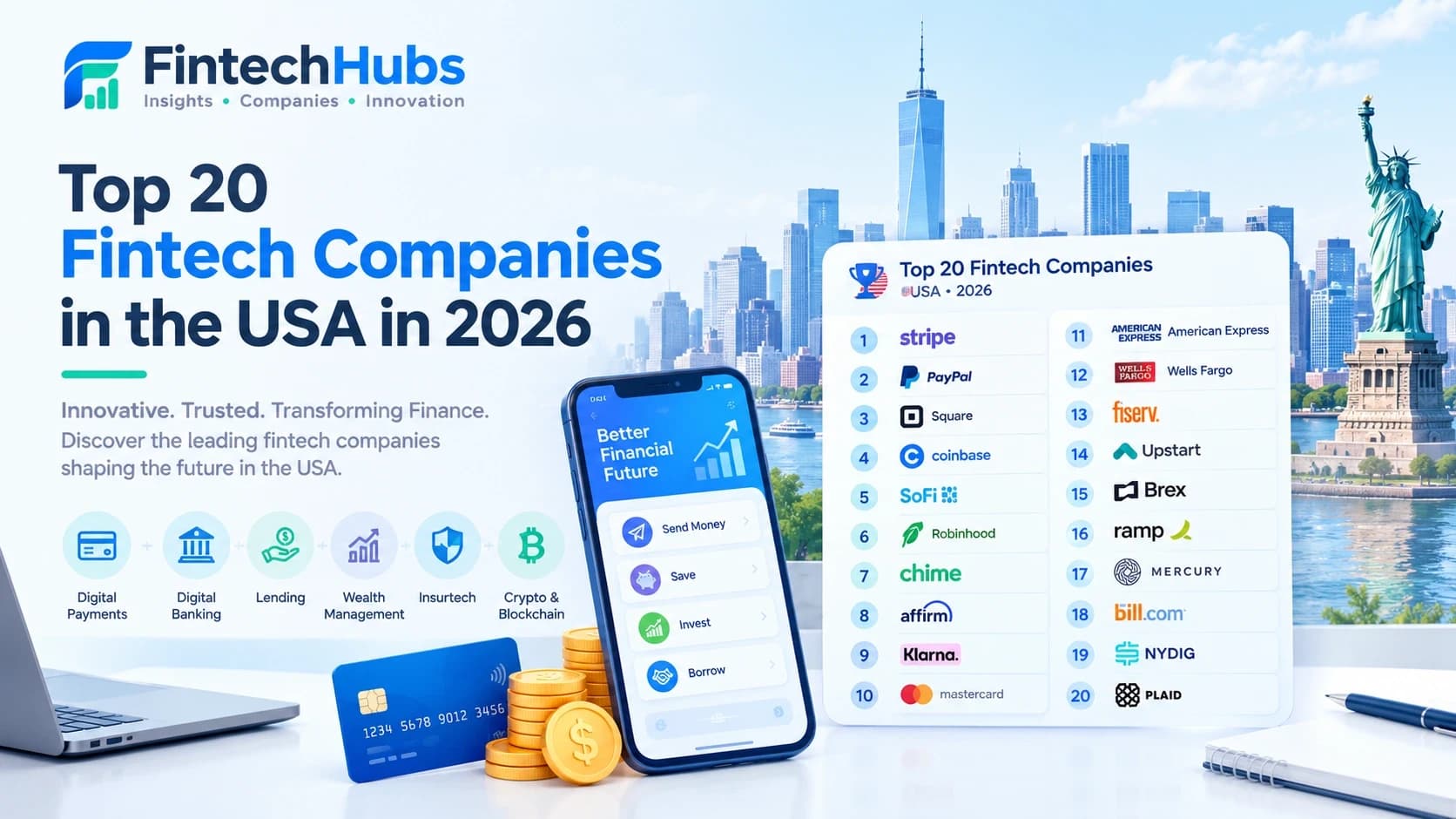
Top 20 Fintech Companies in the USA in 2026
American fintech has matured. The 2021 boom produced many startups. The 2022–2023 correction thinned them out. The survivors now look less like disruptors and more like core financial infrastructure. In 2026, they power payments, corporate spending, retail investing, stablecoins and consumer credit. Many are also being bought or copied by the banks they once threatened.
This article profiles 20 US-headquartered fintech companies that shape the industry this year. It also covers the trends behind their rise, the risks they face, and what to watch next.
Key takeaways
Stripe, Ramp and Robinhood anchor the top tier by scale and momentum.
AI-driven finance, stablecoins and bank–fintech consolidation are the defining themes of 2026.
The IPO window that reopened in 2025 is still open. Plaid is reportedly weighing a listing, and Stripe has so far stayed private.
Public fintech stocks have been volatile and sensitive to interest rates, even as operating results improve.
Methodology: How This List Was Built
The ranking is an editorial judgment, not an official index. Companies were weighed on five criteria:
Scale: Valuation or market capitalization, payment volume, revenue, and customer base.
Growth momentum: Recent funding, earnings, and product expansion.
Product breadth and defensibility: How hard the business is to replace.
Financial health: Profitability or a credible path to it.
Industry influence: Whether competitors, banks and regulators react to the company's moves.
Only companies headquartered in the US were considered. Non-US names such as Adyen, Klarna, Revolut and Nubank are excluded, even though they compete in the American market. Where I am less certain of a current figure, I describe the company qualitatively instead.
The State of US Fintech in 2026
1. AI is the new growth story: Investors reward fintechs with a credible AI angle. Ramp's June 2026 round was widely framed around AI-driven bookkeeping and spend management. Several companies now position their products around autonomous "agents" that handle reconciliation, approvals, and fraud review.
2. Stablecoins have moved into mainstream payments: Circle, Coinbase, SoFi, and traditional banks are all building stablecoin rails. Regulatory clarity in the US has encouraged this.
3. Banks are buying instead of fighting: Capital One completed its acquisition of Brex in April 2026, in a mix of stock and cash.
4. Public markets are choosy: The 2025 IPO class (Circle, Chime, Klarna) showed that going public does not guarantee a premium. Chime priced at about $11.6 billion, less than half its $25 billion private peak.
5. Megadeal ambitions are back: In 2026, Stripe and Advent International pursued a bid for PayPal worth more than $50 billion. It would have been among the largest fintech deals ever. It was later abandoned (see PayPal below).
At-a-Glance Overview
# | Company | HQ | Core segment | Status |
|---|---|---|---|---|
1 | Stripe | San Francisco / Dublin | Payments infrastructure | Private |
2 | Ramp | New York | Spend management / corporate cards | Private |
3 | Robinhood | Menlo Park, CA | Retail investing/crypto | Public (HOOD) |
4 | PayPal (incl. Venmo) | San Jose, CA | Digital payments | Public (PYPL) |
5 | Block (Square, Cash App) | Oakland, CA | Merchant and consumer payments | Public |
6 | Coinbase | Remote-first / US | Crypto exchange and infrastructure | Public (COIN) |
7 | Circle | Boston / New York | Stablecoins (USDC) | Public (CRCL) |
8 | Plaid | San Francisco | Open-banking APIs | Private |
9 | SoFi | San Francisco | Digital bank/lending | Public (SOFI) |
10 | Affirm | San Francisco | Buy now, pay later | Public (AFRM) |
11 | Chime | San Francisco | Neobank | Public (CHYM) |
12 | Toast | Boston | Restaurant tech and payments | Public |
13 | Bill Holdings | San Jose, CA | B2B payments automation | Public |
14 | Marqeta | Oakland, CA | Card issuing platform | Public |
15 | Upstart | San Mateo, CA | AI-driven lending | Public |
16 | Mercury | San Francisco | Startup banking | Private |
17 | Kalshi | New York | Regulated prediction markets | Private |
18 | Fiserv (Clover) | Milwaukee, WI | Core banking and merchant tech | Public |
19 | Bilt | New York | Rent-based rewards and payments | Private |
20 | Brex (Capital One) | San Francisco | Corporate cards and spend software | Owned by Capital One |
The Top 20 Fintech Companies in the USA
Stripe
What it does: Payment processing, billing, fraud prevention, tax, identity, treasury and card issuing for online businesses.
Stripe is the clear leader in private fintech. It was valued at $159 billion in a February 2026 employee tender offer, with a total payment volume of $1.9 trillion in 2025, up 34% year over year. That valuation was a large jump from the prior year's $91.5 billion in February 2025.
The company has also been an active dealmaker. In July 2026 it announced a $53 billion joint bid with Advent International for PayPal. The consortium later abandoned the pursuit. It has also been reported to be acquiring the AI model marketplace OpenRouter, with sources putting the price between roughly $7 billion and $8 billion.
Strengths: developer-first products, broad platform, strong profitability signals.
Watch-outs: no IPO date, intense competition from Adyen, PayPal and Block, and the integration load of large acquisitions.
Ramp
What it does: Corporate cards, expense management, bill pay and AI-assisted accounting for businesses.
Ramp is one of the fastest-growing fintechs in the country. On June 4, 2026 it announced a $750 million round at a $44 billion valuation, with over $1 billion in annualized revenue, positive free cash flow and $200 billion in annualized purchase volume. In September, Bloomberg reported early talks to raise about $1 billion at a $60 billion valuation. Those talks were not finalized at the time of writing.
Strengths: rapid growth, product velocity, clear AI positioning.
Watch-outs: a valuation that assumes sustained hypergrowth, and rising competition from banks, including a Brex now backed by Capital One.
Robinhood
What it does: Commission-free trading, options, crypto, retirement accounts and banking-style features.
Robinhood is the largest publicly traded name in US consumer fintech. It reported Q2 2026 revenue of $1.31 billion, up 32% year over year, with $369 billion in platform assets and a market cap around $92 billion. Its diversification across equities, options, crypto and subscriptions has made it more resilient than narrower peers.
Strengths: brand with younger investors, product breadth, strong revenue growth.
Watch-outs: dependence on trading activity and market sentiment, and ongoing regulatory scrutiny of retail trading.
PayPal (including Venmo)
What it does: Online checkout, peer-to-peer payments (Venmo), merchant services and consumer credit.
PayPal's year has been eventful. Its market value had fallen to about $36 billion earlier in 2026, then recovered to roughly $52.6 billion on takeover speculation and better second-quarter results. When Stripe and Advent walked away in late August, the stock dropped about 15%. A future approach remains possible, but for now PayPal returns to its own turnaround.
Strengths: huge user base, global brand, Venmo's network effects.
Watch-outs: slowing branded checkout growth, competition from Apple Pay and Stripe, and leadership transitions.
Block (Square and Cash App)
What it does: Square provides seller tools and payments, Cash App provides consumer banking, investing and bitcoin services, and Afterpay adds buy now, pay later.
Block runs one of the few two-sided ecosystems in fintech, with merchants on one side and consumers on the other. It was part of an early group that approached PayPal in April but left before Stripe and Advent made their bid. A recent market snapshot placed its market cap at around $44 billion.
Strengths: integrated ecosystem, Cash App engagement, bitcoin exposure.
Watch-outs: profitability consistency and increasing competition in small-business payments.
Coinbase
What it does: Crypto exchange, custody, institutional trading, staking and the Base layer-2 network.
Coinbase remains the largest US-based crypto platform. Recent developments include a CFTC-cleared derivatives clearing arm and a stablecoin payments partnership with Citi, while investors question whether trading activity can reaccelerate after weak quarterly revenue. Its market cap was about $53 billion in late September.
Strengths: regulatory standing, institutional relationships, diversified revenue beyond spot trading.
Watch-outs: cyclical revenue and heavy dependence on stablecoin economics tied to Circle.
Circle
What it does: Issues USDC, one of the largest regulated dollar stablecoins, and provides payment and treasury infrastructure.
Circle went public in 2025. Its June 2025 IPO raised $1.05 billion at $31 per share. Estimates of its current market cap vary widely by source, roughly $20 billion to $28 billion. In September 2026, Binance made a $100 million investment and extended its USDC arrangement for five years.
Strengths: first-mover regulatory positioning, growing USDC volumes.
Watch-outs: earnings sensitivity to interest rates, and distribution costs shared with partners such as Coinbase.
Plaid
What it does: Connects apps to users' bank accounts through APIs, enabling account linking, payments and identity verification.
Plaid is the quiet plumbing behind many fintech apps. It was valued at about $8 billion in a February 2026 employee share sale, and Bloomberg reported on July 1 that it was considering a US IPO and had talked to banks. Estimates for a listing range from roughly $8.5 billion to $10 billion, though no filing had been made as of the latest reporting I found.
Strengths: the largest developer ecosystem in open banking.
Watch-outs: account linking is becoming commoditized, and open-banking rules remain unsettled.
SoFi
What it does: Digital banking, student and personal loans, mortgages, investing, crypto and a growing "everything app" ecosystem.
SoFi holds a national bank charter, which is a real cost advantage in funding. Its operating results are strong, but the stock has lagged. Shares were down about 30% in 2026 despite better-than-expected second-quarter results. Its market cap was around $20.6 billion, and it has promoted stablecoin settlement work with Mastercard.
Strengths: bank charter, member growth, product cross-sell.
Watch-outs: credit quality, rate sensitivity and a valuation debate.
Affirm
What it does: Point-of-sale installment loans and a debit and card product, with a broad merchant network that includes Shopify.
Affirm has moved firmly into profitability. Reports described its most profitable quarter ever and a new Shopify Australia deal. Recent coverage highlights strong fiscal 2026 results alongside renewed debate over valuation and credit risk.
Strengths: underwriting data, merchant partnerships, 0% APR positioning.
Watch-outs: consumer credit cycles and funding costs.
Chime
What it does: Fee-light mobile banking, early pay, and debit and credit-builder products for everyday Americans.
Chime is the leading US neobank by consumer reach. It went public in 2025 at a steep discount to its peak private valuation. Its market cap was about $12.7 billion in early September 2026.
Strengths: large primary-account base, low-cost customer acquisition.
Watch-outs: reliance on interchange revenue and competition from SoFi, Cash App and big banks.
Toast
What it does: Restaurant point-of-sale, payments, payroll and back-of-house software.
Toast shows how vertical software plus payments creates durable fintech revenue. It owns the restaurant workflow, then monetizes the payments flowing through it.
Strengths: deep vertical focus, strong customer retention.
Watch-outs: restaurant industry cyclicality and competition from Square and Clover.
Bill Holdings
What it does: Accounts payable and receivable automation for small and mid-sized businesses and accounting firms.
Bill sits inside the finance back office of hundreds of thousands of businesses. B2B payments remain a huge, still largely paper-and-ACH market.
Strengths: network of businesses and accountants.
Watch-outs: pressure from Ramp, Brex and ERP vendors on features and price.
Marqeta
What it does: Card-issuing and processing platform used by fintechs and expense and delivery apps.
Marqeta is the engine behind many branded cards. Modern card issuing lets developers launch virtual and physical cards through an API.
Strengths: flexible, developer-friendly platform.
Watch-outs: customer concentration and competition from Stripe Issuing and bank-owned platforms.
Upstart
What it does: An AI-powered lending marketplace connecting banks and credit unions with borrowers.
Upstart argues that machine-learning underwriting approves more borrowers at lower loss rates than traditional scores. Its results track funding-market conditions closely.
Strengths: differentiated underwriting model, bank-partner distribution.
Watch-outs: reliance on capital markets and volatile loan-origination volumes.
Mercury
What it does: Banking for startups and small businesses, delivered with partner banks.
Mercury has become the default operating account for many venture-backed companies. It is expanding into treasury, cards and bill pay.
Strengths: strong brand in startups, polished product.
Watch-outs: dependence on partner banks and rising competition from Ramp and Brex.
Kalshi
What it does: A federally regulated exchange for event contracts, commonly called prediction markets.
Kalshi is one of the most-watched young companies in finance. Seedtable placed it second among US fintech startups in its 2026 ranking, behind Ramp. Its legal and regulatory battles with states and other regulators are as important to its future as its product.
Strengths: early regulatory approval, rapid volume growth.
Watch-outs: state-level legal challenges and political risk.
Fiserv (Clover)
What it does: Core processing for banks and credit unions, plus the Clover merchant platform.
Fiserv is the incumbent among this group, but its Clover platform competes directly with Square and Toast. Its reach into thousands of financial institutions makes it structurally important.
Strengths: distribution through banks, scale.
Watch-outs: pressure to prove Clover's growth and manage legacy-platform complexity.
Bilt
What it does: A rewards program and card that lets renters earn points on housing payments.
Bilt turned rent, the largest monthly expense for many households, into a loyalty engine. It appeared on Forbes' Fintech 50 2026 list.
Strengths: a differentiated, high-frequency use case.
Watch-outs: reliance on card-partner economics and landlord adoption.
Brex (now part of Capital One)
What it does: Corporate cards, spend management software and business banking.
Brex ends this list as a signal of where the sector is heading. Capital One completed its acquisition on April 7, 2026, with Brex's founder continuing as CEO. Brex now has a bank's balance sheet behind it.
Strengths: integrated card, software and banking offering, now with bank-scale funding.
Watch-outs: integration challenges and competition from Ramp.
Sector Breakdown
Segment | Leaders on this list |
|---|---|
Payments infrastructure | Stripe, Marqeta, Fiserv |
Consumer banking and lending | SoFi, Chime, Affirm, Upstart |
Corporate finance | Ramp, Brex, Bill, Mercury |
Investing and crypto | Robinhood, Coinbase, Circle |
Merchant software | Block, Toast, Fiserv |
Open banking | Plaid |
Emerging models | Kalshi, Bilt |
Key Challenges Facing US Fintech
Interest-rate sensitivity: Rate-sensitive fintech stocks sold off when yields rose. SoFi, Affirm and Robinhood all fell in late September on rising yields and inflation worries.
Regulation: Rules on open banking, stablecoins, crypto and prediction markets are still taking shape and differ by agency and state.
Credit risk: BNPL and consumer lending depend on underwriting that has not been tested through a severe downturn.
Valuation resets: Private marks can rise quickly and fall just as fast, as Stripe, Chime and Klarna have all shown.
Bank partnerships: Many fintechs rely on sponsor banks, which adds compliance and concentration risk.
Competition from incumbents: Banks have more capital and are now buying the best fintech assets.
Outlook: What to Watch Through 2027
IPOs. Plaid is the most visible candidate. Stripe's decision remains the largest open question.
More bank–fintech deals. The Brex acquisition set a precedent.
PayPal's next move. A renewed approach remains possible.
Stablecoin adoption. Watch bank and card-network integrations.
AI agents in finance. Expect more automation in accounting, underwriting and fraud, along with new risk controls.
Ramp's next round. A completed $60 billion round would confirm its position among the most valuable private US tech companies.
Who Should Care, and Why
Investors: Public names offer liquidity but volatility. Private ones are accessible mainly through secondary markets. Research each company's earnings, credit quality and rate exposure.
Founders: The winners combine a narrow wedge, such as rent, restaurants or startup banking, with later expansion into payments and credit.
Job seekers: Stripe, Ramp, Robinhood and Plaid are known for demanding hiring bars and strong engineering cultures.
Business owners: Compare fees, payout speed and integrations before choosing a payments or spend platform.
Frequently Asked Questions (FAQs)
1. What is a fintech company?
A fintech company uses technology to deliver or improve financial services such as payments, lending, banking, investing and insurance.
2. Which is the most valuable fintech company in the USA in 2026?
By private valuation, Stripe leads. It was valued at $159 billion in its February 2026 tender offer. By public market cap, Robinhood is among the largest, at roughly $92 billion.
3. Is Stripe public?
No. Stripe remains private and uses periodic employee tender offers for liquidity. As of the sources I found, it had not announced an IPO date.
4. Did Stripe buy PayPal?
No. A consortium of Advent and Stripe abandoned its pursuit of PayPal in late August 2026. Reports said the two sides disagreed on price, and a future approach remains possible.
5. Which US fintech startups are growing fastest?
Ramp stands out. It reported roughly 170% year-over-year growth in purchase volume in March 2026. Kalshi is also frequently cited among top US fintech startups.
6. Is Plaid going public?
It may. Bloomberg reported on July 1, 2026 that Plaid was considering a US IPO. No public filing had been reported in the sources I reviewed.
7. What happened to Brex?
Capital One acquired it. The deal closed on April 7, 2026. Brex continues to operate under its founder as CEO.
8. Are fintech stocks a good investment in 2026?
It depends on your goals and risk tolerance. Fintech stocks have been volatile and sensitive to rates and credit conditions. I am not a financial advisor, so consider professional advice and your own research.
9. What are the biggest fintech trends in 2026?
AI-driven finance, stablecoin payments, bank–fintech consolidation, embedded finance, and the growth of regulated prediction markets.
10. How do I choose between fintech providers?
Compare fees, security and regulatory standing, deposit protection (look for FDIC-insured partner banks), integrations, customer support and long-term stability. For business products, also check contract terms and data portability.
Conclusion
The US fintech leaders of 2026 are larger, more profitable and more intertwined with traditional finance than their predecessors. Stripe and Ramp show how far private fintech can scale. Robinhood, Coinbase and Circle show the potential and the volatility of public markets. Consolidation, symbolized by Capital One's purchase of Brex and the attempted PayPal takeover, suggests the next phase will be defined as much by deals as by products.
Disclaimer: This article is for informational purposes only and is not financial, legal or investment advice. Valuations and market capitalizations change frequently and vary by source. Verify current figures with official filings and company announcements before making decisions.
Share this article
Related Articles
Top 20 RegTech Companies in the USA in 2026
Explore the top 20 RegTech companies in the USA in 2026, featuring leading firms in compliance, risk management, fraud prevention, and regulatory technology.

OSINT Framework: Open Source Intelligence Guide
Explore the OSINT Framework to discover open source intelligence tools, data sources, investigation methods, and resources for effective online research.
Sanctions Screening: Compliance & Risk Management Guide
Learn how sanctions screening helps businesses detect restricted entities, reduce financial crime risks, and maintain regulatory compliance.