
Travel Rule Compliance: Requirements, Challenges & Solutions
Learn about Travel Rule compliance requirements, key challenges, and solutions for crypto businesses. Discover how VASPs can strengthen AML compliance and meet regulatory obligations.
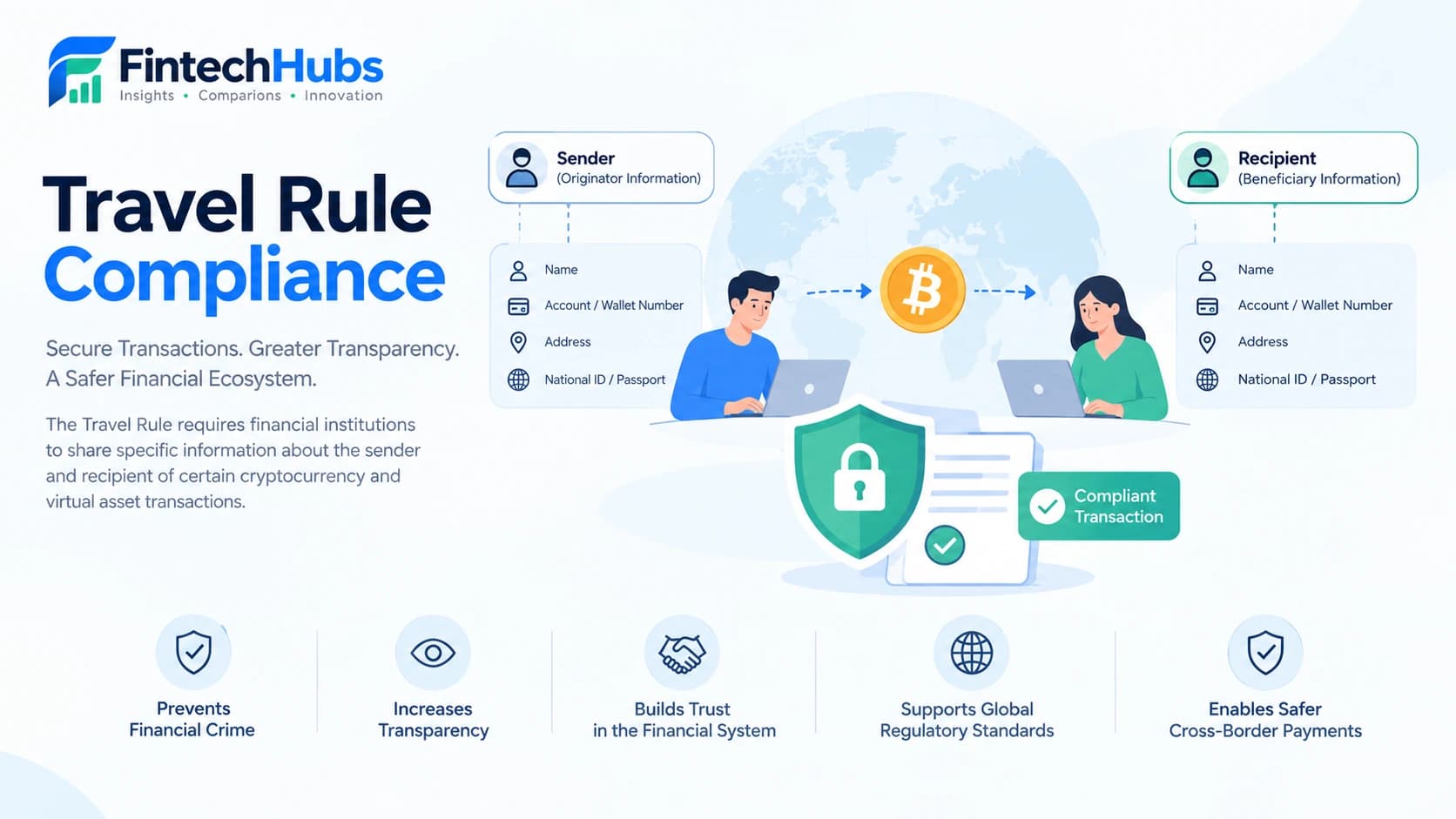
Travel Rule Compliance: Requirements, Challenges, and Solutions for Crypto Businesses
Digital assets can move across borders in minutes, between businesses that may be licensed in different countries and, in some cases, between parties neither of which is clearly identified. For regulators concerned with money laundering, terrorist financing, and sanctions evasion, this creates a visibility gap: when a transfer arrives, who sent it and who is meant to receive it?
The Travel Rule is the international standard designed to close that gap. It requires certain businesses to collect, verify, and pass on identifying information about the parties to a transfer so that the receiving business and authorities can screen and, where necessary, investigate. For crypto exchanges, custodians, and other virtual asset service providers, Travel Rule compliance has moved from a future concern to a licensing and operating requirement in a growing number of jurisdictions.
This guide explains what the Travel Rule is, who it applies to, what data must be exchanged, the practical challenges businesses face, and the technical and operational solutions available.
What Is the Travel Rule
The Travel Rule requires financial institutions, and in its crypto application, virtual asset service providers (VASPs), to obtain and transmit specified originator and beneficiary information alongside a funds transfer. The name reflects the idea that the information must "travel" with the transaction from the sending institution to the receiving institution.
In the virtual asset context, the rule typically means:
The sending VASP collects and verifies originator information, and collects beneficiary information.
The sending VASP securely transmits that information to the receiving VASP, before or at the time of the transfer.
The receiving VASP obtains the information, checks it, and screens the parties.
Both institutions retain records and report suspicious activity where required.
Origins: From Traditional Finance to Virtual Assets
A version of the rule has existed in banking and wire transfers for years. In 2019, the Financial Action Task Force (FATF), the global standard setter for anti-money laundering and counter-terrorist financing, clarified that its Recommendation 16 on wire transfers applies to virtual asset transfers and VASPs through its guidance on virtual assets. Since then, FATF has reviewed implementation globally and repeatedly urged jurisdictions to put the rule into law and enforce it.
FATF's standards are not directly binding on businesses; they become binding when countries implement them in national legislation. This is why Travel Rule requirements differ across jurisdictions even though they share a common origin.
Who Must Comply
Covered entities are generally VASPs, which FATF describes as businesses conducting activities for or on behalf of others such as:
Exchange between virtual assets and fiat currencies
Exchange between one or more forms of virtual assets
Transfer of virtual assets
Safekeeping or administration of virtual assets or instruments enabling control over them
Participation in and provision of financial services related to an issuer's offer or sale of virtual assets
In practice this includes centralized exchanges, custodians, brokerages, some payment and treasury providers, and other crypto-asset service providers, depending on local definitions. Traditional financial institutions that facilitate virtual asset transfers may also have obligations.
Whether a particular business or activity is in scope, especially for decentralized finance, wallet software providers, and non-custodial services, depends on national law and is an area of continuing debate.
What Information Must Be Shared
Requirements vary, but the FATF-aligned baseline generally includes:
Originator (sender) information
Name
Account identifier (for example, wallet address or account number)
Physical address, national identity number, customer identification number, or date and place of birth (one or more, depending on the jurisdiction)
Beneficiary (recipient) information
Name
Account identifier (for example, wallet address or account number)
Some jurisdictions require more detailed beneficiary data or additional identifiers. Information about the originator must generally be verified by the sending VASP, while beneficiary information is typically collected, with the receiving VASP responsible for its own customer verification.
How Travel Rule Compliance Works Step by Step
Detecting the transfer: Identify an outgoing or incoming virtual asset transfer and determine whether it is above any applicable threshold and in scope.
Identify the counterparty: Determine whether the destination or source address belongs to another VASP or to an unhosted wallet. This often uses blockchain analytics, address attribution, and VASP directories.
Assess the counterparty VASP: Perform due diligence on the other VASP's licensing, AML controls, and whether it can receive Travel Rule data.
Collect and verify originator data: For outgoing transfers, confirm customer information from onboarding records and collect beneficiary details.
Transmit securely: Send the required data to the counterparty VASP using a supported messaging protocol or provider network, using appropriate encryption.
Screen and decide: Both sides screen the parties against sanctions and risk lists and decide whether to proceed, hold, reject, or escalate the transfer.
Receive and validate (incoming transfers): Check that received data is present, complete, and consistent with the receiving customer's records.
Complete or return: Release funds, hold for review, or return the transfer according to policy and law.
Record and report: Keep records for the required period and file suspicious activity reports where warranted.
Global Regulatory Landscape
Implementation is uneven. Broad patterns, to be verified against current law, include:
Region | General Position (verify current rules) |
|---|---|
FATF (global standard) | Recommends the rule apply to VASP transfers, with a de minimis threshold of USD/EUR 1,000 |
United States | Applies through Bank Secrecy Act funds transfer and travel rules, with a USD 3,000 threshold for covered transmittals; crypto-specific guidance has been debated and updated over time |
European Union | Transfer of Funds Regulation recast applies to crypto-asset transfers, generally with no minimum threshold for transfers between service providers, and additional rules for self-hosted wallets; applied from the end of 2024 alongside the MiCA framework |
United Kingdom | Travel Rule obligations for cryptoasset businesses introduced in 2023 under money laundering regulations |
Singapore | Travel Rule requirements for digital payment token service providers under the payment services framework, with a lower local threshold |
Hong Kong, Japan, South Korea, Switzerland and others | Have implemented or are implementing Travel Rule requirements, with differing thresholds and scope |
Other jurisdictions | Many are in various stages of legislation or enforcement; FATF's reviews note gaps |
Thresholds, data fields, and effective dates differ and change. Businesses operating across borders must map requirements for each jurisdiction in which they or their counterparties operate.
Key Challenges for Crypto Businesses
Fragmented regulation: Different thresholds, data fields, and scope rules across jurisdictions create complexity for global operators.
The sunrise issue: Some jurisdictions enforce the rule while others do not, so a compliant VASP may transact with counterparties unable or unwilling to exchange data.
Counterparty identification: It can be difficult to determine whether an address belongs to a VASP, which one, or to a private wallet.
Interoperability: Multiple messaging protocols and networks exist, and not every VASP uses the same one.
Unhosted wallets: Transfers to and from self-custodied wallets raise questions about ownership verification and risk.
Data protection conflicts: Sharing personal data across borders must be balanced against privacy and data transfer laws.
Timing and user experience: Collecting data before a transfer can add friction, and blockchain transfers are irreversible once broadcast.
Data quality: Missing, mismatched, or inconsistent names and identifiers can trigger false alerts or failed transfers.
Cost and resources: Integration, vendor fees, and compliance staffing can be significant, particularly for smaller firms.
Technology limits: Some assets, chains, and transaction types, such as certain privacy-enhancing designs or smart contract interactions, complicate data exchange.
Evolving rules: Regulators continue to refine requirements, so programs must be adaptable.
Technical Approaches and Messaging Protocols
Travel Rule data is exchanged between VASPs through secure messaging. Several protocols and networks have emerged, including:
Open standards and protocols: Developed by industry groups and communities, such as Open VASP and the Travel Rule Protocol (TRP)
Network-based approaches: Such as TRISA, which uses certificate-based identity for participating VASPs
Proprietary or provider-led networks: Operated by compliance technology companies
Direct bilateral integrations: Between VASPs using APIs
Key design considerations include:
Secure transport and encryption: Of personal data
Counterparty authentication: So data goes only to verified VASPs
Message standards: Such as common data models like IVMS 101 for formatting originator and beneficiary information
Pre-transaction vs. post-transaction exchange: Models and how they fit with blockchain settlement
Fallback handling: When the counterparty cannot be reached
Because no single protocol is universal, many VASPs use a provider or gateway that connects to multiple networks.
Solution Categories and Vendor Landscape
Solutions generally fall into these categories:
Dedicated Travel Rule platforms: That provide VASP discovery, protocol connectivity, data exchange, and workflow management
Blockchain analytics providers: That offer address attribution, risk scoring, and sometimes Travel Rule modules
Identity verification and KYC providers: That bundle Travel Rule capability with onboarding and AML tools
Exchange or custody platform features: With built-in Travel Rule tools
In-house builds: For large institutions with the resources to integrate directly with multiple networks
Examples of companies active in this space include Notabene, Sumsub, Chainalysis, Elliptic, TRM Labs, and others, along with network and protocol initiatives such as TRISA and Open VASP. This is not an exhaustive list, a ranking, or an endorsement; capabilities and coverage change frequently.
When evaluating a provider, consider:
Coverage of counterparty VASPs and supported protocols
Jurisdictional rule coverage and update process
Integration effort and API quality
Data security and privacy controls
Handling of un hosted wallets
Pricing model and scalability
Reporting, audit trail, and case management
Vendor financial stability and support
Handling Un hosted (Self-Hosted) Wallets
Transfers involving wallets not controlled by a VASP are a major practical and policy question.
Common approaches include:
Risk-based assessment: Evaluate transaction size, customer profile, and address risk using blockchain analytics.
Ownership or control verification: Methods may include signed message proofs, micro-transfers (satoshi tests), or screen-sharing or document-based confirmation.
Information collection from the customer: Obtain beneficiary or originator details directly from the customer where the counterparty is not a VASP.
Enhanced controls above thresholds: Some jurisdictions impose specific verification requirements for larger transfers to or from self-hosted wallets.
Policy limits: Some firms restrict or prohibit certain unhosted wallet transfers based on risk appetite.
Requirements vary significantly by jurisdiction, and the approach should be documented and consistently applied.
Integrating the Travel Rule with AML and Sanctions Controls
The Travel Rule works best as part of a broader compliance framework, not as a standalone control.
Customer due diligence: Travel Rule data quality depends on accurate onboarding records.
Sanctions screening: Screen originator and beneficiary names and addresses against sanctions lists.
Blockchain analytics: Combine address risk scoring with Travel Rule data to identify exposure to illicit activity.
Transaction monitoring: Use Travel Rule data to enrich alerts and detect unusual patterns.
Case management and reporting: Link Travel Rule exceptions to investigation workflows and suspicious activity reporting.
Governance: Maintain policies for hold, reject, and return decisions, with clear escalation paths.
Implementation Roadmap
Phase 1: Scoping and regulatory mapping. Identify applicable jurisdictions, thresholds, data requirements, and effective dates. Confirm whether the business is a VASP under local definitions.
Phase 2: Policy and risk assessment. Define Travel Rule policy, counterparty due diligence standards, unhosted wallet approach, and risk appetite.
Phase 3: Solution selection. Evaluate build, buy, or hybrid. Test connectivity and coverage with the counterparties that matter most.
Phase 4: Integration. Connect to onboarding, wallet, ledger, screening, and monitoring systems. Design customer-facing flows to collect required data.
Phase 5: Testing and pilot. Run test transfers, handle exception paths, and validate record keeping.
Phase 6: Rollout and training. Train operations, compliance, and support staff. Update customer terms and notices.
Phase 7: Monitoring and improvement. Track failure rates, counterparty response times, false alerts, and regulatory changes. Review annually and when rules change.
Best Practices
Map requirements by jurisdiction and review them regularly.
Adopt a risk-based approach to counterparty VASPs and unhosted wallets.
Perform counterparty due diligence and keep records of decisions.
Use standardized data formats to reduce errors and mismatches.
Verify data quality at onboarding, since downstream transfers depend on it.
Design for multiple protocols or use a provider that does.
Define clear procedures for incomplete data, delayed responses, and rejected transfers.
Protect personal data with encryption, access controls, and data transfer safeguards.
Keep complete audit trails of data sent, received, and decisions made.
Test regularly and monitor failure rates.
Engage with regulators and industry groups to stay current.
Train staff on both the rule and the operational workflow.
Data Protection and Privacy Considerations
Travel Rule compliance involves sharing personal data with other institutions, often across borders.
Lawful basis and purpose limitation. Collect and share only what is required and permitted.
Cross-border transfers. Use appropriate safeguards where data moves between jurisdictions with different privacy regimes.
Counterparty due diligence on data handling. Confirm that the recipient VASP can protect the data it receives.
Security. Encrypt data in transit and at rest, and restrict access.
Retention. Keep records for the legally required period, and no longer than necessary.
Transparency. Inform customers about data collection and sharing in privacy notices.
Incident response. Maintain procedures for data breaches involving Travel Rule data.
Where Travel Rule duties and privacy laws interact, seek legal advice in each relevant jurisdiction.
Future Trends
Broader global adoption as more jurisdictions legislate and enforce, narrowing the "sunrise" gap
Greater interoperability among networks and protocols
Standardization of data formats and verification methods
Improved unhosted wallet verification techniques and clearer regulatory expectations
Integration with digital identity and verifiable credentials to reduce repeated data collection
Stablecoin and tokenized asset coverage as regulators focus on payment-like use cases
Expansion beyond exchanges to additional service types and traditional institutions handling digital assets
More automation and AI in screening, matching, and exception handling
Stronger supervisory scrutiny and enforcement actions
Frequently Asked Questions
1. What is the Travel Rule in crypto?
It is a requirement that virtual asset service providers collect, verify, and share originator and beneficiary information with the counterparty VASP when transferring virtual assets, so that both sides can screen and monitor the transfer.
2. Where does the Travel Rule come from?
It stems from FATF Recommendation 16 on wire transfers, which FATF extended to virtual assets and VASPs in its 2019 guidance. Countries implement it through national laws.
3. Who must comply?
VASPs as defined in applicable law, such as exchanges, custodians, and certain transfer or brokerage services. Scope varies by country, and some traditional institutions are also covered.
4. What is the threshold?
FATF recommends USD/EUR 1,000. National thresholds differ, and some jurisdictions apply no minimum for transfers between service providers. Check local rules.
5. What data must be shared?
Generally the originator's name, account identifier, and an additional identifier such as address or date of birth, along with the beneficiary's name and account identifier. Exact requirements vary.
6. What about unhosted wallets?
Approaches include risk assessment, ownership verification, collecting customer information, and enhanced controls above thresholds. Rules differ by jurisdiction.
7. What is the "sunrise issue"?
It is the situation in which some jurisdictions enforce the rule while others do not, so a compliant VASP may be unable to exchange required data with a counterparty.
8. Do I need a Travel Rule solution provider?
Not necessarily, but most firms use one to discover counterparties, connect to multiple protocols, and manage workflows. Large firms may build their own.
9. Does the Travel Rule conflict with privacy laws?
It can create tension, particularly for cross-border data sharing. Firms should apply data minimization, security controls, lawful transfer mechanisms, and legal advice.
10. What happens if a business does not comply?
Consequences can include regulatory penalties, enforcement action, licensing consequences, reputational harm, and loss of banking or counterparty relationships, depending on the jurisdiction.
Conclusion
The Travel Rule has become a central compliance requirement for crypto businesses, turning transparency about who sends and receives value into a standard operating obligation. Compliance demands more than a technical connection: it requires accurate customer data, jurisdiction-by-jurisdiction rule mapping, counterparty due diligence, a defined approach to unhosted wallets, strong privacy safeguards, and integration with sanctions screening and transaction monitoring. As global adoption widens and interoperability improves, firms that build flexible, well-governed programs now will be better placed to operate across borders and adapt as rules continue to evolve.
Disclaimer: This article is provided for general informational and educational purposes only. It does not constitute legal, regulatory, or compliance advice. Company and protocol mentions are not endorsements or rankings. Rules, thresholds, and effective dates change frequently; verify current requirements with official sources and qualified professionals before acting.
Share this article
Related Articles
ComplyAdvantage vs Dow Jones AML Screening: Features, Data, and Use Cases
Compare ComplyAdvantage and Dow Jones AML screening solutions, including sanctions screening, PEP checks, adverse media, integrations, pricing, and key selection factors.
What Is KYC? Know Your Customer Explained
Learn what Know Your Customer (KYC) means, how the verification process works, and why it matters for fraud prevention, AML compliance, and financial security.
Compliance Orchestration in Financial Services Explained
Discover how compliance orchestration unifies KYC, AML, screening, and monitoring into one workflow. Learn benefits, key components, and how to implement it.