
Adverse Media Screening: A Guide to Smarter Risk Management
Learn how adverse media screening works, why it matters, key challenges, best practices, and how AI improves AML and due diligence risk management.
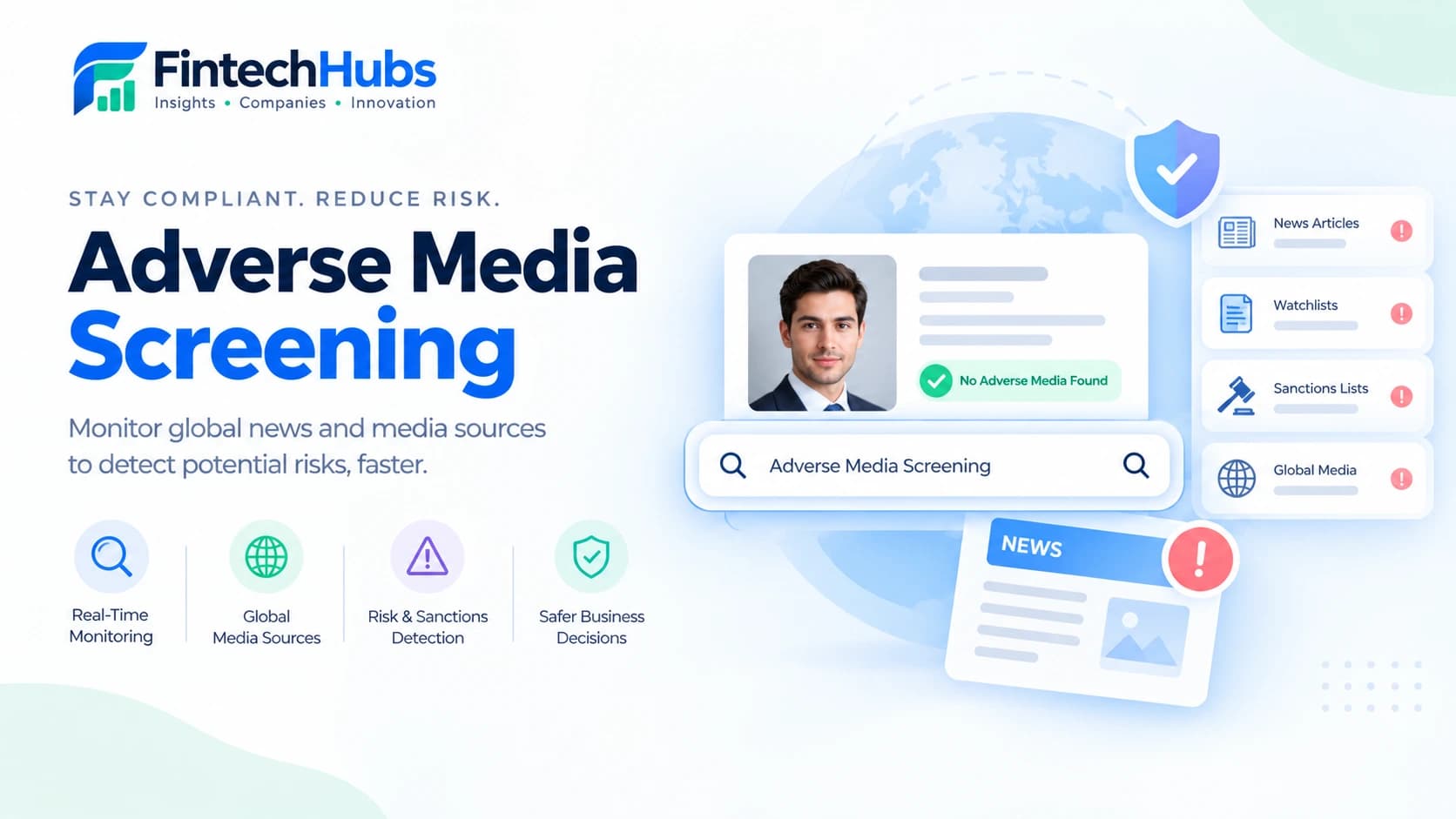
Adverse Media Screening: A Guide to Smarter Risk Management
Financial crime rarely announces itself. Before a bribery scheme, fraud ring, or sanctions-evasion network appears in a regulatory filing, there are often signs in the public record: a news report about an investigation, a court story, or a local article about a business owner's past. Adverse media screening is the practice of finding, assessing, and acting on that information.
For banks, fintechs, insurers, law firms, crypto businesses, and any organization that must know who it is dealing with, adverse media screening has moved from an optional extra to a core part of customer due diligence. This guide covers what it is, why it matters, how it works, where it goes wrong, and how to build a program that is effective and defensible.
What Is Adverse Media Screening?
Adverse media screening (also called negative news screening) is the process of searching publicly available sources for negative information about an individual or organization, then evaluating whether that information indicates financial crime, reputational, legal, or integrity risk.
It is usually applied to:
Prospective customers: During onboarding
Existing customers: Through periodic or event-driven reviews
Beneficial owners, directors, and controlling persons: Of corporate clients
Third parties: Such as suppliers, agents, intermediaries, and joint venture partners
Investment targets and counterparties: In M&A and investment due diligence
Employees and senior hires: In higher-risk roles
Unlike sanctions or watchlist screening, which match names against official lists, adverse media screening depends on unstructured information: articles, broadcasts, blogs, court reports, and other open sources. That makes it more valuable, because it can surface risk before any formal listing, and more difficult, because the information is messy, ambiguous, and enormous in volume.
Why Adverse Media Screening Matters
Detecting risk before it becomes official
Formal designations and convictions lag behind real events. Media coverage of allegations, investigations, or arrests can give early warning that a relationship carries elevated risk.
Meeting regulatory expectations
Most major anti-money laundering (AML) frameworks expect a risk-based approach to customer due diligence. Regulators and supervisory guidance in many jurisdictions treat adverse media checks as a standard component of enhanced due diligence, particularly for higher-risk customers.
Protecting reputation
Being linked to a customer involved in corruption, fraud, or human rights abuses can damage trust with clients, investors, and the public, even where no law was broken.
Reducing financial and legal exposure
Failing to identify a known risk can lead to enforcement action, fines, remediation costs, and litigation. Screening is a documented control showing that the organization took reasonable steps.
Supporting better business decisions
Beyond compliance, screening informs commercial decisions such as whether to enter a partnership, extend credit, or onboard a high-value client.
The Regulatory and Standards Landscape
Requirements differ by country and sector, so organizations should confirm obligations with qualified legal or compliance counsel. The main reference points are:
FATF Recommendations: The Financial Action Task Force sets the global standard for AML/CFT and promotes a risk-based approach, including enhanced measures for higher-risk customers.
European Union AML Directives: The successive AML directives and the newer EU AML framework emphasize customer due diligence, beneficial ownership transparency, and enhanced due diligence for high-risk relationships.
United States: The Bank Secrecy Act, the FinCEN Customer Due Diligence Rule, and guidance from federal banking regulators expect institutions to understand customer risk and monitor for suspicious activity.
United Kingdom: The Money Laundering Regulations and guidance from the Joint Money Laundering Steering Group (JMLSG) and the FCA outline risk-based due diligence expectations.
Anti-bribery and corruption laws: Laws such as the US FCPA and the UK Bribery Act make third-party due diligence, including media checks, a practical necessity.
Data protection laws: GDPR and similar regimes govern how personal data from media sources may be collected, processed, retained, and shared.
Few regulations name "adverse media" explicitly. Instead, they require institutions to understand and manage risk, and adverse media screening is a widely accepted way of doing so.
What Counts as Adverse Media?
Not every negative story is relevant to risk management. Most programs define categories tied to their risk appetite and regulatory obligations. Common categories include:
Category | Examples |
Financial crime | Money laundering, fraud, embezzlement, tax evasion, Ponzi schemes |
Corruption | Bribery, kickbacks, abuse of office, procurement fraud |
Organized crime | Racketeering, trafficking, criminal association |
Terrorism and extremism | Terrorist financing, links to designated groups |
Sanctions and trade | Sanctions evasion, export control violations, proliferation |
Cybercrime | Hacking, ransomware, illicit crypto activity |
Regulatory and legal | Enforcement actions, license revocations, bans, significant litigation |
Environmental and social | Illegal logging, forced labor, serious safety violations |
Violent and serious crime | Murder, kidnapping, serious assault |
Reputational concerns | Credible allegations of misconduct, ethics scandals |
Defining these categories, and the severity of each, in written policy is the foundation of a consistent program.
How Adverse Media Screening Works
Step 1: Define scope and risk appetite
Decide who is screened, when, in which languages and regions, and for which risk categories. A risk-based approach means higher-risk customers receive deeper screening.
Step 2: Collect subject data
Gather identifiers: full name, aliases, date of birth, nationality, country of residence, company registration details, and known associates. The more identifiers available, the more accurately results can be matched.
Step 3: Search sources
Search a broad mix of sources (see Section 6) using name variations, transliterations, and risk-related keywords.
Step 4: Match and filter
Determine whether each hit actually refers to the subject. Common names, similar company names, and shared transliterations create many false matches.
Step 5: Assess relevance and severity
Evaluate each confirmed match against questions such as:
Is the allegation relevant to financial crime or integrity risk?
How serious is it?
How recent is it?
Is the source credible?
What is the subject's role: accused, convicted, witness, victim, or bystander?
Has the matter been resolved, dismissed, or overturned?
Step 6: Escalate and decide
Route material findings to an analyst or compliance officer, who may approve, reject, request more information, apply enhanced due diligence, or exit the relationship.
Step 7: Document the rationale
Record sources reviewed, findings, reasoning, and the final decision. This is critical for audits and regulatory inquiries.
Step 8: Monitor ongoing
Risk changes over time. Ongoing monitoring re-screens customers periodically and on trigger events, and ideally alerts on new coverage in near real time.
Sources Used in Adverse Media Screening
Effective screening draws on several types of public information:
International and national news outlets
Regional and local media:Which often report first on local misconduct
Trade and industry publications
Government and regulatory publications: Such as enforcement notices and press releases
Court and legal records: Where publicly available
Law enforcement and prosecutorial announcements
NGO and investigative journalism reports
Public registers and company filings
Curated risk databases: From commercial data providers
Web and social platforms: Used with caution given reliability concerns
Source reliability matters: A report from an established outlet with editorial standards carries more weight than an anonymous blog post. Programs commonly grade sources and treat uncorroborated claims differently from corroborated ones.
Manual vs. Automated Screening
Manual screening
Analysts use search engines and databases directly.
Strengths: Flexible, good for complex or niche cases, strong human judgment.
Weaknesses: Slow, inconsistent between analysts, hard to scale, and prone to gaps in language and source coverage.
Automated screening
Software searches large source sets, matches names, and categorizes content.
Strengths: Speed, scale, consistent rules, audit trails, continuous monitoring.
Weaknesses: False positives, dependence on data quality, and the need for tuning and oversight.
The hybrid model
Most mature programs combine both. Technology handles collection, matching, and prioritization, while trained analysts handle judgment-intensive review and decisions.
The Role of AI and Machine Learning
Modern screening tools increasingly use artificial intelligence to improve accuracy and efficiency:
Natural language processing (NLP): To understand context, for example distinguishing a person accused of fraud from a person who reported it.
Entity resolution: To link mentions of the same person or company across articles and name variants.
Risk classification: To tag articles by crime type and severity.
Multilingual processing: To read and translate sources from many regions.
Deduplication and clustering: To group repeated coverage of the same event so analysts review it once.
Prioritization and scoring: To rank alerts for analyst attention.
AI should support, not replace, human decision-making. Organizations should validate model performance, document how it works, and retain human oversight, particularly where decisions affect customers' access to services.
9. Key Challenges and How to Address Them
Challenge | Why it happens | Mitigation |
High false positives | Common names, partial matches, broad keywords | Use multiple identifiers, tune matching thresholds, apply entity resolution |
Information overload | Volume of global content | Risk-category filtering, deduplication, scoring |
Language and transliteration | Names spelled differently across scripts | Multilingual tools, name-variant libraries |
Source credibility | Rumors, propaganda, or defamatory content | Source grading, corroboration requirements |
Outdated or resolved matters | Old stories remain online | Recency rules, check for outcomes and retractions |
Bias and fairness | Uneven media coverage across regions and groups | Calibrated policies, human review, regular testing |
Data privacy | Processing personal data from public sources | Lawful basis, minimization, retention limits |
Inconsistent decisions | Subjective analyst judgment | Written procedures, quality assurance, decision matrices |
Resource constraints | Large alert volumes | Automation, risk-based tiering, clear escalation paths |
Best Practices for an Effective Program
Adopt a risk-based approach: Match the depth of screening to customer and product risk.
Write clear policies: Define categories, severity levels, look-back periods, and decision criteria.
Use strong identifiers: Date of birth, nationality, and company details sharply reduce false matches.
Cover multiple languages and regions: Risk is global and so should be your source coverage.
Verify before acting: Confirm identity match and source reliability before drawing conclusions.
Distinguish allegation from conviction: Treat each appropriately and avoid presuming guilt.
Apply recency thoughtfully: Define how far back you look and when older matters remain relevant.
Screen the whole relationship: Include beneficial owners, directors, and key associates, not only the account holder.
Integrate with other controls: Combine with sanctions, PEP, KYC, and transaction monitoring.
Monitor continuously: Don't rely solely on onboarding checks.
Maintain audit trails: Record what was searched, found, and decided, and why.
Train your team: Analysts need skills in open-source research, bias awareness, and regulatory expectations.
Test and tune: Review false-positive and false-negative rates regularly and adjust.
Provide a fair process: Where appropriate, allow customers to clarify adverse findings.
Adverse Media Screening Within the Wider Compliance Framework
Adverse media screening is most effective as one layer of an integrated control environment:
KYC/CDD establishes identity and baseline risk; adverse media adds behavioral and reputational context.
Enhanced Due Diligence (EDD) adverse media findings often trigger deeper investigation into source of wealth and funds.
Sanctions screening Catches formally listed parties; adverse media can reveal potential evasion before listing.
PEP screening Politically exposed persons are higher risk for corruption, and media coverage often provides context.
Transaction monitoring findings from media screening can adjust a customer's risk rating and monitoring intensity.
Suspicious activity reporting credible adverse information may support a decision to file a report where legally required.
Industry Use Cases
Banking and lending: Onboarding, correspondent banking relationships, trade finance, and private banking.
Fintech and payments: Merchant onboarding and agent networks.
Cryptocurrency and digital assets: Counterparty and customer due diligence in a high-risk environment.
Insurance and reinsurance: Underwriting, claims fraud, and intermediary vetting.
Legal and professional services: Client acceptance and conflict checks.
Real estate and luxury goods: Identifying illicit funds in high-value transactions.
Corporate compliance: Supplier, agent, and distributor due diligence.
Investment and private equity: Pre-deal integrity checks on targets, sellers, and co-investors.
Human resources: Pre-employment screening for sensitive positions, subject to local law.
Illustrative Scenario
The following is a hypothetical example for illustration only.
A bank is onboarding a trading company. Standard KYC checks are clean. Adverse media screening, however, returns several articles from regional outlets reporting that the company's majority owner is under investigation for procurement bribery in a neighboring country.
The analyst confirms the match using date of birth and company registration, assesses source credibility, and notes the matter is an active investigation with no conviction. The case is escalated for enhanced due diligence. The bank requests additional information on source of wealth, applies a higher risk rating with closer transaction monitoring, and requires senior approval before onboarding. Every step is documented.
The relationship is not automatically refused, but the risk is understood, managed, and recorded. This is the purpose of a well-run program.
Choosing an Adverse Media Screening Solution
When evaluating providers, consider:
Source breadth and depth: Global, regional, and local coverage; update frequency.
Language support: Native-language search and transliteration handling.
Matching accuracy: Fuzzy matching quality and entity resolution.
Risk categorization: Relevance and quality of crime-type tagging.
False-positive management: Filtering, scoring, and deduplication.
Explainability: Whether results and AI decisions can be understood and justified.
Workflow and case management: Alerts, escalations, notes, and approvals.
Audit trail and reporting: Evidence for regulators and internal audit.
Integration: APIs and compatibility with KYC, onboarding, and monitoring systems.
Security and privacy: Data protection, hosting, certifications, and retention controls.
Scalability and cost: Fit for current and projected volumes.
Vendor support and governance: Transparency about methodology and ongoing improvement.
Measuring Program Effectiveness
Useful key performance indicators include:
Alert volume and false-positive rate
True-positive rate and material findings per period
Average time to review and resolve an alert
Percentage of alerts escalated a.dnd outcomes of escalation
Backlog and aging of open alerts
Quality assurance pass rate on analyst decisions
Coverage: share of customer base screened and re-screened on schedule
Number of relationships exited or restricted due to findings
Audit and regulatory findings related to screening
Data Protection and Ethical Considerations
Adverse media involves personal data and allegations about real people, so responsible handling is essential:
Lawful basis and purpose limitation: Process data only for legitimate compliance purposes.
Data minimization and retention: Keep only what is necessary, for as long as necessary.
Accuracy: Verify information and correct or remove findings that prove wrong.
Fairness and non-discrimination: Avoid decisions based on bias, rumor, or irrelevant characteristics.
Proportionality: Don't treat every negative story as disqualifying.
Transparency and recourse: Offer a way for individuals to respond where appropriate and lawful.
Security: Protect screening results as sensitive information.
Implementation Roadmap
Assess: Current risks, regulatory obligations, and existing controls.
Define: Policy, risk categories, severity levels, and decision rules.
Select: Tools and data sources that fit your risk profile.
Design: Workflows for alerts, escalation, and documentation.
Pilot: On a sample population and measure false positives.
Train: Analysts and compliance staff.
Deploy: Across customer segments, starting with highest risk.
Monitor and refine: Thresholds, categories, and processes.
Review: Regularly through independent testing and audits.
Future Trends
Generative AI and large language models: For summarizing articles and drafting case notes, with human validation.
Real-time and event-driven monitoring: Replacing periodic batch reviews.
Greater multilingual and cross-border coverage: As risk becomes more global.
Network and relationship analysis: Linking individuals, companies, and events.
Explainable AI: Driven by regulatory demand for transparency.
Deeper integration: of adverse media with transaction, behavioral, and ownership data.
Growing concern over misinformation and synthetic content: increasing the importance of source verification.
Frequently Asked Questions (FAQs)
1. What is adverse media screening?
It is the process of searching public sources for negative information about a person or organization and assessing whether it indicates financial crime, legal, or reputational risk.
2. Is adverse media screening legally required?
Few laws mention it by name, but most AML and anti-corruption frameworks require risk-based due diligence. Regulators widely regard adverse media checks as a standard way to meet that expectation, especially for higher-risk customers. Check the specific rules in your jurisdiction.
3. How is adverse media screening different from sanctions or PEP screening?
Sanctions and PEP screening compare names against official or curated lists. Adverse media screening analyzes unstructured news and public content, which can reveal risk before any formal listing.
4. When should adverse media screening be performed?
At onboarding, periodically during the relationship based on risk, and when trigger events occur, such as a change in ownership, unusual activity, or news alerts. Continuous monitoring is increasingly common.
5. Who should be screened?
The customer, beneficial owners, directors, controlling persons, and, for higher-risk relationships, key associates and third parties.
6. What types of news are considered adverse?
Reports of financial crime, corruption, fraud, terrorism, sanctions violations, organized crime, serious regulatory breaches, and other serious misconduct. Your policy should define the categories and severity levels.
7. How far back should screening go?
There is no universal rule. Many organizations set look-back periods by risk category and severity, keeping older matters in scope when they involve serious crimes or remain unresolved.
8. How can false positives be reduced?
Use strong identifiers, entity resolution, tuned matching thresholds, risk-category filters, and deduplication, and review results with trained analysts.
9. Does adverse media always mean rejecting a customer
No. Findings must be assessed for identity match, source credibility, severity, recency, and outcome. Many cases lead to enhanced due diligence or closer monitoring rather than refusal.
10. Can AI replace human analysts in adverse media screening?
No. AI can speed up collection, matching, and prioritization, but human judgment is needed to interpret context, weigh credibility, and make fair, defensible decisions.
Conclusion
Adverse media screening turns the public record into a practical risk management tool. Done well, it gives organizations early warning of financial crime and reputational threats, supports regulatory compliance, and improves the quality of business decisions. Done poorly, it buries teams in noise or leaves real risks undetected.
The most effective programs combine clear policy, risk-based scoping, strong technology, skilled analysts, and rigorous documentation. They treat adverse media not as a box to tick but as a continuous source of intelligence within a broader compliance framework. As sources multiply, AI advances, and regulators raise expectations, organizations that invest in a smart, balanced screening approach will be better placed to protect themselves and the communities they serve.
Share this article
Related Articles
Sanctions Screening: Compliance & Risk Management Guide
Learn how sanctions screening helps businesses detect restricted entities, reduce financial crime risks, and maintain regulatory compliance.

Biometric Authentication: Secure, Password Free Identity
A complete look at biometric verification for secure identity authentication: how it works, key technologies, and why it's replacing passwords.

Liveness Detection: A Complete Guide
Understand liveness detection how it stops spoofing and deepfakes, active vs passive methods, key technologies, industries, best practices, and 10 FAQs.