
Predictive Financial Analytics: AI Forecasting in 2026
Learn how predictive financial analytics and AI are transforming forecasting in 2026, from cash flow and credit risk to scenario planning and best practices.
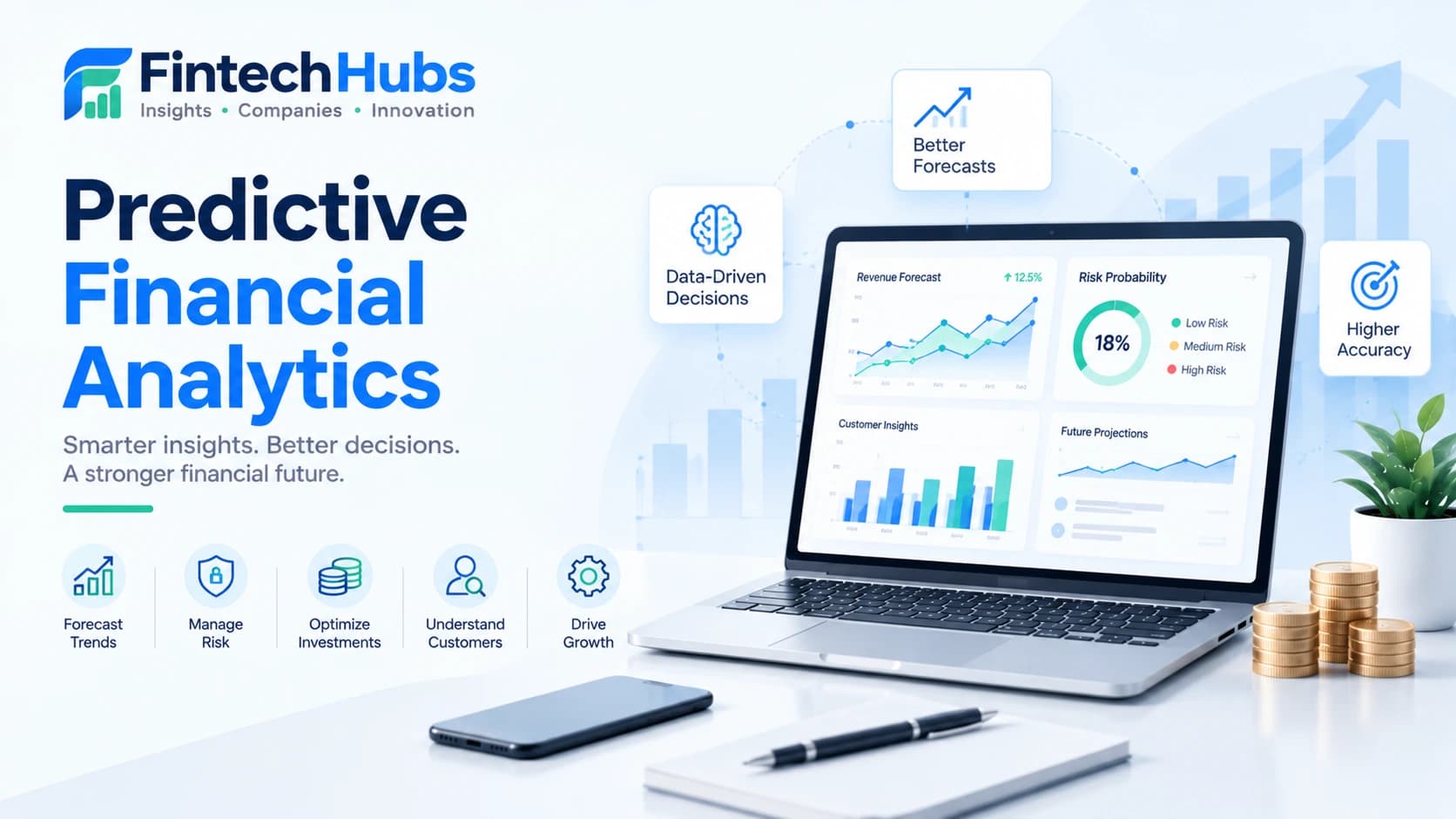
Predictive Financial Analytics: How AI Is Transforming Financial Forecasting in 2026
Financial forecasting has always been central to planning: budgets, cash management, credit decisions, capital allocation, and risk control all depend on estimates of what will happen next. For decades, those estimates relied on spreadsheets, historical averages, and the judgment of finance teams. That approach works in stable conditions but struggles when markets move quickly, data volumes grow, and business models change.
Predictive financial analytics applies statistical modeling and artificial intelligence to financial data to estimate future outcomes such as revenue, cash flow, credit losses, demand, and risk. In 2026, machine learning, large language models, and cloud data platforms have made these methods accessible to organizations well beyond large banks and hedge funds.
This guide explains what predictive financial analytics is, how it works, where it is used, and what organizations should consider when adopting it.
This article is for general informational and educational purposes only. It does not constitute financial, investment, legal, or tax advice. Forecasts are estimates, not guarantees.
What Is Predictive Financial Analytics
Predictive financial analytics is the use of historical and real-time data, statistical techniques, and machine learning models to forecast future financial outcomes and to quantify the uncertainty around them. It sits between descriptive analytics (what happened) and prescriptive analytics (what should we do), answering the question: what is likely to happen next?
Typical outputs include revenue and expense forecasts, cash flow projections, probability of default for a borrower, expected fraud losses, demand estimates, and scenario ranges under different assumptions.
How Predictive Financial Analytics Works
Define the forecasting objective: Specify the target (for example, next quarter's cash position), the time horizon, and the decision the forecast will support.
Collect and integrate data: Combine internal sources such as ledgers, billing, and transaction data with external signals such as economic indicators and market data.
Clean and prepare data: Handle missing values, correct errors, align time periods, and remove duplicates.
Engineer features: Create variables that capture seasonality, trends, customer behavior, and relationships between metrics.
Select and train models: Choose suitable algorithms and train them on historical data.
Validate and backtest: Test models on data they have not seen to check accuracy and stability.
Deploy into workflows: Feed forecasts into planning tools, dashboards, or automated decisions.
Monitor and retrain: Track accuracy over time and update models as conditions change.
Traditional Forecasting vs. AI-Driven Forecasting
Dimension | Traditional Forecasting | AI-Driven Forecasting |
|---|---|---|
Method | Spreadsheets, trend lines, manual assumptions | Machine learning and statistical models trained on data |
Data used | Mostly internal, structured data | Internal, external, and unstructured data |
Update frequency | Periodic (monthly, quarterly) | Continuous or near real time |
Granularity | Often aggregated | Can forecast at detailed levels (product, customer, region) |
Scenario analysis | Manual, limited scenarios | Many scenarios generated quickly |
Bias | Subject to human optimism or conservatism | Reduces some bias but can inherit data bias |
Explainability | Easy to trace | Varies; complex models need explainability tools |
Human role | Builds the numbers | Reviews, challenges, and interprets model output |
The two approaches are complementary. Many finance teams use AI forecasts as a baseline and apply human judgment for events the data cannot capture.
Core Machine Learning Techniques
5.1 Time Series Models
Methods such as ARIMA (Autoregressive Integrated Moving Average), exponential smoothing, and newer deep learning architectures model patterns over time, including trend and seasonality.
5.2 Regression and Tree-Based Models
Linear regression, gradient boosting, and random forests relate outcomes to multiple drivers and often perform strongly on structured financial data.
5.3 Neural Networks and Deep Learning
Recurrent and transformer-based models can capture complex, non-linear relationships in large datasets.
5.4 Classification Models
Used to estimate probabilities, such as the likelihood a borrower defaults or an invoice is paid late.
5.5 Probabilistic and Bayesian Methods
Produce a range of outcomes with confidence intervals rather than a single number, which supports better risk-aware decisions.
5.6 Natural Language Processing and Large Language Models
Extract signals from text such as earnings commentary, contracts, and news, and help analysts query data and draft narrative explanations of forecasts.
5.7 Scenario Simulation and Monte Carlo Methods
Run thousands of simulated paths to estimate how outcomes vary under different assumptions.
5.8 Anomaly Detection
Flags unusual movements in financial data that may indicate errors, fraud, or emerging risk.
Types/Branches of Predictive Financial Analytics
6.1 Revenue and Sales Forecasting
Estimates future sales by product, segment, or region using historical sales, pipeline data, pricing, and seasonality.
6.2 Cash Flow and Liquidity Forecasting
Predicts inflows and outflows so treasury teams can manage working capital and funding needs.
6.3 Credit Risk and Default Prediction
Estimates the probability that a borrower will not repay, supporting underwriting, pricing, and loss provisioning.
6.4 Fraud and Loss Forecasting
Predicts expected fraud losses and flags high-risk transactions or accounts.
6.5 Budgeting and Financial Planning (FP&A)
Automates baseline budgets, rolling forecasts, and variance analysis for corporate finance teams.
6.6 Market and Investment Forecasting
Supports portfolio risk estimates, volatility forecasts, and scenario analysis for investment decisions.
6.7 Customer Behavior and Lifetime Value Prediction
Forecasts churn, spending, and customer value to guide pricing, retention, and marketing spend.
6.8 Demand and Inventory Forecasting
Links demand predictions with procurement and financial planning for product-based businesses.
6.9 Stress Testing and Scenario Planning
Models how portfolios and balance sheets might behave under adverse economic conditions.
6.10 Insurance and Claims Forecasting
Estimates claim frequency and severity to support pricing and reserving.
Key Data Sources
Internal financial data: General ledger, accounts receivable and payable, billing, payroll
Transaction and customer data: Payments, usage, subscriptions, support interactions
Market data: Prices, rates, volatility, commodity and currency movements
Macroeconomic indicators: Inflation, employment, interest rates, consumer sentiment
Alternative data: Web traffic, shipping data, satellite imagery, and similar non-traditional signals, used subject to licensing and privacy rules
Unstructured text: Earnings call transcripts, filings, contracts, and news
Data quality and rights to use the data matter as much as model sophistication.
Technologies and Tools Powering Predictive Analytics
Cloud data platforms and warehouses: For scalable storage and processing
Machine learning frameworks: For training and deploying models
Automated machine learning (AutoML): To speed up model selection and tuning
Data pipelines and API: Integrate ERP, banking, and market data
Business intelligence and visualization tools: To present forecasts to decision-makers
Large language model assistants: That let finance users ask questions in plain language and generate commentary
Model monitoring and explainability tools: To track drift and interpret predictions
Connected planning platforms: That embed forecasts into budgeting and FP&A workflows.
Why It Matters
Better forecasts improve decisions across the organization. A more accurate cash flow forecast reduces the need for expensive short-term borrowing. Improved credit risk prediction supports fairer pricing and lower losses. Faster scenario analysis helps leaders react to changing conditions rather than waiting for the next planning cycle.
Predictive analytics also changes how finance teams spend their time, shifting effort from assembling numbers to analyzing drivers and advising the business.
Industries and Use Cases
Banking: Credit scoring, loss provisioning, liquidity forecasting, fraud loss estimation
Fintech and lending: Underwriting, repayment prediction, customer lifetime value
Insurance: Claims forecasting, pricing, reserving
Asset and wealth management: Risk forecasting, scenario analysis, client outcome projections
Corporate finance (all sectors): Revenue forecasts, cash management, rolling budgets
Retail and e-commerce: Demand and revenue forecasting, markdown planning
Healthcare and public sector: Budget forecasting and resource planning
Energy and commodities: Price and demand forecasting, hedging analysis
Benefits of AI-Driven Financial Forecasting
Improved accuracy in many settings, especially where large datasets and complex patterns exist
Speed: forecasts and scenarios update in minutes rather than weeks
Granularity: predictions at detailed levels rather than only totals
Earlier warning: detection of emerging risks and trend shifts
Efficiency: less manual data assembly for finance teams
Consistency: repeatable, documented methods across teams
Better uncertainty handling: ranges and probabilities support risk-aware planning
Challenges and Limitations
Data quality and silos: Incomplete or inconsistent data produces unreliable forecasts.
Model drift: Relationships change over time, so models need ongoing monitoring and retraining.
Unprecedented events: Models trained on history may fail in conditions never seen before.
Explainability: Complex models can be hard for stakeholders, auditors, and regulators to interpret.
Overfitting: A model that fits history too closely may perform poorly on new data.
Bias and fairness: Models can reproduce or amplify bias in historical data, especially in credit decisions.
Generative AI errors: Language models can produce confident but incorrect commentary and require verification.
Skills and change management: Teams need data literacy, and forecasts must be trusted to be used.
Cost and infrastructure: Implementation requires investment in data, tools, and talent.
Governance, Risk, and Regulatory Considerations
Organizations using predictive models for financial decisions should consider:
Model risk management: documentation, independent validation, and ongoing performance review, particularly in regulated institutions
Explainability and transparency: the ability to explain how a model reached an outcome, especially for credit and other consumer-impacting decisions
Fairness and non-discrimination: testing models for biased outcomes across groups
Data privacy and protection: lawful collection, consent, retention, and cross-border handling of personal data
Data licensing: confirming rights to use external and alternative data
Auditability: keeping records of inputs, model versions, and decisions
Human oversight: defining when people must review or override automated outputs
Emerging AI regulation: requirements for higher-risk AI uses are evolving across jurisdictions
Requirements differ by country and sector. Consult current regulatory guidance and qualified professionals.
Best Practices for Implementation
Start with a clear business question: And a measurable success metric.
Invest in data foundations: Before advanced models.
Begin with a focused use case: Such as cash flow or collections, then expand.
Benchmark against a simple baseline: To confirm that added complexity is worthwhile.
Keep humans in the loop, combining model output with business knowledge.
Document assumptions and model versions: For transparency and audit.
Monitor accuracy and drift: And retrain on a schedule.
Use scenario ranges: Not single-point forecasts, when decisions carry risk.
Train finance teams: To interpret and challenge model output.
Verify generative AI output: Before it appears in reports or external communications.
Measuring Forecast Accuracy
Common measures include:
Mean absolute error (MAE) and mean absolute percentage error (MAPE) for average forecast miss
Root mean squared error (RMSE), which penalizes large misses more heavily
Bias, to check whether forecasts consistently run high or low
Prediction interval coverage, to test whether stated ranges contain actual outcomes as often as claimed
Backtesting results across different periods and market conditions
Business impact metrics, such as reduced borrowing costs or lower credit losses
No single metric is sufficient; use several and compare them against a baseline method.
Future Trends in 2026 and Beyond
Generative AI as a finance copilot: That explains variances, drafts commentary, and answers questions about forecasts in natural language
Continuous, driver-based forecasting: Replacing fixed annual budget cycles
Real-time forecasting: Fed by payment, banking, and operational data streams
Greater explainability: Driven by regulatory and internal governance expectations
Agentic workflows: In which AI systems prepare, test, and refresh forecasts with human approval
Wider access: As cloud and low-code tools reduce the cost for mid-sized organizations
Stronger model governance: As AI-specific regulation and supervisory expectations mature
Integration of external and alternative data: With stronger attention to privacy and licensing
Frequently Asked Questions
1. What is predictive financial analytics?
It is the use of data, statistics, and machine learning to forecast future financial outcomes such as revenue, cash flow, credit risk, and losses.
2. How is AI changing financial forecasting?
AI can process larger and more varied datasets, update forecasts continuously, run many scenarios quickly, and detect patterns that manual methods may miss.
3. Is AI forecasting more accurate than traditional methods?
Often it is, particularly with large, high-quality datasets, but not always. Simple methods can perform well in stable conditions, so models should be benchmarked against a baseline.
4. Does AI replace finance professionals?
No. It automates data work and generates baselines, while professionals provide judgment, context, and accountability for decisions.
5. What data do I need to get started?
Clean historical financial data such as sales, expenses, and cash flows is the foundation. External economic and market data can be added later.
6. Can small and mid-sized businesses use predictive analytics?
Yes. Cloud-based planning tools and AutoML have lowered cost and technical barriers, making basic predictive forecasting accessible to smaller organizations.
7. What are the main risks of AI forecasting?
Poor data quality, model drift, overfitting, bias, limited explainability, and over-reliance on model output without human review.
8. How do models handle unexpected events like a sudden economic shock?
Models trained in history may struggle. Scenario analysis, stress testing, and human judgment are important complements during unusual conditions.
9. How often should forecasting models be updated?
It depends on the use case, but models should be monitored continuously and retrained regularly, or whenever accuracy declines or conditions change significantly.
10. Are AI financial models regulated?
Regulated institutions face model risk management, fairness, and privacy expectations, and AI-specific rules are developing in many jurisdictions. Requirements vary, so check current guidance.
Conclusion
Predictive financial analytics is changing financial forecasting from a periodic, manual exercise into a continuous, data-driven capability. Machine learning improves speed, granularity, and the handling of uncertainty, while generative AI is making forecasts easier to explore and explain. The strongest results come from combining reliable data, sound governance, and human judgment, and from treating forecasts as ranges of likely outcomes rather than certainties. Organizations that build these foundations in 2026 are better positioned to plan with confidence as conditions evolve.
Disclaimer: This article is provided for general informational and educational purposes only. It does not constitute financial, investment, legal, or tax advice. Forecasts and models carry uncertainty and may be inaccurate. Readers should consult qualified professionals before making financial decisions.
Share this article
Related Articles
AML Screening Explained: Process, Types, Tools and Best Practices
Learn what AML screening is, why it matters, how the process works, what lists and checks are involved, common challenges, and how to build an effective screening program.
FinTech Software Development: Solutions, Benefits & Trends
Fintech software development explained: services, architecture, PCI DSS and DORA compliance, delivery process, pricing models, partner checklist, and FAQs.

Top 10 Fintech Companies in India: Services & Comparison
Compare the top 10 fintech companies in India, from PhonePe and Razorpay to Groww and Zerodha. See services, features, and how to choose the right platform.