FinTech Software Development: Solutions, Benefits & Trends
Fintech software development explained: services, architecture, PCI DSS and DORA compliance, delivery process, pricing models, partner checklist, and FAQs.
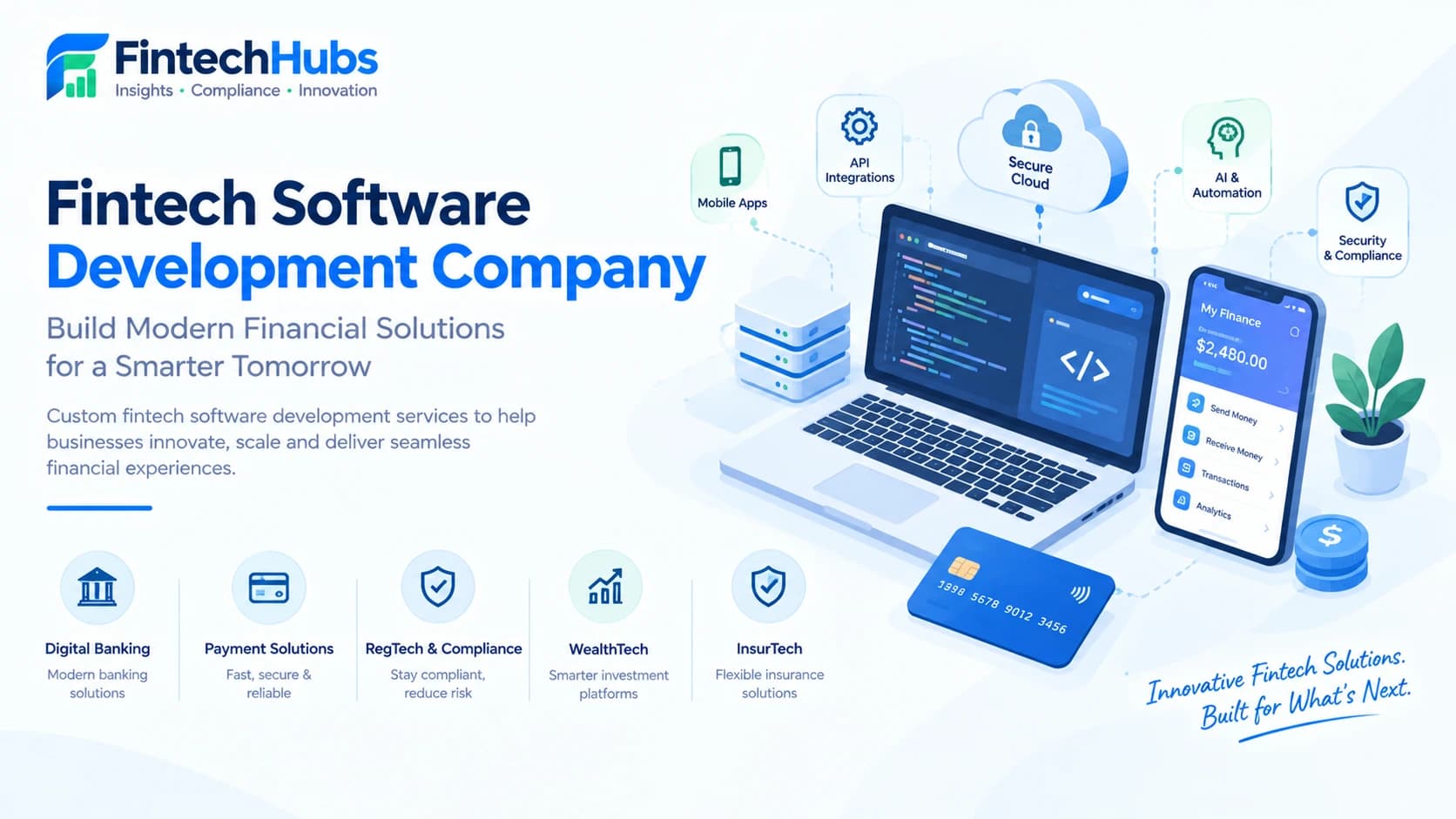
Fintech Software Development Company: Services, Technology, Compliance, and How to Choose the Right Partner
A fintech software development company designs, builds, integrates, tests, and maintains software for financial products. The work is harder than ordinary application development because the software handles money, personal data, and regulated activity. Errors are costly, downtime is visible, security failures are reputation-ending, and compliance is not optional.
This guide explains what such a company does, the types of solutions it builds, the technology and architecture patterns it uses, the regulatory and security standards it must respect, how a mature delivery process works, how engagement and pricing models compare, and how to evaluate and select a partner. It closes with trends, pitfalls, a due-diligence checklist, and 10 FAQs. The central message: in fintech, the right development partner is the one that combines financial domain knowledge, security and compliance discipline, and reliable engineering, not simply the one with the lowest rate or the longest technology list.
What Is a Fintech Software Development Company?
1.1 Definition
A fintech software development company is a technology services or product engineering firm that specializes in building software for financial services. Clients include:
Startups creating new financial products
Banks and credit unions modernizing channels and core systems
Payment service providers and processors building platforms and integrations
Lenders and non-bank financial companies digitizing origination and servicing
Insurers and wealth managers building digital experiences and analytics
Non-financial companies embedding payments, lending, or banking into their products
1.2 How it differs from a general software company
Dimension | General software development | Fintech software development |
|---|---|---|
Data sensitivity | Moderate | Very high: financial, identity, and transaction data |
Regulation | Varies | Heavy and multi-jurisdictional |
Correctness | Bugs are inconvenient | Bugs can mean financial loss, legal exposure, and customer harm |
Availability | High desirable | Often near-continuous, with strict recovery targets |
Auditability | Optional | Mandatory: every action must be traceable |
Integration | Typical APIs | Banks, card networks, payment rails, bureaus, KYC and AML vendors |
Domain knowledge | Helpful | Essential: ledgers, settlement, reconciliation, risk, compliance |
1.3 Business models
Companies in this space generally operate as one or more of:
Custom development partner: Builds bespoke products for a client.
Product engineering partner: Acts as an extended team for a long-lived product.
Platform or white-label provider: Offers reusable components or modules to configure and extend.
Consulting and integration specialist: Of causes on architecture, vendor selection, and system integration.
Why Demand Keeps Growing
Customer expectations: People expect instant, mobile-first, transparent financial services.
Real-time payments: Instant payment systems around the world require always-on, resilient platforms.
Open banking and open finance: Standardized APIs allow new services to be built on shared data, with customer consent.
Embedded finance: Non-financial brands add payments, credit, and insurance directly into their journeys.
Legacy modernization: Many institutions run decades-old core systems that limit speed and increase cost.
Regulatory change: New rules for resilience, reporting, authentication, and data require continual engineering.
Data and AI: Institutions want better risk, fraud, personalization, and operations through analytics and automation.
Core Services
Service | What it includes |
|---|---|
Product discovery and consulting | Market and user research, scope definition, regulatory mapping, roadmap, build-versus-buy analysis |
UX and UI design | Research, prototyping, accessible interfaces, trust and security cues, onboarding design |
Web and mobile app development | Customer apps, merchant dashboards, admin and back-office portals |
Backend and API development | Services for accounts, transactions, ledgers, notifications, and reporting |
Payments engineering | Gateway and PSP integration, card and bank payments, wallets, payouts, reconciliation |
Core banking and ledger systems | Account management, double-entry ledgers, interest and fee engines, product configuration |
Lending platforms | Application, credit scoring, underwriting workflows, servicing, collections |
KYC, AML, and onboarding | Identity verification, screening, risk scoring, case management |
Fraud and risk systems | Rules engines, machine learning models, monitoring, alerts |
Open banking and API integration | Consent management, data aggregation, third-party provider connections |
Data engineering and analytics | Pipelines, warehouses, dashboards, regulatory and management reporting |
AI and automation | Document processing, assistants, anomaly detection, operations automation |
Cloud and DevOps | Infrastructure as code, CI/CD, observability, resilience, cost management |
Security and compliance engineering | Secure design, penetration testing support, audit evidence, control automation |
Quality assurance | Functional, performance, security, and reconciliation testing |
Maintenance and support | Monitoring, incident response, upgrades, and enhancements |
Legacy modernization | Migration, API enablement, strangler-pattern refactoring, data migration |
Types of Fintech Solutions
4.1 Payments and money movement
Payment gateways and orchestration, merchant acquiring tools, digital wallets, remittance platforms, bill payment, payouts and marketplace splits, instant payment connectors, and reconciliation systems.
4.2 Digital banking and neobanks
Mobile-first current accounts, savings, cards, spending analytics, and savings goals, often built on a banking-as-a-service provider or on a licensed institution’s core.
4.3 Lending and credit
Loan origination and servicing, buy-now-pay-later, credit scoring with alternative data, invoice financing, and collections tools.
4.4 Wealth, trading, and investment
Brokerage apps, robo-advisory, portfolio analytics, order management, and compliance monitoring.
4.5 Insurance technology
Policy administration, claims automation, underwriting engines, and embedded insurance.
4.6 Regulatory technology (RegTech)
Transaction monitoring, sanctions screening, regulatory reporting, audit trails, and compliance workflow tools.
4.7 Embedded finance and BaaS
APIs and orchestration layers that let non-financial companies offer accounts, cards, lending, or payments under the oversight of a regulated partner.
4.8 Digital assets and tokenization
Wallets, custody integrations, exchanges, and tokenized-asset platforms, all subject to rapidly evolving, jurisdiction-specific rules. Clients should verify legal status early.
4.9 Enterprise finance tools
Treasury management, cash forecasting, expense management, invoicing, and accounts payable and receivable automation.
Technology and Architecture
5.1 Architectural principles
Correctness first: Financial state changes must be accurate, idempotent, and reproducible.
Double-entry ledger design: Every movement of value is recorded as balanced entries, giving traceability and simple reconciliation.
Event-driven architecture: Domain events (payment initiated, authorized, settled, reversed) support auditability, integration, and real-time features.
Idempotency and retries: APIs must tolerate repeated requests without duplicating money movement.
Resilience: Redundancy, graceful degradation, and tested disaster recovery.
Separation of concerns: Isolate sensitive components (card data, keys, identity) to reduce risk and compliance scope.
Observability: Logs, metrics, and traces tied to business transactions.
5.2 Common technology building blocks
Layer | Typical choices |
|---|---|
Front end | React, Angular, or Vue for web; native or cross-platform frameworks for mobile |
Back end | Java, Kotlin, C#, Go, Node.js, or Python, chosen for reliability, ecosystem, and team skills |
Data stores | Relational databases for transactional integrity; caches; document or search stores for specific needs |
Messaging | Event streaming and message queues for asynchronous processing |
Infrastructure | Public cloud, containers, orchestration, infrastructure as code |
Security | Identity providers, secrets management, hardware security modules or managed key services, WAF |
Observability | Centralized logging, metrics, tracing, alerting |
Data and AI | Data warehouses and lakes, feature stores, model monitoring |
Technology choice should follow requirements for consistency, latency, regulatory residency, and team expertise, not fashion.
5.3 Integration landscape
Fintech products rarely stand alone. Typical integrations include:
Banks and payment rails (cards, bank transfers, instant payment schemes)
Payment gateways, acquirers, and PSPs
Identity verification, document verification, and biometric providers
Sanctions, PEP, and adverse-media screening services
Credit bureaus and alternative data providers
Accounting, ERP, and CRM systems
Notification providers (email, SMS, push)
Regulatory reporting gateways
A strong partner designs an anti-corruption layer or adapter pattern so that vendor changes do not ripple through the whole system, and builds for vendor outages with fallback options.
5.4 Legacy modernization approaches
API wrapping: Expose legacy functions through modern APIs without replacing the core.
Strangler pattern: Gradually move capabilities to new services while the old system continues to run.
Parallel run: Operate old and new in tandem and compare results before cutover.
Core replacement: A full migration, which is the highest-risk path and needs thorough data migration, testing, and rollback plans.
5.5 AI in fintech software
AI is used for fraud detection, credit decisioning, document extraction, customer service, and operations. Good practice includes explainability where decisions affect customers, bias testing, human oversight on consequential decisions, strict data governance, and clear controls over generative AI use with sensitive data.
Security, Compliance, and Regulation
Regulatory requirements depend on the product type, the countries involved, and the institution’s licence. The standards below are common reference points; a competent partner will map applicable rules early.
6.1 Security and assurance frameworks
Standard or regulation | Relevance |
|---|---|
PCI DSS (currently version 4.0.1) | Required wherever payment card data is stored, processed, or transmitted |
ISO/IEC 27001 | Information security management system certification |
SOC 2 | Independent report on security, availability, confidentiality, and related controls |
GDPR and other data protection laws | Lawful processing, data subject rights, breach notification, cross-border transfers |
PSD2 and open banking rules | Strong customer authentication and regulated third-party access in the EU, UK, and similar regimes |
AML/CFT requirements | Customer due diligence, monitoring, reporting of suspicious activity |
DORA (EU Digital Operational Resilience Act) | ICT risk management, incident reporting, testing, and third-party oversight for EU financial entities, applicable from January 2025 |
Local central bank and financial regulator rules | Licensing, outsourcing, data localization, reporting, and consumer protection |
Rules evolve (for example, EU payments legislation is under ongoing revision), so always check current requirements with legal counsel.
6.2 Secure development practices
Threat modeling: At design time for each major feature.
Secure SDLC: Code review, static and dynamic analysis, dependency scanning, and secrets detection in CI/CD.
Least privilege and segregation of duties: Across environments and teams.
Strong encryption: For data in transit and at rest, with managed key lifecycle.
Tokenization: And data minimization to reduce exposure of card and personal data.
Penetration testing: Before launch and periodically afterward.
Software bill of materials: And supply-chain risk management.
Incident response plans: That are rehearsed, with clear roles and notification procedures.
Audit logging: That is tamper-resistant and aligned with retention rules.
6.3 Compliance by design
Rather than treating compliance as a final review, mature teams embed it: regulatory requirements become backlog items and acceptance criteria, controls are automated and produce evidence continuously, and compliance specialists participate in design reviews.
A Mature Delivery Process
Stage 1: Discovery and scoping (typically 2-6 weeks)
Clarify business goals, users, and success metrics.
Map regulatory and licensing implications.
Define scope, assumptions, risks, and integration needs.
Produce a roadmap and a high-level architecture.
Stage 2: Design
User research, journeys, and prototypes.
Detailed architecture, data model, and security design.
API contracts and integration specifications.
Stage 3: Minimum viable product (MVP) build
Prioritize the smallest set of features that proves value and can legally and safely operate.
Build in short iterations with demonstrations and stakeholder feedback.
Stage 4: Testing and assurance
Automated unit, integration, and end-to-end tests.
Financial correctness tests: ledger balance checks, rounding, currency handling, idempotency, reversal and refund flows, reconciliation against simulated external statements.
Performance and load tests for peak events.
Security testing and independent penetration tests.
User acceptance testing and, where needed, regulator or partner certification tests.
Stage 5: Launch
Staged rollout with feature flags, limited cohorts, and monitoring.
Runbooks, support training, and rollback plans.
Go-live checklist signed off by engineering, security, compliance, and operations.
Stage 6: Operate and improve
Service-level objectives, on-call rotation, and incident reviews.
Continuous releases, dependency upgrades, and cost optimization.
Product analytics and a regular roadmap review.
Durations depend on scope, regulatory approvals, and third-party dependencies, and are illustrative.
Engagement Models and Pricing Factors
8.1 Engagement models
Model | Description | Best for | Watch-outs |
|---|---|---|---|
Fixed price | Defined scope, schedule, and price | Well-understood, small to medium projects | Change requests, scope disputes, hidden quality trade-offs |
Time and materials | Pay for effort; scope evolves | Evolving products and discovery-heavy work | Needs strong governance and transparent reporting |
Dedicated team | Long-term team working as part of the client organization | Ongoing product development | Requires clear ownership and onboarding |
Build-operate-transfer | Partner builds and runs a team, then transfers it to the client | Setting up an offshore or nearshore center | Needs a clear transfer plan and knowledge capture |
Outcome or milestone-based | Payments linked to deliverables or results | Clear measurable goals | Requires precise acceptance criteria |
8.2 Factors that drive cost and time
Product complexity and number of integrations
Regulatory scope and number of jurisdictions
Security and availability requirements
Platforms (web, iOS, Android, back office)
Data migration and legacy dependencies
Team seniority, location, and size
Quality and testing depth
Post-launch support and service levels
Be cautious of estimates that look unusually low for regulated, integration-heavy products; they often omit security, compliance, testing, and operations.
Build, Buy, or Partner?
Option | Advantages | Disadvantages |
|---|---|---|
Buy a packaged platform | Faster start, proven components, vendor support | Customization limits, licence costs, vendor lock-in |
Build custom | Differentiation, full control | Longer time, higher risk and cost |
Hybrid (buy the commodity, build the differentiator) | Balances speed and uniqueness | Needs good integration architecture |
Partner with a development company | Access to expertise and capacity | Requires strong governance and knowledge transfer |
A common wise pattern is to buy or configure commodity capabilities (such as identity verification or card issuing) and build what differentiates the product, using a development partner to integrate and accelerate.
How to Choose a Fintech Software Development Partner
10.1 Evaluation criteria
Domain expertise: Demonstrated experience in your segment (payments, lending, banking, etc.) and your target regulatory regimes.
Security and compliance maturity: Relevant certifications or attestations, documented secure SDLC, and willingness to share audit evidence.
Engineering quality: Code review practices, automated testing, CI/CD, observability, and incident handling.
Architecture capability: Ability to explain trade-offs and design for resilience, scale, and change.
Team stability and seniority: Low turnover, clear roles, and access to senior engineers and architects.
Transparent communication: Regular demos, accessible project data, honest risk reporting.
References and case studies: Verifiable client references, ideally with similar scope and regulation.
Intellectual property and exit: Clear ownership of code, documentation, and infrastructure, plus transition support if you leave.
Commercial fit. Pricing transparency, flexible terms, and clear service levels.
Cultural and time-zone fit: Overlapping hours and shared working style.
10.2 Questions to ask
How do you ensure financial correctness, and how do you test ledger and reconciliation logic?
How do you handle sensitive data, secrets, and production access?
Which compliance frameworks have you implemented for clients, and what evidence can you provide?
How do you manage third-party vendor outages and API changes?
What is your approach to incident response and post-incident review?
Who will actually work on our project, and what happens if they leave?
How do you handle scope changes and technical debt?
Can we speak to two or three clients in similar situations?
10.3 Red flags
Vague answers about security or testing
No experience with regulated environments but claims of “full compliance”
Reluctance to share references or sample documentation
Pressure to sign quickly with no discovery phase
Fixed-price promises on ill-defined scope
Heavy dependence on junior staff for critical financial logic
Unclear code ownership or restrictive exit terms
10.4 Run a paid pilot
Before a large commitment, consider a small, paid engagement such as a discovery sprint or proof of concept. It reveals communication quality, technical depth, and working style at low risk.
Governance and Collaboration
Clear ownership: A product owner on the client side with decision authority.
Shared definition of done: Including security, tests, documentation, and compliance evidence.
Regular rhythm: Sprint planning, demos, retrospectives, and steering reviews.
Risk and dependency registers: Reviewed frequently.
Knowledge management: Architecture decision records, runbooks, and onboarding guides so no single person is a bottleneck.
Access controls:: Last-privilege access to production, with approvals and audit trails for the partner’s staff.
Measuring Success
Delivery
Lead time and deployment frequency
Change failure rate and time to restore service
Scope and schedule predictability
Quality and reliability
Defect escape rate and severity
Availability against service-level objectives
Reconciliation break rate and incident counts
Security and compliance
Vulnerability remediation time
Audit findings and control test results
Time to produce compliance evidence
Business outcomes
Activation, conversion, and retention
Transaction volume and success rate
Cost to serve and time to launch new features
Trends Shaping the Industry
Real-time everything: Instant payments and continuous settlement demand always-on, event-driven systems.
Open finance: Data-sharing frameworks expand from banking to broader financial data.
Composable architecture: Modular, API-first stacks replace monolithic cores.
AI-assisted engineering and operations: AI supports coding, testing, support, fraud detection, and compliance, under human oversight.
Operational resilience regulation: Rules such as DORA increase expectations on testing, third-party risk, and incident reporting.
Embedded and vertical finance: Software platforms add finance for specific industries.
Interoperability and cross-border links: Domestic instant payment systems are increasingly linked internationally.
Stronger fraud and scam controls: Name verification, behavioral analytics, and shared intelligence become standard.
Common Pitfalls
Starting without regulatory clarity: Product and licensing decisions drive architecture.
Underestimating integrations: Bank and vendor onboarding often takes longer than coding.
Treating security as a final phase: Retrofitting is expensive and risky.
Skipping financial correctness testing: Rounding, currency, and reversal bugs can be severe.
No reconciliation design: If money moves, you must be able to prove where it is.
Over-engineering the MVP, or under-engineering the foundation: Balance speed with a sound ledger and data model.
Single-vendor dependence: Plan for outages and exits.
Ignoring operations: Launch is the beginning of running the service.
Weak knowledge transfer: Documentation and handover planning protect the client.
Choosing on price alone: Cheap, inexperienced teams often cost more over time.
Frequently Asked Questions (FAQs)
1. What does a fintech software development company do?
It designs, builds, integrates, tests, and maintains software for financial services, such as payment platforms, digital banking apps, lending systems, wealth and trading tools, insurance platforms, and compliance solutions. It combines software engineering with knowledge of finance, security, and regulation.
2. How is fintech development different from regular software development?
Fintech systems handle money and sensitive data, so they require higher standards for correctness, security, auditability, availability, and compliance. They also depend on complex integrations with banks, card networks, and regulated service providers.
3. How much does it cost to build a fintech product?
Costs vary widely with scope, integrations, regulatory requirements, security needs, platforms, and team location. A focused MVP is far cheaper than a full banking platform. A reliable estimate comes after a discovery phase that defines requirements, architecture, and compliance obligations.
4. How long does fintech software development take?
A simple MVP may take a few months, while multi-jurisdiction, integration-heavy products can take a year or more. Regulatory approvals, partner onboarding, and security testing often determine the timeline more than coding does.
5. Which compliance standards matter most?
It depends on the product and markets. Common ones include PCI DSS for card data, ISO/IEC 27001 and SOC 2 for security management, GDPR and similar data protection laws, AML and KYC rules, PSD2 and open banking requirements, and operational resilience rules such as DORA in the EU. Local licensing and central bank rules also apply.
6. Should we build custom software or buy an existing platform?
Often a hybrid works best: buy or configure commodity capabilities (identity verification, card issuing, standard ledgers) and build the features that differentiate your product. Custom builds give control but cost more and take longer; packaged platforms are faster but can limit flexibility.
7. How do we keep a fintech application secure?
Use secure design and threat modeling, a secure development lifecycle, strong encryption, tokenization, least-privilege access, continuous vulnerability scanning, regular penetration testing, robust logging and monitoring, and rehearsed incident response. Choose a partner that can show evidence of these practices.
8. What technology stack is best for fintech?
There is no single best stack. Choose languages and platforms for reliability, ecosystem maturity, performance, security tooling, and the availability of skilled engineers. Common choices include Java, Kotlin, C#, Go, Node.js, and Python on cloud infrastructure, with relational databases for transactional integrity and event streaming for scalability.
9. How do we choose the right fintech development partner?
Check domain and regulatory experience, security and compliance maturity, engineering practices, team stability, communication transparency, verifiable references, and clear IP and exit terms. Ask detailed questions about financial correctness and incident handling, and consider a small paid pilot before a large contract.
10. Can a development partner help modernize our legacy banking systems?
Yes. Common approaches include wrapping legacy functions with APIs, gradually replacing components using the strangler pattern, running old and new systems in parallel, and, where justified, replacing the core. Success depends on careful data migration, testing, rollback planning, and strong governance.
Disclaimer
This article is provided for general informational and educational purposes only and does not constitute legal, regulatory, financial, or technical advice. Regulations, standards, and market practices vary by jurisdiction and change over time. Organizations should consult qualified legal, compliance, and technical professionals before making decisions. The article does not endorse or refer to any specific company.
Share this article
Related Articles
AML Screening Explained: Process, Types, Tools and Best Practices
Learn what AML screening is, why it matters, how the process works, what lists and checks are involved, common challenges, and how to build an effective screening program.
Predictive Financial Analytics: AI Forecasting in 2026
Learn how predictive financial analytics and AI are transforming forecasting in 2026, from cash flow and credit risk to scenario planning and best practices.
Top 10 Fintech Companies in India: Services & Comparison
Compare the top 10 fintech companies in India, from PhonePe and Razorpay to Groww and Zerodha. See services, features, and how to choose the right platform.