
AML Screening Explained: Process, Types, Tools and Best Practices
Learn what AML screening is, why it matters, how the process works, what lists and checks are involved, common challenges, and how to build an effective screening program.
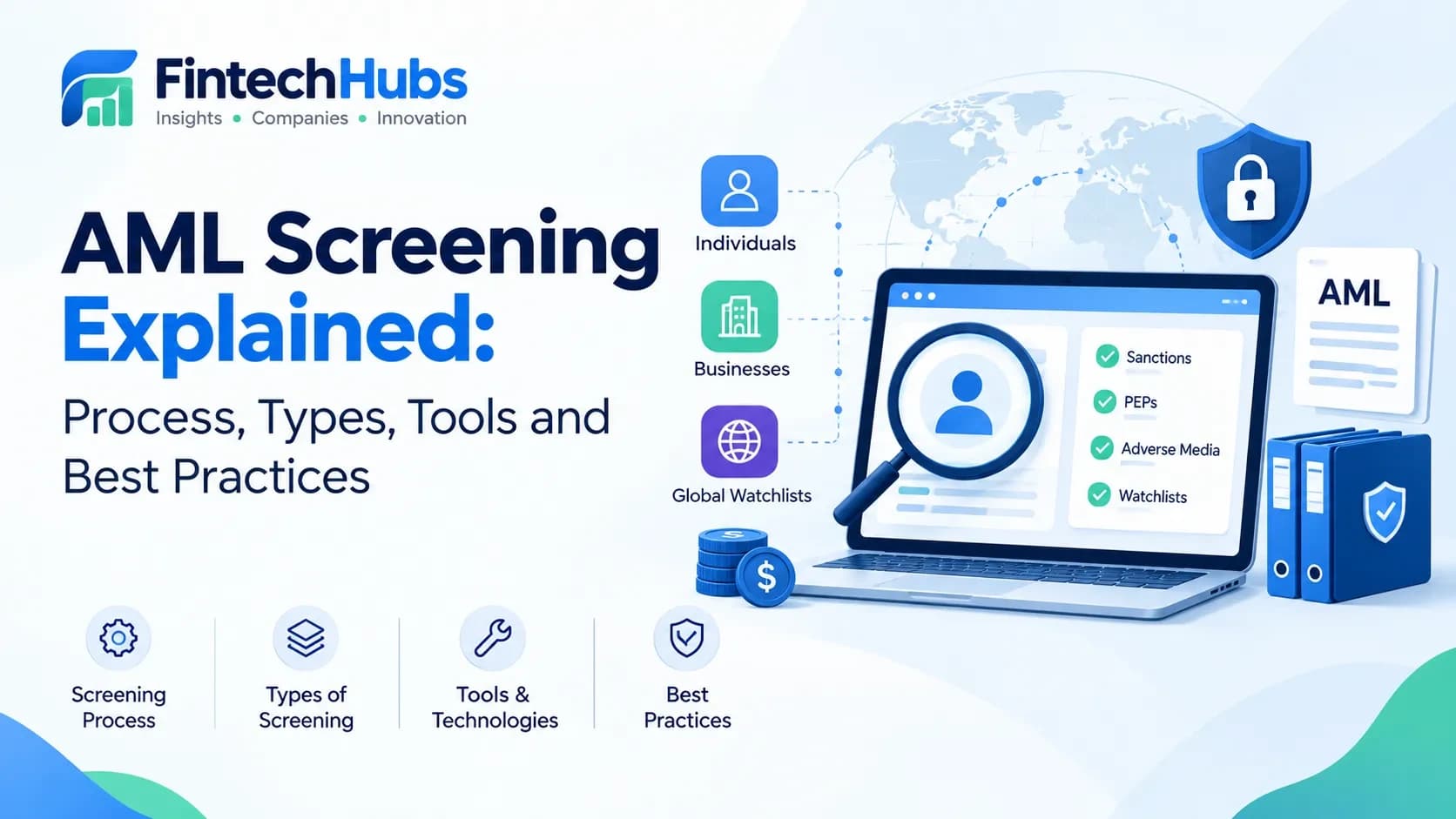
AML Screening: The Complete Guide to Detecting Financial Crime Risk
What Is AML Screening?
AML screening is the process of checking customers, business partners, and transactions against trusted sources of risk information to find links to money laundering, terrorist financing, sanctions evasion, corruption, and other financial crimes. The goal is simple: before a firm opens an account, onboards a vendor, or processes a payment, it should know whether the person or entity on the other side presents an unacceptable level of risk.
Screening is one of the core controls inside a wider Anti-Money Laundering (AML) program. It works alongside identity verification, customer due diligence, transaction monitoring, and suspicious activity reporting. While monitoring looks at what a customer does over time, screening asks a different question: who is this customer, and are they connected to known risk?
Why AML Screening Matters
Financial crime damages economies, funds organized crime and terrorism, and undermines trust in the financial system. Regulated businesses are the gatekeepers that criminals try to exploit. Effective screening matters for several reasons.
Legal compliance: Most jurisdictions legally require regulated firms to screen against sanctions lists and to apply risk-based due diligence.
Avoiding penalties: Regulators have imposed very large fines on banks, payment firms, and other businesses for weak screening controls. Individuals in senior roles can also face personal liability.
Protecting reputation: Being linked to a sanctioned party, a corrupt official, or a criminal network can destroy customer and investor confidence.
Reducing real-world harm: Strong screening makes it harder for illicit funds to enter legitimate channels.
Operational resilience: Catching a high-risk relationship at onboarding is far cheaper than unwinding it later.
Who Needs to Perform AML Screening?
Obligations vary by country, but the following sectors are commonly in scope:
Banks, credit unions, and building societies
Payment institutions, e-money firms, and money service businesses
Cryptocurrency exchanges and virtual asset service providers
Broker-dealers, asset managers, and insurers
Fintech and neobank platforms
Casinos, gaming, and online betting operators
Real estate agents, lawyers, accountants, and trust or company service providers
Dealers in high-value goods such as precious metals, jewelry, and art
Even businesses outside formal regulation often screen voluntarily, especially when they trade internationally or work with banking partners that expect it.
The Legal and Regulatory Framework
AML rules are shaped by international standards and then implemented through national laws.
Financial Action Task Force (FATF): The global standard-setter. Its Recommendations form the basis for most national AML regimes and promote a risk-based approach.
United States: The Bank Secrecy Act and the USA PATRIOT Act set program requirements, FinCEN issues guidance and rules, and OFAC administers sanctions programs that apply broadly to U.S. persons and often to transactions involving the U.S. financial system.
European Union: A series of Anti-Money Laundering Directives and a developing single rulebook, supported by a new EU-level AML authority, govern obligated entities. EU restrictive measures cover sanctions.
United Kingdom: The Money Laundering Regulations, the Proceeds of Crime Act, and the sanctions regime administered by OFSI set the requirements, with the FCA and other bodies supervising.
Other regions: Authorities such as AUSTRAC in Australia, FINTRAC in Canada, MAS in Singapore, and many national regulators apply comparable rules.
Because regulations change frequently, always confirm current requirements with your regulator or a qualified compliance professional.
Types of AML Screening
1. Sanctions Screening
Sanctions screening compares customer and counterparty data with lists of individuals, entities, vessels, and countries subject to restrictions. Common sources include lists from the UN Security Council, OFAC, the European Union, the UK, and national authorities. A match may require blocking assets, rejecting a transaction, or reporting to authorities. Sanctions obligations are generally strict, so there is little room for error.
2. PEP Screening
A Politically Exposed Person (PEP) is someone who holds, or has held, a prominent public function, such as a head of state, minister, senior judge, military leader, or executive of a state-owned enterprise. Their family members and close associates are also usually in scope. PEP status is not a sign of wrongdoing, but because of their position and influence these individuals carry a higher risk of bribery and corruption, so enhanced due diligence is expected.
3. Adverse Media Screening
Adverse media screening, sometimes called negative news screening, searches news and public sources for reports linking a person or company to fraud, bribery, organized crime, terrorism, human trafficking, tax evasion, or other misconduct. It helps uncover risk that has not yet appeared on any official list.
4. Watchlist and Law Enforcement Screening
Beyond sanctions, firms may check lists published by law enforcement agencies, regulators, and international bodies, including wanted-person notices, debarment lists, and enforcement actions against financial firms.
5. Ultimate Beneficial Owner (UBO) Screening
Criminals often hide behind layered company structures. Screening should therefore extend to the individuals who ultimately own or control a business, typically defined by an ownership threshold or by effective control, not only to the legal entity itself.
6. Transaction Screening
Payments are checked in real time or near real time for sanctioned parties, restricted jurisdictions, and suspicious references before they are completed. This applies to senders, recipients, banks involved, and payment message details.
How the AML Screening Process Works
While each firm designs its own workflow, most programs follow these steps.
Collect data: Gather accurate information such as full name, date of birth, nationality, address, identification numbers, and, for companies, registration details and ownership.
Prepare and normalize data: Clean the data, standardize formats, and handle transliteration, titles, and aliases so that comparisons are reliable.
Run the screening: Compare the data against sanctions, PEP, adverse media, and watchlist sources using matching logic.
Generate alerts: The system flags potential matches according to configured thresholds.
Review and investigate: Analysts compare the alert with additional identifiers to decide whether it is a true match, a false positive, or needs escalation.
Decide and document: Approve, reject, restrict, or escalate the relationship, and record the rationale in an auditable way.
Report where required: True matches or suspicious indicators may require reporting to the relevant authority, such as submitting a suspicious activity report.
Monitor continuously: Re-screen the customer base whenever lists update or when customer details change.
When Should Screening Happen?
At onboarding: Before establishing a business relationship.
Periodically: At intervals tied to the customer's risk rating.
On an ongoing basis: Automated daily or event-driven re-screening when watchlists change.
At transaction time: For payments and transfers.
Trigger events: Changes in ownership, address, business activity, or a negative news event.
Name Matching Techniques
Matching names accurately is the technical heart of screening. A name can appear in many forms, so systems rely on several techniques:
Exact matching: Finds identical strings but misses variations.
Fuzzy matching: Scores similarity to catch misspellings, spacing differences, and typographical errors.
Phonetic matching: Algorithms such as Soundex and Metaphone catch names that sound alike.
Transliteration handling: Names from Arabic, Cyrillic, Chinese, and other scripts can be romanized in several valid ways.
Alias and nickname libraries: Account for "also known as" entries and common name variants.
Machine learning models: Help rank alerts and reduce noise, ideally with explainable results.
Thresholds need careful tuning. Set them too loose and analysts drown in false positives. Set them too tight and true risks slip through.
Key Benefits of an Effective Screening Program
Stronger regulatory compliance and audit readiness
Earlier detection of high-risk customers
Lower exposure to fines and enforcement action
Better protection of brand and reputation
Faster, smoother onboarding for low-risk customers
A consistent, documented decision trail
Common Challenges
High False Positive Rates
Common names produce many irrelevant alerts. Industry experience suggests the vast majority of screening alerts are not true matches, which creates heavy manual workloads.
Poor Data Quality
Incomplete or inconsistent customer data makes matching unreliable. Missing dates of birth, for example, make it hard to discount false matches.
Complex Ownership Structures
Shell companies, nominee directors, and cross-border holdings hide the real controllers of a business.
Rapidly Changing Lists
Sanctions designations can change quickly in response to geopolitical events, so stale lists create real exposure.
Multilingual and Cultural Name Variations
Naming conventions differ widely across regions, which complicates matching.
Legacy Systems and Fragmented Tools
Separate systems for onboarding, payments, and monitoring can leave gaps and duplicate effort.
Best Practices for AML Screening
Adopt a risk-based approach: Apply stronger controls to higher-risk customers, products, geographies, and delivery channels.
Use reliable, up-to-date data: Choose reputable list providers with fast update cycles and clear source coverage.
Improve input data quality: Capture complete, structured data at onboarding.
Tune and test regularly: Validate thresholds and matching logic against test data and review results periodically.
Automate where sensible: Use automation for list updates, rescreening, and low-risk alert clearing, while keeping humans in control of complex decisions.
Keep a full audit trail: Record who reviewed each alert, what evidence was used, and why a decision was made.
Train staff: Analysts should understand typologies, list sources, and escalation procedures.
Govern the program: Assign clear ownership, run independent testing, and report metrics to senior management.
Integrate with the wider AML framework: Connect screening with KYC, risk scoring, and transaction monitoring so findings feed one another.
Review the program after change: Update controls when you enter new markets, launch new products, or when regulations shift.
Top AML Screening Software Compared
The 18 tools below cover the main routes to AML screening: risk-data providers, enterprise financial crime suites, AI-driven platforms, identity-verification tools with built-in screening, and blockchain analytics. The table is a starting point for shortlisting, not a ranking. Features, data sources, and packaging change often, so confirm current details and pricing with each vendor before you decide.
# | Software | Primary focus | Screening coverage | Best suited for |
1 | ComplyAdvantage | Risk data and screening platform | Sanctions, PEP, adverse media, ongoing monitoring | Fintechs, banks, payment firms |
2 | LSEG World-Check | Risk intelligence database | Sanctions, PEP, adverse media, enhanced due diligence data | Large banks and global enterprises |
3 | Dow Jones Risk & Compliance | Risk data feeds and screening tools | Sanctions, PEP, adverse media, state-owned entities | Institutions needing deep research data |
4 | LexisNexis Bridger Insight XG | Customer and counterparty screening | Sanctions, PEP, watchlists | Mid-size banks, money service businesses |
5 | LexisNexis Risk Solutions Firco | Sanctions filtering for customers and payments | Sanctions, payment message screening | Banks with high payment volumes |
6 | NICE Actimize | Enterprise financial crime suite | Watchlist screening, transaction monitoring, case management | Large banks and global institutions |
7 | Oracle Financial Crime and Compliance Management | Enterprise AML suite | KYC, watchlist screening, transaction monitoring | Large regulated institutions |
8 | SAS Anti-Money Laundering | Analytics-led AML suite | Watchlist filtering, monitoring, investigation | Banks with strong analytics teams |
9 | Napier AI | AI-driven compliance platform | Name and transaction screening, monitoring | Banks, fintechs, wealth managers |
10 | Hawk | AI-powered fraud and AML platform | Customer, payment screening, monitoring | Banks and payment companies |
11 | Unit21 | No-code risk and compliance platform | Monitoring, case management, screening via integrations | Fintechs and growing compliance teams |
12 | Sumsub | Identity verification with AML | Sanctions, PEP, adverse media at onboarding | Fintech, crypto, gaming, marketplaces |
13 | Jumio | Identity verification with AML screening | Sanctions, PEP, adverse media at onboarding | Banks, fintechs, online platforms |
14 | Trulioo | Global identity and business verification | Watchlist, sanctions, PEP checks | Companies onboarding customers worldwide |
15 | Moody's KYC solutions (Orbis) | Company data and entity intelligence | Company ownership, screening, third-party risk | Corporate KYC, UBO and supplier checks |
16 | Sanction Scanner | Screening and monitoring tool | Sanctions, PEP, adverse media | Small and mid-size regulated firms |
17 | Chainalysis | Blockchain analytics | Wallet and transaction risk screening | Crypto exchanges, custodians, authorities |
18 | Silent Eight | AI alert adjudication | Reduces false positives in name and transaction screening | Banks with high alert volumes |
AML Screening Software Profiles
Each profile gives a short overview, the main strengths, and points to check during evaluation. These are general descriptions written for comparison purposes, so run a demo and request current specifications before buying.
1. ComplyAdvantage
ComplyAdvantage offers a cloud-based platform built around its own risk intelligence database and screening engine. It covers sanctions, PEPs, and adverse media, and supports ongoing monitoring of customers and transactions.
Strengths: API-first design, quick integration, and a focus on cutting false positives.
Consider: Fit and pricing for very large, complex enterprises, and how its data coverage matches your regions.
2. LSEG World-Check
World-Check is one of the best-known risk intelligence databases, widely used by banks to identify sanctioned parties, PEPs, and individuals linked to financial crime. It is available as a data product and through screening workflows.
Strengths: Long market presence, deep profiles, and strong acceptance among regulators and large institutions.
Consider: Cost and the need for solid alert-handling processes to manage match volumes.
3. Dow Jones Risk & Compliance
Dow Jones provides risk and compliance data covering sanctions, PEPs, adverse media, and information on state-owned enterprises, delivered through feeds, APIs, and research tools.
Strengths: Editorially curated content and strong adverse media depth.
Consider: Firms often need to pair the data with their own screening or case tool.
4. LexisNexis Bridger Insight XG
Bridger Insight XG is a screening and due diligence tool for checking customers and counterparties against sanctions lists, PEP data, and other watchlists, with workflow and reporting features.
Strengths: Established in banking and money service businesses, with configurable matching and audit trails.
Consider: Check integration options and user-interface fit for your team.
5. LexisNexis Risk Solutions Firco
The Firco range focuses on filtering customers and payment messages against sanctions and watchlists, with particular strength in high-volume payment environments.
Strengths: Payment screening depth and wide adoption among banks.
Consider: Can require specialist implementation and tuning effort.
6. NICE Actimize
NICE Actimize is an enterprise financial crime suite covering watchlist filtering, transaction monitoring, fraud, and case management on a shared platform.
Strengths: Breadth of modules, scalability, and single-vendor coverage for large institutions.
Consider: Implementation can be complex and costly, which may be more than smaller firms need.
7. Oracle Financial Crime and Compliance Management
Oracle's financial crime and compliance suite combines KYC, watchlist screening, transaction monitoring, and investigation tools, often deployed alongside Oracle's banking technology.
Strengths: Enterprise scale and integration with wider Oracle platforms.
Consider: Heavy deployment effort and a better fit for large organizations with mature IT teams.
8. SAS Anti-Money Laundering
SAS applies its analytics heritage to AML, offering watchlist filtering, monitoring, and investigation capabilities with advanced analytics and machine learning.
Strengths: Strong analytics, modeling, and data-management capabilities.
Consider: Typically suited to larger banks with data-science resources.
9. Napier AI
Napier AI provides a compliance platform that includes name and transaction screening, transaction monitoring, and risk scoring, with an emphasis on AI-assisted detection and explainability.
Strengths: Modern architecture and a focus on reducing false positives with transparent models.
Consider: Validate fit with your data volumes and local regulatory expectations.
10. Hawk
Hawk offers an AI-powered platform for anti-money laundering and fraud, including customer and payment screening and transaction monitoring.
Strengths: Machine-learning-driven detection and a unified view of financial crime risk.
Consider: Review model explainability and regulatory acceptance in your jurisdiction.
11. Unit21
Unit21 is a no-code risk and compliance platform for transaction monitoring, case management, and reporting, with screening typically added through integrations with data providers.
Strengths: Flexible rule building, quick setup, and appeal to fast-growing fintechs.
Consider: Confirm which screening data sources are supported natively or through partners.
12. Sumsub
Sumsub is an identity verification and compliance platform that bundles document and biometric checks with AML screening for sanctions, PEPs, and adverse media at onboarding and on an ongoing basis.
Strengths: Combined KYC and AML in one workflow and wide use in fintech and crypto.
Consider: Less suited to complex transaction-level payment filtering used by large banks.
13. Jumio
Jumio provides online identity verification with AML screening features, helping businesses verify users and check them against sanctions, PEP, and adverse media sources.
Strengths: Strong identity verification core and streamlined digital onboarding.
Consider: Evaluate screening depth against dedicated risk-data platforms.
14. Trulioo
Trulioo specializes in global identity and business verification and includes watchlist screening as part of its onboarding offering.
Strengths: Broad international coverage for individual and business verification.
Consider: Check the level of screening and monitoring functionality you need beyond onboarding.
15. Moody's KYC Solutions (Orbis)
Moody's brings together company data, ownership structures, and risk intelligence, with its Orbis database widely used to research corporate ownership and third-party risk.
Strengths: Rich company and ultimate beneficial owner data suited to corporate KYC.
Consider: Best for entity and ownership research, and may need pairing with other tools for transaction screening.
16. Sanction Scanner
Sanction Scanner is a screening and monitoring tool covering sanctions, PEP, and adverse media checks, aimed at businesses seeking an accessible AML solution.
Strengths: Approachable for small and mid-size firms with simpler needs.
Consider: Check scalability and coverage for complex, multi-jurisdiction operations.
17. Chainalysis
Chainalysis is a blockchain analytics provider that helps crypto businesses and authorities screen wallet addresses and trace transactions for links to illicit activity, sanctions exposure, and scams.
Strengths: Specialized crypto intelligence that traditional list-based tools lack.
Consider: Focused on digital assets, so it does not replace customer screening for sanctions and PEPs.
18. Silent Eight
Silent Eight uses AI to adjudicate screening alerts, helping teams review name and transaction matches faster and more consistently.
Strengths: Can sharply reduce manual alert review and improve consistency.
Consider: It sits on top of an existing screening engine, so it complements rather than replaces one.
Choosing AML Screening Software
When comparing solutions, consider the following:
Coverage and quality of sanctions, PEP, and adverse media data
Accuracy of matching and ability to configure thresholds
Real-time and batch screening support
Ongoing monitoring and automatic rescreening
Alert management, case workflows, and audit reporting
Integration options, such as APIs and connectors for your core systems
Scalability, performance, and uptime
Data security, privacy compliance, and hosting options
Transparency of any AI or machine learning used
Total cost, including implementation and support
The Role of Technology and AI
Modern platforms use artificial intelligence and automation to cut noise and speed up investigations. Examples include entity resolution to link records belonging to the same person, natural language processing to classify adverse media articles, and risk scoring to prioritize alerts. Regulators generally welcome innovation, but they expect firms to understand and be able to explain how their models reach decisions. Technology supports, rather than replaces, human judgment and accountability.
Emerging Trends
Perpetual KYC: Continuous, event-driven reviews replace fixed periodic refreshes.
Real-time payments: Faster payment rails demand faster screening decisions.
Crypto and digital assets: Screening increasingly covers wallet addresses and blockchain activity.
Greater focus on beneficial ownership: Public and private registers are expanding.
Explainable AI: Pressure is growing for transparent, auditable models.
Sanctions complexity: Wider sanctions programs and evasion tactics call for stronger controls across supply chains.
Data sharing and public-private partnerships: Collaboration between firms and authorities is increasing.
Consequences of Weak Screening
Firms with inadequate controls can face regulatory fines, enforcement orders, restrictions on business activity, loss of banking relationships, criminal liability in serious cases, costly remediation programs, and long-term reputational damage. Many high-profile enforcement cases have involved failures to screen properly or to act on alerts.
AML Screening Checklist
Written policy and procedures approved by senior management
Defined risk assessment covering customers, products, and geographies
Complete data collection at onboarding
Screening against sanctions, PEP, adverse media, and relevant watchlists
Beneficial ownership identification and screening
Documented alert handling and escalation process
Ongoing monitoring with automatic rescreening
Regular tuning and independent testing of the system
Staff training and competence records
Record retention in line with local law
Management information and board reporting
Frequently Asked Questions
What is the difference between AML screening and KYC?
KYC, or Know Your Customer, is about verifying identity and understanding who the customer is and what they do. AML screening is one step within the broader process that checks that customer against risk lists and media sources.
What is the difference between AML screening and transaction monitoring?
Screening checks names and entities against lists. Transaction monitoring analyses behavior and money movements over time to spot unusual patterns.
How often should customers be screened?
At onboarding, on an ongoing basis whenever lists change, and at intervals tied to the risk rating of the customer. Many firms now use automated continuous screening.
What is a false positive in AML screening?
A false positive is an alert triggered by a similar name or detail that turns out not to refer to the actual customer. Reducing false positives without missing true matches is one of the main goals of tuning.
Is PEP status a reason to reject a customer?
Not automatically. PEPs are usually accepted but need enhanced due diligence, senior approval, and closer monitoring.
Do small businesses need AML screening?
If the business is in a regulated sector, yes. Even if not directly regulated, sanctions laws can apply to anyone, so basic screening is a sensible precaution.
Can AML screening be fully automated?
Automation handles list matching and routine clearing very well, but ambiguous matches and high-risk decisions still need trained human review.
Conclusion
AML screening is a foundation of modern financial crime prevention. By checking customers and counterparties against sanctions, PEP, adverse media, and watchlist sources, organizations can spot risk early, meet their legal duties, and protect themselves from penalties and reputational harm. The most effective programs combine good data, well-tuned matching, sensible automation, skilled analysts, and clear governance, all anchored in a risk-based approach. As regulations and criminal tactics continue to evolve, regular review and continuous improvement will keep a screening program effective.
“Disclaimer: This article is for general informational purposes and does not constitute legal or compliance advice. Requirements differ by jurisdiction and change over time, so consult your regulator or a qualified professional.”
Share this article
Related Articles
FinTech Software Development: Solutions, Benefits & Trends
Fintech software development explained: services, architecture, PCI DSS and DORA compliance, delivery process, pricing models, partner checklist, and FAQs.
Predictive Financial Analytics: AI Forecasting in 2026
Learn how predictive financial analytics and AI are transforming forecasting in 2026, from cash flow and credit risk to scenario planning and best practices.
Top 10 Fintech Companies in India: Services & Comparison
Compare the top 10 fintech companies in India, from PhonePe and Razorpay to Groww and Zerodha. See services, features, and how to choose the right platform.